SYNOPSIS
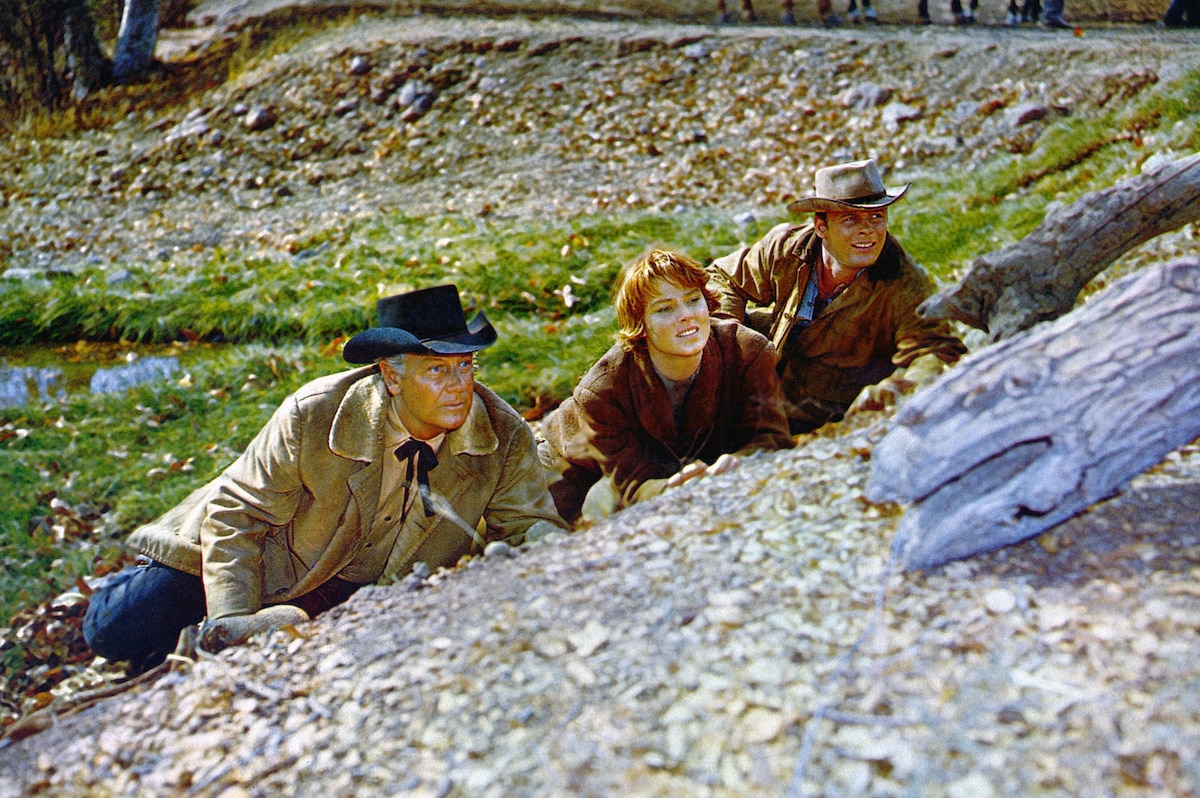
At a traveling sideshow, former lawman Steve Judd
encounters an old friend, Gil Westrum, another ex-lawman
fallen on hard times. The two agree to escort a gold
shipment from a mining camp high in the Sierras to the town
below. The temptation to steal the shipment gets the
better of Gil during their journey, resulting in a bitter
riff between the two former friends. And the journey is
complicated by the presence of Elsa, a young woman running
away from her stern fundamentalist father. When Elsa's
wedding to one of the miners goes awry at a drunken
celebration, she flees with the two aging lawmen and their
hotheaded young companion, bringing the wrath of the miners
down on them.
Director: Sam Peckinpah
Producer: Richard E. Lyons
Screenplay: N.B. Stone, Jr.
Cinematography: Lucien Ballard
Editing: Frank Santillo
Art Direction: Leroy Coleman, George W. Davis
Music: George Bassman
Cast: Joel McCrea (Steve Judd), Randolph Scott (Gil
Westrum), Mariette Hartley (Elsa Knudsen), Ron Starr (Heck
Longtree), James Drury (Billy Hammond), Edgar Buchanan
(Judge Tolliver), R.G. Armstrong (Joshua Knudsen), Jenie
Jackson (Kate).
C-94m. Letterboxed.
Why RIDE THE HIGH COUNTRY is Essential
Sam Peckinpah's name today is synonymous with screen
violence. Audiences with only a glancing familiarity with
his work think of such films as The Wild Bunch
(1969) and Straw Dogs (1971) as having been
influential primarily for the way violence is used and
depicted on film. Yet, Ride the High Country,
despite a key Peckinpah sequence of a shoot-out among a
barnyard full of chickens, is a bucolic and remarkably
poetic demonstration of what this brilliant, erratic, often
difficult artist brought to American cinema and to the
motion pictures' depiction of the West.
Many have pointed to Ride the High Country as the
film that initiated Peckinpah's great theme, the decline of
the West. And while there is undeniable truth in that,
there is more going on here - and in all his work - than
simply a study of historical changes and the death of the
frontier. Peckinpah used the Western genre as the perfect
setting for his career-long focus on men who have outlived
their times but cling to their moral code. He frequently
played out that conflict through two protagonists, often
mirror images, each one an example to the other of what he
might have been under different circumstances and choices:
Brian Keith and Chill Wills in his first feature film,
The Deadly Companions (1961), Charlton Heston and
Richard Harris in Major Dundee (1965), William
Holden and Robert Ryan in The Wild Bunch, Jason
Robards and David Warner in The Ballad of Cable
Hogue (1970), James Coburn and Kris Kristofferson in
Pat Garrett and Billy the Kid (1973). In Ride
the High Country, Peckinpah takes a long look at two
such men - Steve Judd (Joel McCrea) and Gil Westrum
(Randolph Scott) - in their twilight years, powerless to
stop the changes in the world around them and struggling
with themselves and with each other as they try to define
themselves in relation to the new order.
McCrea and Scott were the perfect choices for the roles,
each one having played iconic Western heroes almost
exclusively for the latter half of their long careers. The
elegiac sense of this film is amplified further by the two
stars' advancing age and the fact that this was Scott's
final picture before his long retirement. McCrea, too, was
expected to end his movie career after this. Although he
resurfaced four years later to make an additional four
Westerns, they were minor at best, and many see the
Peckinpah film as his true swan song.
For Peckinpah, however, Ride the High Country was
just the beginning, and the themes he explored here for the
first time form the philosophy that guided him through all
his work. "I love outsiders," he once said. "Unless you
conform, give in completely, you're going to be alone in
this world. But by giving in, you lose your independence
as a human being....I'm nothing if not a romantic, and I've
got this weakness for losers on a grand scale, as well as a
kind of sneaky affection for all the misfits and drifters
in the world." He could as easily have been talking about
himself and the life and career that would follow this
early project.
Ride the High Country began filming on location at
Mammoth Lake, near Bishop, California but a freak snowstorm
forced the production to close down and Peckinpah was
ordered to move his cast and crew to the MGM back lot at
Bronson Canyon in Hollywood to complete the film. Although
the movie was completed in only 26 days, Peckinpah ran into
problems when Joseph R. Vogel replaced Sol Siegel as MGM's
chief executive. The mogul allegedly fell asleep while
screening the film and later proclaimed it "the worst
picture I ever saw," dooming its chances for a successful
commercial run.
Despite the poor distribution, Ride the High Country
managed to attract the praise of the country's leading
critics. Newsweek wrote, "That Hollywood can't tell
the gold from the dross has seldom been so plainly
demonstrated. Ride the High Country, deemed unworthy
of a first-class run, has been gradually leaked - like a
secret - to various theatres around the country. When it
reached New York last week, Ride, a modest,
meaningful and faultlessly crafted film, was dumped
carelessly as the bottom half of neighborhood double bills,
playing in the abysmal company of The Tartars
[1961]. In fact, everything about this picture has the ring
of truth, from the unglamorized settings to the flavorful
dialogue and the natural acting, Ride the High
Country is pure gold."
by Rob Nixon & Jeff Stafford
Ride the High Country: The Essentials
by Rob Nixon & Jeff Stafford | May 03, 2006
SIGN UP FOR OUR NEWSLETTERS

CONNECT WITH TCM