The strapless black satin gown that designer Jean Louis created for Rita Hayworth's "Put the Blame on Mame" number was based on the dress (with straps) worn by Madame X in the famous painting by John Singer Sargent. The painting, done in 1884, hangs at the Metropolitan Museum in New York.
The two songs Hayworth sings in Gilda, "Put the Blame on Mame" and "Amado Mio," were written by Doris Fisher and Allan Roberts. The songwriting team also composed the entire song score for Hayworth's next film, Down to Earth (1947), as well as "Please Don't Kiss Me," the sole number Rita Hayworth performed in Orson Welles' The Lady from Shanghai (1947).
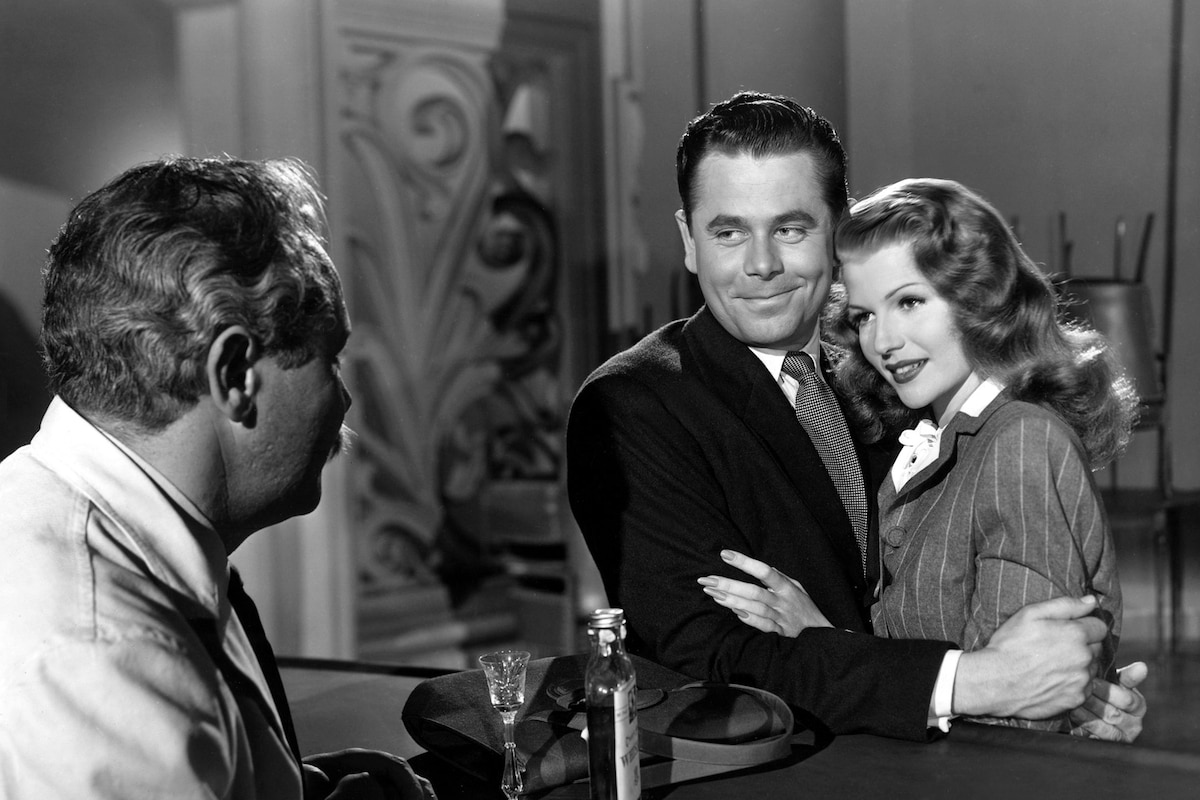
While it is well-known that in Gilda Rita Hayworth's voice was dubbed by singer Anita Ellis for the major musical numbers, it must be noted that Hayworth's own voice, as well as guitar-playing, can be heard in the film as Gilda reprises the song "Put the Blame on Mame" while sitting at the casino bar. Hayworth was also known to have sung for the troops during many live appearances during WWII, and she also sang onstage in 1940 at the El Capitan Theater in Hollywood during a run of Charlot's Revue.
Gilda was such an enormous financial success for Columbia Pictures that Rita Hayworth's agent, Johnny Hyde, demanded that studio chief Harry Cohn give his client a share of profits for subsequent pictures. Cohn refused, but when Hayworth called in "sick" for several days during production of her next film, Down to Earth, Cohn relented. Hayworth formed the Beckworth Corporation to collect twenty-five percent of the net profits from the remaining films on her Columbia contract.
In the same year that Gilda opened in theaters, the primary behind-the-scenes personnel behind the film were entangled in a nasty lawsuit that exposed to the public much of the workings of Hollywood production and Columbia Pictures in particular: director Charles Vidor sued studio mogul Harry Cohn. The case was heard beginning December 9, 1946, and the doings on the set of their most recent picture together came up often. Vidor was trying to get out of his contract and cited Cohn's "abusive language," among other iniquities. As Bob Thomas writes in King Cohn, "Vidor added that Cohn accused him during the making of Gilda of using too much film, quitting early, and shooting excessive retakes. The director added, ?I told Mr. Cohn that the delays were due to the fact that Miss Hayworth got tired at five o'clock in the afternoon and was unable to give her best performances. I also told him that his abuse was upsetting me, that I could not sleep, that I had to have doctors give me injections, and that I was nervous.'" Witnesses from the set of Gilda were brought forth by the defense to testify that Cohn was not the only person using abusive language; Vidor was guilty too. As Thomas related, "Steven Geray declared that during the filming of Gilda, Vidor berated him about his performance in a scene. When Geray tried to explain, Vidor shouted, ?Shut up, goddammit!' and took him in a corner to continue the attack in Hungarian. Glenn Ford confirmed the Geray incident and added that there were several goddammits from Vidor during Gilda, ?addressed mostly to the little people on the set who couldn't answer him.'" Vidor ultimately lost the lawsuit and remained at Columbia, where he again directed Hayworth and Ford, in The Loves of Carmen (1948). Shortly after completing that film, however, he bought out his Columbia contract for $75,000.
FAMOUS QUOTES from GILDA (1946)
Johnny Farrell (Glenn Ford): (voiceover) To me a dollar was a dollar in any language.
Ballin Mundson (George Macready): (referring to his cane, which conceals a spring-loaded knife): It is a most faithful, obedient friend. It is silent when I wish to be silent. It talks when I wish to talk.
Johnny: I'll be better if you had me on your side. (referring to Mundson's cane) You see, this way you'll have two friends. You've no idea how faithful and obedient I can be - for a nice salary.
Johnny: I was born last night when you met me in that alley. That way, I'm no past and all future, see? And I like it that way.
Mundson: You're sharp, Johnny, almost as sharp as my other little friend. But not quite so obedient.
Johnny: No?
Mundson: My other little friend will kill for me, Johnny.
Johnny: Well, that's what friends are for.
Mundson: (a toast) To us, Johnny. To the three of us.
Johnny: Three of us. (Voiceover) Makes me laugh now to think back. Me so sure it was just the three of us. I soon found out, all right.
Johnny: (hears faint singing) Where's the canary?
Mundson: How did you know?
Johnny: How'd I know what?
Mundson: So you don't know. Come. (Opens door) This is where the canary is, John. Quite a surprise to hear a woman singing in my house, eh, Johnny?
Mundson: Gilda, are you decent?
Gilda (Rita Hayworth): Me? (She snaps her head up into frame, whipping her hair behind) Sure, I'm decent.
Gilda: (upon being introduced to Farrell) Johnny. That is such a hard name to remember and such an easy one to forget.
Mundson: Look your best, my beautiful. This will be the casino's first glimpse of you.
Gilda: I'll look my very best, Ballin. I want all the hired help to approve of me.
Mundson: It's an odd coincidence, Johnny. Listen to this. She told me she was born the night she met me. All three of us have no pasts, just futures. Isn't that interesting?
Johnny (voiceover): It was all I could do to walk away. I wanted to go back up in that room and hit her. What scared me was, I-I wanted to hit him too. I wanted to go back and see them together with me not watching. I wanted to know.
Mundson: (to Johnny) I was forced to leave Gilda alone while I looked for you, and Gilda is much too beautiful to be left alone.
Gilda: It's a small world in Argentina, isn't it?
Johnny: Isn't it? Why did you marry him?
Gilda: My husband's a very attractive man.
Johnny: You don't love him.
Gilda: What was that word again, Johnny?
Johnny: You married him for his money.
Gilda: That happened to come with it.
Johnny: Now, that's a great way to make a living.
Gilda: That wouldn't be the big pot calling the little kettle black, now would it?
Johnny: I was down and out. He picked me up. Put me on my feet.
Gilda: Now isn't that an amazing coincidence, Johnny. That's practically the story of my life.
Johnny: (to Gilda, who is dancing with other men) Pardon me, but your husband is showing. You can't talk to men down here the way you would at home. They don't understand it.
Gilda: Understand what?
Johnny: They think you mean it.
Gilda: Mean what?
Johnny: Doesn't it bother you at all that you're married?
Gilda: What I want to know is, does it bother you?
Mundson: You're a child, Gilda, a beautiful greedy child. And it amuses me to feed you beautiful things because you eat with so good an appetite.
Gilda: But I shouldn't make any mistakes.
Mundson: No, you shouldn't.
Gilda: If you're worried about Johnny Farrell, don't be. I hate him.
Mundson: And he hates you. That's very apparent. But hate can be a very exciting emotion. Very exciting. Haven't you noticed that? ...There's a heat in it that one can feel. Didn't you feel it tonight?
Gilda: No.
Mundson: I did. It warmed me. Hate is the only thing that has ever warmed me.
Gilda: (being dragged again from the dance floor) If I'd been a ranch, they would've named me the Bar Nothing.
Gilda: I've got some news for you, Johnny. I'm going to do exactly what I please when I please. I was true to one man once, and look what happened. I made up my mind then...
Johnny: This isn't about us, it's about him.
Gilda: Really? You don't say so.
Johnny: And get this straight. I don't care what you do, but I'm gonna see to it that it looks all right to him. From now on, you go anywhere you please with anyone you please, but I'm gonna take you there and I'm gonna pick you up and bring you home. Get that? Exactly the way I'd take and pick up his laundry.
Gilda: I hate you so much I would destroy myself to take you down with me. Now I've warned you. Now that's all fair and even.
Johnny: All fair and even. Now would it interest you to know that I know why you're hanging around here at five o'clock in the morning?
Gilda: I told you. I'm the laundry. I'm simply obeying instructions.
Johnny: Now who's kidding who, Gilda?
Johnny: Statistics show that there are more women in the world than anything else - except insects.
Gilda: Hate is a very exciting emotion. Haven't you noticed? Very exciting. I hate you too, Johnny. I hate you so much, I think I'm gonna die from it. Darling... (Gilda and Johnny kiss) I think I'm gonna die from it.
Compiled by John Miller
Trivia - Gilda - Trivia & Fun Facts About GILDA
by John Miller | May 03, 2006
SIGN UP FOR OUR NEWSLETTERS

CONNECT WITH TCM