The title of Hot Cars (1956) refers not to "hot rods" but to stolen cars. As Variety put it: "a good title for this little programmer aimed at the supporting slot on regular dual bills.... [It's] no shattering expose of the stolen car racket, but there's enough indication of how hot autos are merchandised to the unsuspecting public to carry off the title."
Running just sixty minutes, this little B film released by United Artists features John Bromfield as a car salesman who learns that his boss is stocking stolen cars. With a wife and sick kid to support, he reluctantly decides to continue, leading to a chain of melodrama that culminates with a vivid fight on a rollercoaster.
Bromfield was a solid leading man of B movies in this period, best known for Westerns. In fact, soon after completing Hot Cars, he'd be cast in the hit western TV series The Sheriff of Cochise, in which he played Sheriff Frank Morgan in 142 episodes over five seasons from 1956-1960. (After the second season, the show was re-titled U.S. Marshal.)
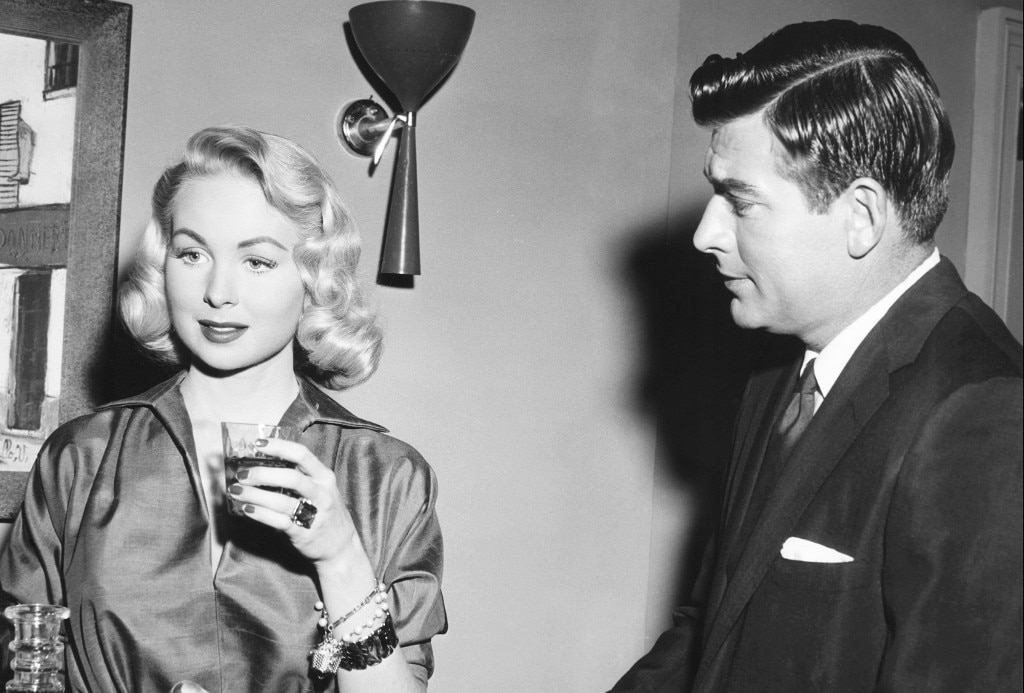
Hot Cars is also of interest for its leading lady, Joi Lansing, something of a cult favorite. Born Joy Rae Brown, she was a stunning blonde model whose first film role had come in 1947, when she was briefly signed by MGM. Her film career moved in fits and starts, however, and many appearances were mere cameos. In 1955 she appeared as a regular on TV in The Bob Cummings Show, which reignited interest from Hollywood casting directors and led to parts in the Oscar-winning (for Best Story) The Brave One (1956) as well as Hot Cars. Two years later, she'd be featured by Orson Welles as the woman in the car in the bravura opening sequence of Touch of Evil (1958). (Welles also cast her in his TV drama The Fountain of Youth that same year.) Hot Cars is a good showcase for Lansing, who glides through entertaining dialogue as in the scene where Bromfield attempts to resist her advances by protesting, "I told you already, I'm married." Lansing replies, "I have a terrible memory."
The picture was produced by Aubrey Schenck and Howard W. Koch's Bel-Air Productions, which had a distribution deal with United Artists and turned out a number of moderately successful programmers in the 1950s, including Big House, U.S.A. (1955) and Hell Bound (1957). In an interview with film historian Tom Weaver, Schenck later said that Koch was beloved by seemingly everyone. "He was a remarkable guy... He had some personality! He would go to locations and people would bend over backwards for him. We got things that no other companies could get because of his way of dealing with people. That's his great forte, his personality and his ability to convince people to do things his way." Schenck said that occasionally Koch would even step in as assistant director to get a film back on track. "You'd say to him, 'Howard, we're a little behind schedule,' and he'd put you back on schedule the next day."
Hot Cars was adapted from a novel by screenwriters Don Martin and Richard H. Landau, both of whom had notable film noir credits. Landau had written The Crooked Way (1949) and Roadblock (1951), while Martin had penned The Pretender (1947), Destination Murder (1950) and Shakedown (1950), among many other cheap little films for poverty row studios. Martin was also a pulp novelist and had worked as a playwright, poet, and newspaperman.
This film was director Don McDougall's first and only feature film credit in a career otherwise comprised of hundreds of television credits. He got good reviews. The Hollywood Reporter praised the movie's "excitement, ...romance and interesting writing and acting.... Donald McDougall has kept his action paramount and has one very good scene toward the end, an exciting climax aboard a rollercoaster, well photographed by William Margulies."
The film was shot on location in the Culver City section of greater Los Angeles, known at the time for its many used car lots, and at Ocean View Park in Santa Monica, which housed the rollercoaster.
Look for character actor Dabbs Greer as a nosy detective, in one of his 300+ screen roles. Born Robert William Greer, his feature-film career started with one classic, Reign of Terror (1949), and ended with another, The Green Mile (1999), in which he played the older version of the Tom Hanks character and narrated the film.
By Jeremy Arnold
Hot Cars
by Jeremy Arnold | June 22, 2017
SIGN UP FOR OUR NEWSLETTERS

CONNECT WITH TCM