Japanese director Yasujiro Ozu is best known for his wistful, nuanced family stories, set in contemporary times. There is little drama and only rarely melodrama in his films. Instead, they are often a collection of seemingly minor incidents that quietly delineate character and relationships. But Tokyo Twilight (1957), about a family in crisis, is an anomaly--it is one of Ozu's darkest and most dramatic films.
Shukichi, played by Ozu's longtime leading man Chishu Ryu, is a successful bank executive who has raised two daughters on his own after his wife left him for another man. Both daughters, now adults, have their own problems. The elder, Takako (Setsuko Hara, another Ozu regular), has dutifully married, but the marriage is unhappy and her husband is an abusive alcoholic, so she has returned to her father's home with her young child. Shukichi's spoiled younger daughter, Akiko (Ineko Arima), something of a wild child, is pregnant by her no-good boyfriend and needs money for an abortion, a situation that she conceals from her family. Meanwhile, the ex-wife is back in town running a mahjong parlor and trying to establish relationships with the daughters she abandoned. Appropriately for its bleak mood, Tokyo Twilight is the only one of Ozu's works which takes place in winter. It is also the director's final film to be shot in black and white.
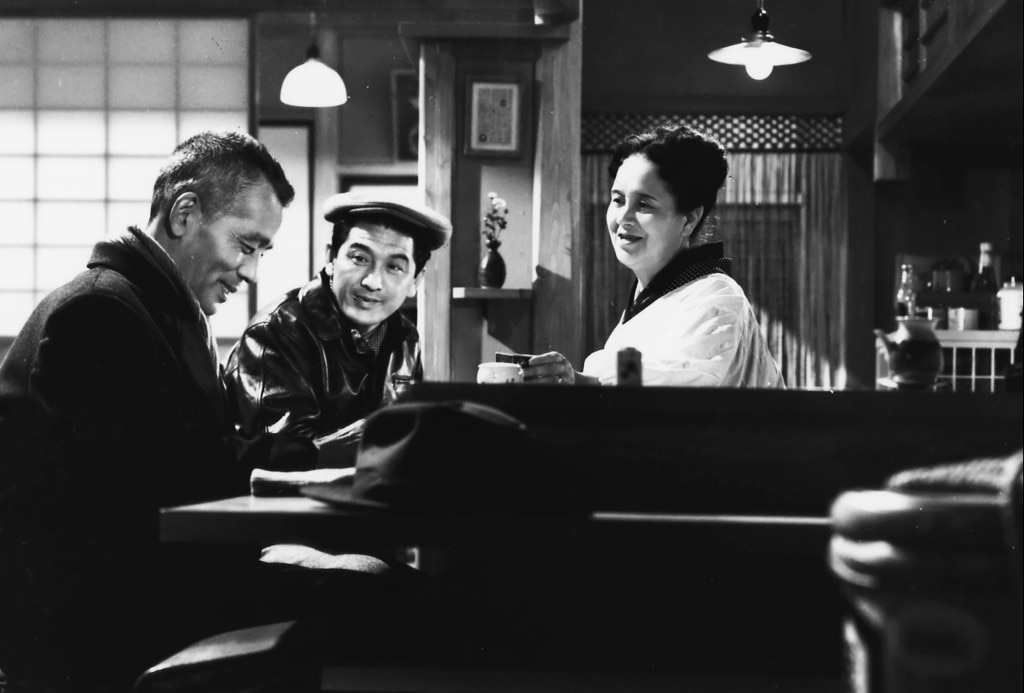
Like most Ozu films, Tokyo Twilight is filled with the director's visual trademarks: the serene and stately compositions that belie the emotional turmoil of the characters; the low-angle shots; the static "pillow shots" of rooms or objects which are held for several seconds longer than usual; and the transitional shots of landscapes or buildings that are characteristic of Ozu's films. But the contrast between the formalism of his style and the contemporary yet timeless issues the family faces serves the story well. Underneath the seemingly tranquil and orderly surface, there is emotional chaos.
Setsuko Hara, who plays the older daughter, was one of Ozu's favorite leading ladies, appearing in six of his films starting in 1949. Tokyo Twilight was her penultimate collaboration with the director. She made only one more Ozu film before retiring from the screen in 1963. Chishu Ryu was also an Ozu regular, who appeared in 52 of Ozu's 54 films. Years later, Ryu told German director Wim Wenders that the success of his collaboration with Ozu was not about what he brought to the role, but about precisely carrying out the director's instructions.
Japanese audiences and critics alike rejected the darkness of Tokyo Twilight's story. It was the first time in twenty-one years that an Ozu work did not make the top ten in Japan's annual Kinema Jumpo film poll, and was considered at the time to be one of the failures of Ozu's career. But its frank (for the era) and straightforward treatment of social issues seems strikingly modern today, and Tokyo Twilight's noir reputation has only been burnished in the ensuing years.
Director: Yasujiro Ozu
Screenplay: Yasujiro Ozu, Kogo Noda
Cinematography: Yuharu Atsuta
Editor: Yoshiyasu Hamamura
Music: Takanobu Saito
Principal Cast: Chishu Ryu (Shukichi), Setsuko Hara (Takako), Ineko Arima (Akiko), Isuzu Yamada (Kisako)
140 minutes
by Margarita Landazuri
Tokyo Twilight
by Margarita Landazuri | June 21, 2017
SIGN UP FOR OUR NEWSLETTERS

CONNECT WITH TCM