Judging from the popularity of several productions from the 1930s, historical epics of colonial derring-do must have been very appealing to audiences of the time, whether because of the turmoil of contemporary politics or because the pictures themselves revised and glossed over so many of the facts of the real-life conflicts they portrayed that precious little history actually survived.
The Charge of the Light Brigade (1936), The Four Feathers (1939), and Gunga Din (1939) all made great cinematic hay out of British imperialism. While not as well executed or enjoyable a film as the others, Clive of India certainly takes its place in that specialized pantheon for sheer nerve in dignifying the worst offenses of the Empire.
The film is based on the life of Robert Clive (1725-1774), acknowledged as the driving force behind the British Empire's conquest of South Asia (today's India, Pakistan, and Bangladesh), largely by plundering the state of Bengal, until Clive's era even wealthier than Britain itself. In securing such abundance for the Crown, Clive also managed to turn himself into a multi-millionaire.
Historians today criticize him for the high taxes he levied upon the Indian people, the forced cultivation of crops leading to a famine that eliminated a third of Bengal's population, and various atrocities perpetrated by his East India Company, one of the earliest examples of an unregulated corporation becoming an international power. Even in Clive's own time, he was vilified in certain quarters, although less for his practices than for lining his own pockets to a staggering degree, despite his protestations that he could have accumulated far more.
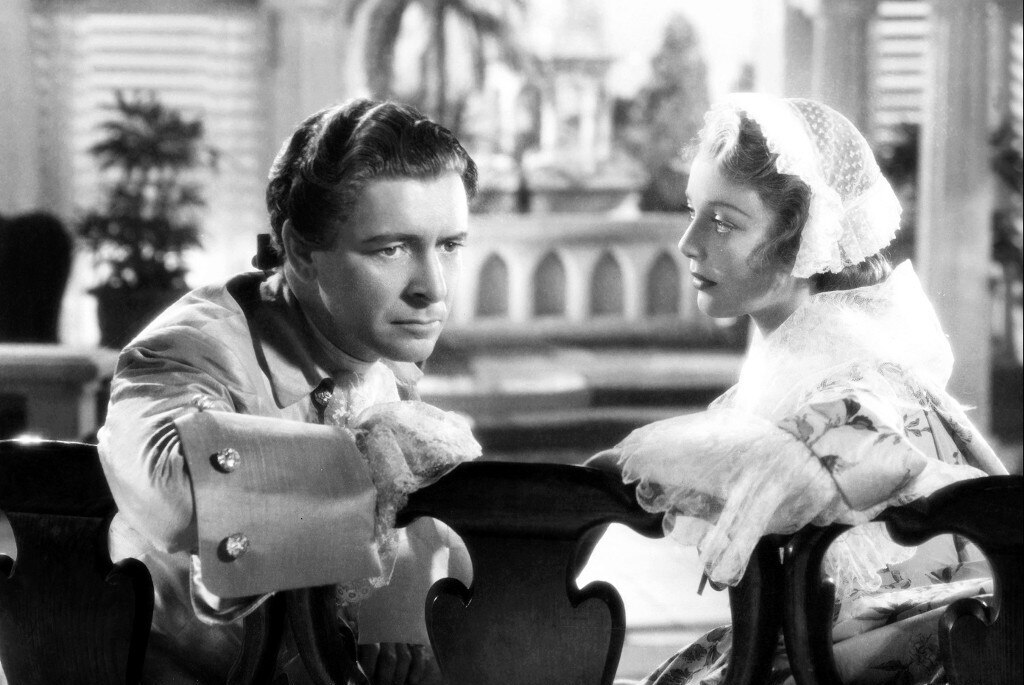
You won't find much in this movie in the way of condemnation of the man that historian William Dalrymple called "an unstable sociopath," but you will see an account of his trial before Parliament. In the person of debonair Ronald Colman, however, we mostly get a dignified portrait of a man consumed by power but touching and loving in his conjugal fidelities.
In his January 1935 review in the New York Times, Andre Sennwald acknowledged the "ethics of imperialism" and "complex political intrigues" that were shunted aside to focus more on "the glamour of the man" and his romance with his long-suffering wife. Sennwald noted that much of the campaign to subjugate India was elided in the screen story but praised the studio's handling of the Battle of Plassey. This victory by the East India Company led to puppet governments installed in Bengal and other states, unleashing the excesses and atrocities synonymous with the British Raj. Sennwald notes that the film readapted "the historical facts for pictorial purposes," allowing Plassey to come "boiling out of the history books in a picturesque hell of armored elephants and gory hand-to-hand combat."
The picture takes a final liberty in having Clive return, broken and tired, to his wife's loving arms. In real life, Clive died at his home in London, aged forty-nine, allegedly from either self-inflicted wounds or an overdose of opium.
According to some modern sources, Darryl F. Zanuck, head of Twentieth Century-Fox, saw a play in London by W.P. Lipscomb and R.J. Minney based on Minney's 1931 book about Clive. Zanuck bought the rights and brought the authors to America to write the screenplay.
The direction was entrusted to Richard Boleslawski, who had just shepherded Greta Garbo in The Painted Veil (1934), an adaptation of a W. Somerset Maugham novel with colonial overtones of its own. After Clive of India, Boleslawski took on another historical drama, Victor Hugo's Les Misérables (1935). The screenplay for that film was written by Lipscomb, who stayed on in Hollywood long enough to also write screenplays for A Tale of Two Cities (1935), The Garden of Allah (1936), and another tale of the English gloriously extending their fortunes in the world, Lloyds of London (1936). Returning to England, Lipscomb adapted Shaw's Pygmalion (1938), winning the Best Writing, Screenplay Academy Award for his work.
The cast included several Fox contract players, notably Loretta Young who, as Clive's wife, earned faint praise from Sennwald as "a competent and winning if slightly less than brilliant actress." Although not confirmed, it has been said that Don Ameche, soon to be a reliable Fox actor, made his uncredited film debut as a prisoner in the infamous Black Hole of Calcutta.
Typical for its time, the film featured Cuban-American Cesar Romero and Russian-born Mischa Auer as Indians. Those great staples of Brit historical dramas, Montagu Love and C. Aubrey Smith, also had key roles, as did Colin Clive, best known for his role as Dr. Victor Frankenstein and a real-life descendant of the title character.
Cinematographer J. Peverell Marley was no slouch at the historical epics Fox liked to throw his way, having shot The House of Rothschild (1934) and The Count of Monte Cristo (1934). His projects following Clive of India included two versions of The Three Musketeers (1935, 1939); the lively robber baron biopic The Toast of New York (1937): In Old Chicago (1937), about Mrs. O'Leary's calamitous cow and the fire it allegedly caused: and another drama of Western expansionism with a blind eye on history, Suez (1938), which earned Marley his first Oscar nomination.
Director: Richard Boleslawski
Producer: Darryl F. Zanuck; William Goetz and Raymond Griffith, associates
Screenplay: W.P. Lipscomb, R.J. Minney, adapted from their play based on Minney's book Clive
Cinematography: J. Peverell Marley
Editing: Barbara McLean
Art Direction: Richard Day
Original Music: Alfred Newman
Cast: Ronald Colman (Robert Clive), Loretta Young (Margaret Maskelyne Clive), Francis Lister (Edmund Maskelyne), C. Aubrey Smith (Prime Minister), Cesar Romero (Mir Jaffar)
By Rob Nixon
Clive of India
by Rob Nixon | June 13, 2017
SIGN UP FOR OUR NEWSLETTERS

CONNECT WITH TCM