Oregon Passage (1957) is a good-looking western with ingredients straight out of the time-tested Hollywood tradition, eye-dazzling scenery and shameless Native American stereotypes included. The main setting is a fort, the main characters are cavalry officers, the secondary characters are wives and buddies, the villain is an Indian warrior, and the action is punctuated by fights, chases, and battles at regular intervals. The most interesting angles are the rivalries and jealousies that arise among the soldiers, who aren't very good at compromising or compartmentalizing where women are concerned. Also interesting is director Paul Landres's skill at creating large-scale production values on a budget that was evidently less than lavish.
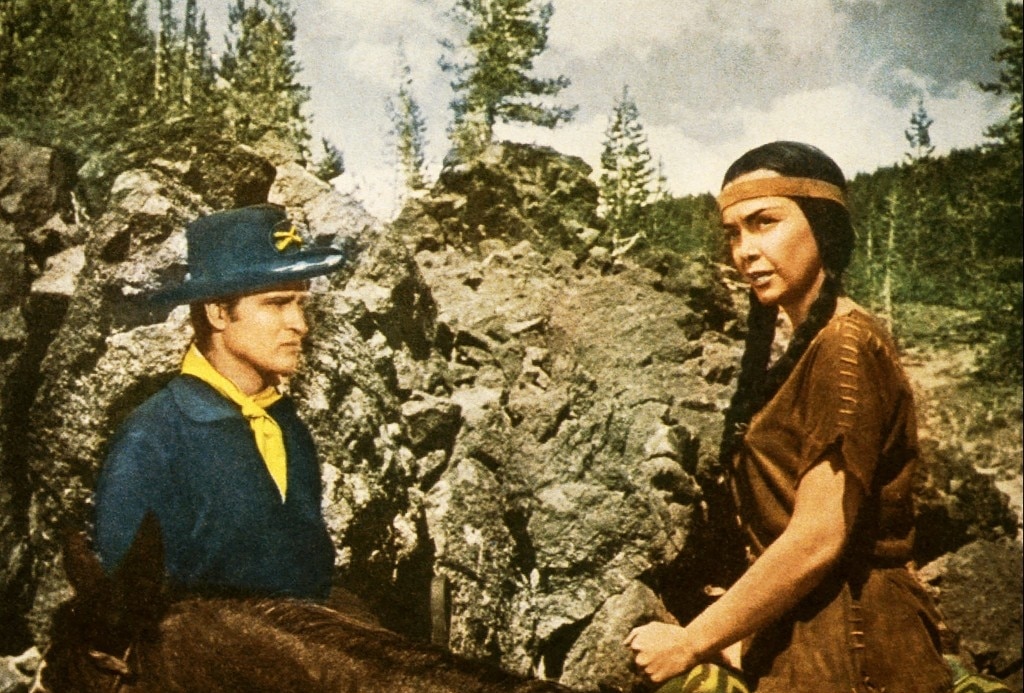
True to its title, Oregon Passage takes place in the Pacific Northwest, where - according to the text after the opening credits - total peace would reign if a Shoshone leader named Black Eagle (H.M. Wynant) weren't pursuing an anti-white vendetta fraught with hatred and violence. The story begins with Lieutenant Niles Ord (John Ericson) conducting a raid on a village where Black Eagle is thought to be living, only to find that it's a purely ceremonial community populated mostly by squaws. Niles is peeved with his Indian scout, Nato (Paul Fierro), for failing to track down Black Eagle's location, but the raiders do manage to rescue Little Deer (Toni Gerry), a perky young woman from a northern tribe who was raised in a Methodist mission and kidnapped by Black Eagle's braves in order to become his bride. Hugely grateful to Niles for rescuing her, Little Deer falls instantly in love with him.
She isn't the only one who thinks Niles is the territory's most desirable bachelor. Back at the fort, Major Roland Dane (Edward Platt) has just become the new commander, and his wife, Sylvia Dane (Lola Albright), actually had a fling with Niles a few years earlier. This was two years before she married Roland, but he's been seething with jealousy ever since their wedding. And rightly so! The moment Niles returns to the fort, Sylvia renews her flirtation with him, making it clear to everyone that the handsome young lieutenant pleases her far more than her aging, grumpy husband could ever do. Making matters worse, Roland badly mistreats the commander he's replacing, Captain Boyson (Harvey Stephens), who became an alcoholic after being captured and tortured by Black Eagle's men. All these pressures fuel the escalating tension between Niles and Roland, and further strains arise from their constant squabbles about how to deal with Black Eagle's ongoing threat.
The real star of Oregon Passage is the atmospheric backdrop provided by the snow-capped mountains, towering trees, dusty trails, and sweeping skies of the Deschutes National Forest, where the picture was filmed with cooperation from the federal government and the chamber of commerce in Bend, Oregon, duly acknowledged at the end. And the real costar is cinematographer Ellis Carter, whose artful use of the wide CinemaScope frame captures the region's natural splendor without detracting from the human drama taking place within it. Although his filmography contains a lot of forgettable titles, Carter's then-recent work included Jack Arnold's classic The Incredible Shrinking Man (1957), a different kind of challenge that he rose to with similar expertise.
Carter might not have had CinemaScope and DeLuxe color at his disposal if Allied Artists had put Oregon Passage into production at any other period in its checkered history. Best known for inexpensive oaters, action-adventure quickies, and Bowery Boys programmers, the company had recently dipped its toe into the big-budget waters with William Wyler's Friendly Persuasion (1956) and Billy Wilder's Love in the Afternoon (1957), but felt the chill of low box-office returns and promptly retreated to the B-movie territory where it had always been most comfortable. Oregon Passage was already in the pipeline when Wilder's picture flopped, but cautious budgeting left clear marks on the production, which has no marquee names more imposing than Ericson and Albright, and battle scenes where mere handfuls of soldiers and Indians are on display. This said, director Landres keeps the story moving at a steady clip, capitalizing nicely on the experience he'd accrued via television series like The Lone Ranger (1949-57) and The Cisco Kid (1950-56) plus many feature-film assignments in the western genre.
The screenplay by Jack DeWitt is based on a novel by Gordon D. Shirreffs called Rio Bravo, which was presumably changed to Oregon Passage because Howard Hawks's movie Rio Bravo (1959) was in the works, going before the camera a few months after Landres's picture premiered. The other production values of Oregon Passage are all solid, including the score by the prolific B-movie composer Paul Dunlap, although it's a tad peculiar that the main theme draws on the melody of "Red River Valley," a song that's appropriate to the story's 19th-century period but has little to do with the Pacific Northwest setting; while no one knows for certain what Red River the lyrics refer to, the piece is usually associated with either the American Midwest or one of the central Canadian provinces.
.
It's regrettable that Oregon Passage allows only two Native American characters to have anything like a personality - the vivacious Little Deer and the loyal scout Nato, whose name has intriguing cold-war connotations - but the last scene suggests that Little Deer and Niles have a future as a couple, which is a sign of social change in the run-up to the 1960s, since that outcome would have been less acceptable to Hollywood sensibilities in earlier times. Also telling is the pivotal moment when the nasty commander shoots and kills his own wife rather than see her in Black Eagle's hands. His kind of anti-Indian fixation echoes similar attitudes explored in John Ford's classic Stagecoach (1939) and The Searchers (1956), which have influenced countless westerns, and Oregon Passage condemns such paranoia in no uncertain terms. It's not one of the great westerns, but many small virtues appear on its colorful 'Scope screen.
Director: Paul Landres
Producer: Lindsley Parsons
Screenplay: Jack DeWitt; from a novel by Gordon D. Shirreffs
Cinematographer: Ellis Carter
Film Editing: Maury Wright
Set Decoration: Jerry Welch
Music: Paul Dunlap
With: John Ericson (Lieutenant Niles Ord), Lola Albright (Sylvia Dane), Toni Gerry (Little Deer), Edward Platt (Roland Dane), Judith Ames (Marion), H.M. Wynant (Black Eagle), John Shepodd (Lieutenant Baird Dobson), Walter Barnes (Sergeant Jed Erschick), Paul Fierro (Nato), Harvey Stephens (Captain Boyson)
Color-80m.
by David Sterritt
Oregon Passage
by David Sterritt | June 12, 2017
SIGN UP FOR OUR NEWSLETTERS

CONNECT WITH TCM