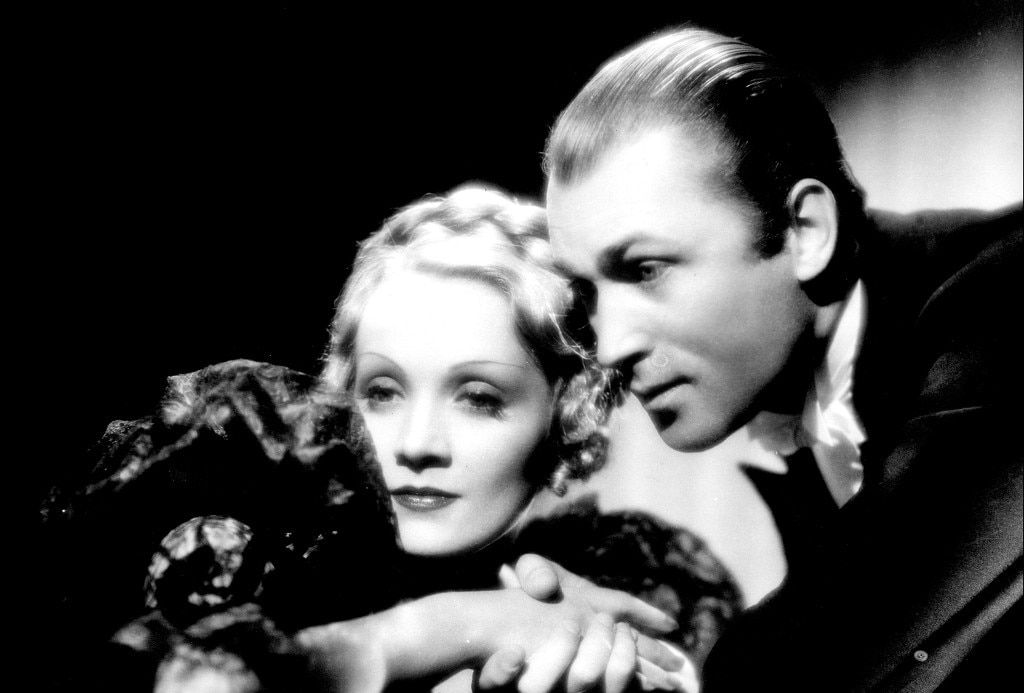
Marlene Dietrich's six-film collaboration with Josef von Sternberg has overshadowed the movies she made for other directors, including those by Billy Wilder, Alfred Hitchcock, and Fritz Lang. Unsung films by second-tier directors such as The Song of Songs (1933) have been virtually forgotten. Directed by Rouben Mamoulian, The Song of Songs was the first Hollywood film starring Dietrich that was not made by von Sternberg.
After the box-office disappointment of Blonde Venus in 1932, Paramount decided to break up the team of von Sternberg and Dietrich. The actress was rushed into The Song of Songs, which caught her off-guard. According to Hollywood lore, on the first day of shooting, a disconcerted Dietrich stepped up to an open mic and whispered, "Joe, where are you?" Dietrich's daughter, Maria Riva, claimed that her mother sought out von Sternberg's advice whenever she was assigned to another director. His advice was always to study the films they made together and learn from them.
The Song of Songs fits the type of material associated with Dietrich's exotic and erotic star image. She stars as Lily Czepanek, a naïve young peasant girl who becomes a world-weary fallen woman because of the men in her life. Lily's story begins when her father dies, forcing her to leave her picturesque village where the trees are in bloom and the sunlight glistens on the leaves. An ominous black train speeds through the night, taking Lily to noisy, gritty Berlin. The contrast between the two locations suggests the innocence of small-town life contrasted against the dangers of the big bad city. Hard-hearted Aunt Rasmussen takes in Lily, who will work in Auntie's bookstore. That the girl is from another world is emphasized by her aunt's critical remarks about her appearance and clothing. She calls Lily's hat "a black pancake" and marvels at the number of petticoats Lily takes off to prepare for bed.
In the back room of her aunt's first floor apartment, Lily looks out the window into the top-story garret of artist Richard Waldow, played by a genteel Brian Aherne. Again, the settings suggest an aspect of the story: Lily's lowly position as an unsophisticated, uneducated village girl vs. Waldow's lofty, cultured lifestyle. In the bookstore, Waldow confesses that he is "stuck" in a rut artistically and only Lily's natural beauty can release him from his creative block. Soon Lily is sneaking away from her aunt's watchful eye and posing nude in Waldow's rooftop studio.
The film's title refers to a biblical passage in the "Song of Solomon" that holds personal meaning for Lily. To the young, virtuous girl, "The Song of Songs" will be the voice of her future beloved, a transference of her love of God and all things holy to her love of the unknown husband of her dreams. Touched by her innocence, Waldow names his new sculpture "The Song of Songs." Lily and Waldow fall in love, but their romantic idyll is disrupted by Baron von Merzbach, who is the artist's primary patron. Unlike Waldow, the Baron, played by Lionel Atwill, covets Lily for her beauty not for her purity, and he persuades the artist to "give her to me." After all, Waldow could not give her the education, the sophistication, and the lifestyle that the Baron can. Spurned by Waldow, Lily becomes the Baroness von Merzbach, which erodes her sense of virtue and begins her slide into sin and cynicism.
Mamoulian, a respected Broadway director when he journeyed to Hollywood in the early sound era, handles Dietrich and the simple, fairy-tale material with skill and style. Viewers familiar with Dietrich's sophisticated look and demeanor will be impressed with her interpretation of young Lily. The beauty of her fresh-scrubbed face and her sweet manner are the polar opposite of her more familiar world-weary, sexually experienced persona.
The Song of Songs is a pre-Code film, and, though not explicit, it does address issues of adult sexuality. Lily experiences a sexual awakening based on her true love for Waldow, who returns her love and feelings of desire. Their emotions are revealed as Lily undresses to pose for Waldow. Mamoulian gives the act of disrobing an erotic charge through careful camerawork. As Lily drops her skirt behind a curtain in the studio, the camera pans quickly from her torso to the bare legs of a female statue in the studio. When she unbuttons her blouse, the camera tilts up before any part of her body is exposed, and when she takes off her blouse, a swish pan to the statue reveals its nude breasts instead of Lily's. At first Waldow is oblivious to Lily, but his feelings quickly change. The moment when the artist knows he has fallen for his model is conveyed when he sees the disrobed Lily for the first time. He is modeling a female figure in clay, and the way he massages the shoulders of the clay sculpture indicates his desire for Lily. The sculptures and clay figures were done by Salvatore Cartaino Scarpitta, who was enjoying a newfound fame for the bas reliefs he created for the newly opened Los Angeles Stock Exchange.
The scenes between Lily and Waldow show the place of desire in true love, while those between Lily and the Baron reveal the dark side of sexual desire, which can be deviant and decadent. Again, Mamoulian suggests this idea visually. On Lily's wedding night, the Baron gapes at a nude sketch of his new bride. As the Baron heads toward his bride's bedroom, the camera tracks closer toward the nude torso depicted in the drawing, revealing exactly what is on von Merzbach's mind.
Von Sternberg may have been justly famous for his expertise in lighting and mise-en-scene, but Mamoulian and his cinematographer, Victor Milner, also used chiaroscuro lighting and set design to comment on story and character. When Lily first arrives in Berlin, she looks out the window at the dark streets of the city. The angles of the buildings and low-key lighting produce a foreboding atmosphere. When Lily enters Waldow's garret studio for the first time, the high contrast lighting on the half-finished statues provokes unease, echoing Lily's frightened state of mind. The main room of the Baron's castle consists of a line of statues in the same stiff pose carefully placed beneath perfectly spaced arches. The uniformity of design suggests von Merzbach's rigid nature.
The Song of Songs is a lesser-known gem in Dietrich's career that reveals her range as an actress as well as director Mamoulian's skill. His imaginative editing and suggestive imagery give the film a passion and hint of eroticism that turns the simple fairy tale into a sophisticated story for adults.
Producer: Rouben Mamoulian for Paramount Pictures
Director: Rouben Mamoulian
Screenplay: Leo Birinski and Samuel Hoffenstein from the novel by Hermann Sudermann and the play by Edward Sheldon
Cinematography: Victor Milner
Art Direction: Hans Dreier
Music: Karl Hajos
Costume: Travis Banton
Cast: Lily Czepanek (Marlene Dietrich), Richard Waldow (Briane Aherne), Baron von Merzbach (Lionel Atwill), Aunt Rasmussen (Alison Skipworth), Walter Von Prell (Hardie Albright), Fraulein Von Schwertfeger (Helen Freeman).
BW-90m.
by Susan Doll
The Song of Songs
by Susan Doll | June 12, 2017
SIGN UP FOR OUR NEWSLETTERS

CONNECT WITH TCM