"Jo, where are you?" Marlene Dietrich is said to have cried into a live microphone, with full amplification, on the set of The Song of Songs (1933), her first American film without Josef von Sternberg, her director, mentor, and, many thought, her Svengali.
Von Sternberg had guided Dietrich through five movies at this point, beginning with The Blue Angel (1930). He created her iconic identity as the most glamorous "movie goddess" at Paramount Pictures, making her that studio's answer to MGM's Greta Garbo. Von Sternberg bedecked Dietrich in exotic furs, feathers and veils, along with white tie and tails and even a gorilla suit. He gave her those enigmatic line readings and, perhaps most importantly, created a system of lighting that lent the Dietrich face an aura of mystery and almost unearthly beauty.
But by 1933 the public had tired of the Dietrich/von Sternberg formula of outrageous entertainment, and their most recent film, Blonde Venus (1932), had flopped at the box office. Paramount decreed that Dietrich should try working with another director, and von Sternberg conceded that the studio was right. According to Maria Riva's biography of her mother, Marlene Dietrich (1992), von Sternberg told his star that the new director should be Rouben Mamoulian: "This way, you will be in the hands of a gentleman who is also a very talented and successful director. He won't be strong enough to fight you, to make you understand what is needed to make a scene important. But if you behave yourself, you may get away with an acceptable performance."
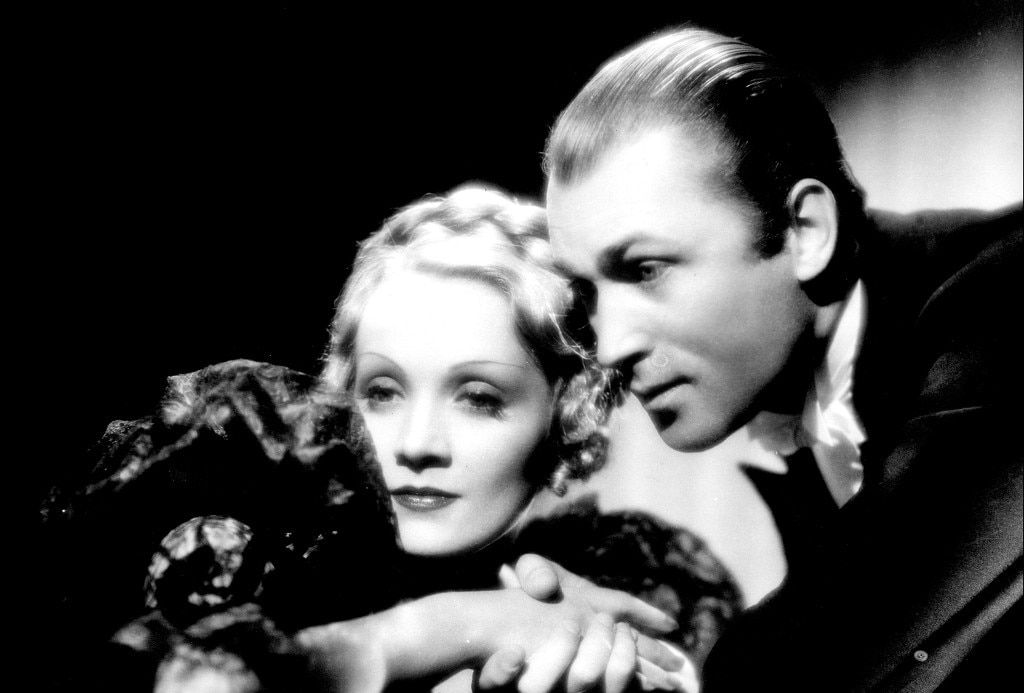
The Song of Songs, adapted from a famous 1908 novel by Hermann Sudermann and a 1914 play by Edward Sheldon, had earlier been given two silent-screen treatments by Paramount - one in 1918 and another, titled Lily of the Dust, in 1924. In a role earlier proposed for Miriam Hopkins and Tallulah Bankhead in the sound remake, Dietrich plays Lily, an idealistic and pious German peasant girl of the early 1900s. After the death of her father, she moves to Berlin to live with a crotchety aunt (Aliston Skipworth). Lily meets a handsome young sculptor, Richard (Brian Aherne), who persuades her to pose in the nude for a statue representing Solomon's "Song of Songs."
The action allows Dietrich a couple of songs: the Franz Schubert/Johann Wolfgang Goethe "Heideroslein"; and Friedrich Hollaender's "Jonny," with English lyrics by Edward Heyman. The latter song, delivered dramatically in the smoky cafe atmosphere, is one that Dietrich sometimes sang in her own cabaret performances - and it's a knockout.
"Like every German girl, I regard this as one of the great works of fiction," Dietrich would tell the press. But Riva wrote that her mother's private reaction to the screenplay was negative though part of that may have stemmed from not being able to work with von Sternberg on it. So she stalled and considered fleeing to her native Germany. However, when Paramount informed her agent, Harry Edington, that she was to report for work, regardless of her opinion, or forfeit her $300,000 salary and be sued by the studio to boot, she complied. The Song of Songs was her final film commitment to Paramount under her current contract, but once she reported for work the studio signed her to a new five-year contract beginning at $4,500 a week - and this during the worst year of the Depression!
Dietrich was not impressed by Mamoulian, a quiet and courtly man who had directed Fredric March to an Oscar in Dr. Jekyll and Mr. Hyde (1931) and had already been assigned to guide Greta Garbo through what would be one of her most evocative performances in Queen Christina (1933).
"Mr. Mamoulian, where is my mirror?" the imperious Dietrich asked her new director on the first day of shooting. She was referring to a huge full-length mirror, transported on a trolley and equipped with its own lights and cables, that she used to monitor her appearance during the filming of each scene. Mamoulian arranged to have the mirror positioned as she wished, but did not follow von Sternberg's pattern of giving his star the precisely shaded line readings to which she was accustomed.
Mamoulian also failed to protect Dietrich from the press and other distractions, and she found herself, on that first day filming, unexpectedly dealing with a telephone call from gossip maven Louella Parsons and an interview complete with photo shoot by Photoplay magazine. Riva writes that her mother glacially informed the film's publicist, "After this...nothing!...will ever again be arranged, scheduled or decided without my permission first! Now...go!"
Most importantly, Mamoulian did not manage to duplicate the lighting system that von Sternberg had perfected to make Dietrich look her most stunning. For the first time, she took control herself, proving that she had been an apt pupil of her master's techniques. Mamoulian was suitably impressed with her knowledge and expertise in creating her own luminous illusions through placing the lights with great precision. "Beautiful, Marlene!" he cried. "Utterly beautiful!" Even the burly, hardened studio technicians, who might have had cause for resentment, stripped off their electricians' gloves and applauded.
Dietrich had, of course, always had a hand in creating her costumes, conferring closely with designer Travis Banton, who worked with her without credit on The Song of Songs. Riva writes that her mother was not much interested in the costuming for the first part of the film, basically repeating her "sweet young peasant girl" look from an earlier film, Dishonored (1931). But she loved the Edwardian finery her character later wore, especially her own version of the principal evening dress -- a breathtaking off-the-shoulder black velvet gown set off by a picture hat adorned with black egret feathers. Decades later, designer Cecil Beaton would recreate the effect for My Fair Lady (1964).
Dietrich had been pre-conditioned to admire new leading man Aherne because he was of the theater and cultured, above the level of a "film actor" in her eyes. Her only reservation was that he had ever accepted this "stupid part in such a bad script." Aherne, who acknowledged that he could see why Fredric March had turned down the role, said he had accepted because he had been "moonstruck" by Dietrich's beauty in Shanghai Express (1932). To celebrate their collaboration, she baked Aherne a cake - and he revealed in his memoirs that he hoped to find opportunities, in turn, to "bake Miss Dietrich." Sure enough, the two immediately became lovers.
Dietrich biographer Steven Bach wrote that, during the 1933 Long Beach earthquake, everybody else at Paramount went home for the day, but "Marlene and Aherne remained in their dressing rooms on Marathon Street, basking in self-generated moonlight." The love affair eventually cooled, but the two would remain lifelong friends and Aherne served, throughout his life, as a father figure to Maria Riva.
Prior to the release of The Song of Songs, the director encountered problems with Will Hays and his Hollywood board of censors. According to Bach in his biography, "Mamoulian wrote the Hays men a hilariously disingenuous letter about how artistic it all was and what connoisseurs of art he knew them to be. It didn't work. Before the picture could be released in the summer of 1933, Will Hays ordered Paramount to cut a reel and a half (about fifteen minutes) before issuing a seal." Paramount brought some of this upon themselves when they sent thousands of replicas of the infamous Dietrich statue to movie theatres to promote the film and promptly aroused the wrath of various religious organizations and women's groups.
The Song of Songs was well-received critically, with much of the praise focusing on Dietrich's "escape" from the influence of her former director. The Hollywood Reporter wrote that the film "confirms the wisdom of emancipating La Dietrich from the Svengali-like domination of von Sternberg." The Los Angeles Examiner took a similar tack: "No Trilby sans Svengali ever gave so fine a portrayal." Newsweek found Dietrich "vibrant and compelling" and felt she had turned the material into "an individual triumph." The New York Times gushed that she "floats through" the movie "with the lyric grace of that apparition which was sent by Heaven to be a moment's ornament."
The picturegoing public, however, was indifferent, and the movie enjoyed only lukewarm box office. Von Sternberg would return from Berlin for Dietrich's next two films, The Scarlet Empress (1934), which would become one of his most celebrated films, and The Devil Is a Woman (1935), in which Dietrich's sculptured beauty reaches a new peak of perfection. The Song of Songs was banned in Nazi Germany because the novel had been written by a Jew and because of Dietrich's refusal to work in that country as long as it was Nazi-controlled. There were also objections on moral grounds because an actress from Germany was starring in a story suggesting that adultery could go unpunished in that country. Criticism of Dietrich by the Nazi propoganda machine would grow ever more vicious, and Bach considers that "its effects would never be entirely erased."
Director: Rouben Mamoulian
Screenplay: Leo Birinsky, Samuel Hoffenstein, based on the novel Das Hohelied by Hermann Sudermann and the play by Edward Sheldon
Cinematography: Victor Milner
Art Direction: Hans Dreir
Costume Design: Travis Banton
Cast: Marlene Dietrich (Lily Czepanek), Brian Aherne (Richard Waldow0, Lionel Atwill (Baron von Merzback), Alison Skipworth (Mrs. Rasmussen), Hardie Albright (Walter Von Prell), Helen Freeman (Fraulein Von Schwerfeger).
BW-90m.
by Roger Fristoe
The Song of Songs
by Roger Fristoe | May 22, 2017
SIGN UP FOR OUR NEWSLETTERS

CONNECT WITH TCM