Chungking Express (1994) was Wong Kar-Wai's third feature to be released but the fourth to be filmed, after Ashes of Time (1994). That film, a lavish costume drama with a big cast and budget, had taken over two years to write, prepare and direct, and after its production wrapped, the Hong Kong filmmaker felt the need for a palate cleanser. So, before he started the editing process on Ashes of Time, he made Chungking Express as a quickie, taking less than three months from inception to release. He worried that the level of meticulousness required by Ashes of Time had damaged his "creative instinct." Chungking, he said, was "like going back to the basics of filmmaking... The only thing that I could fall back on was my creative intuition. At times, I felt like I became a film student again, and the experience was immensely refreshing and enlightening."
The shoot itself took two weeks. "I wanted it to be something like a road movie," the director said. "I shot the project...without a script. I worked during the day writing the scene and then we'd shoot it at night. I wanted to make something very straightforward, very simple."
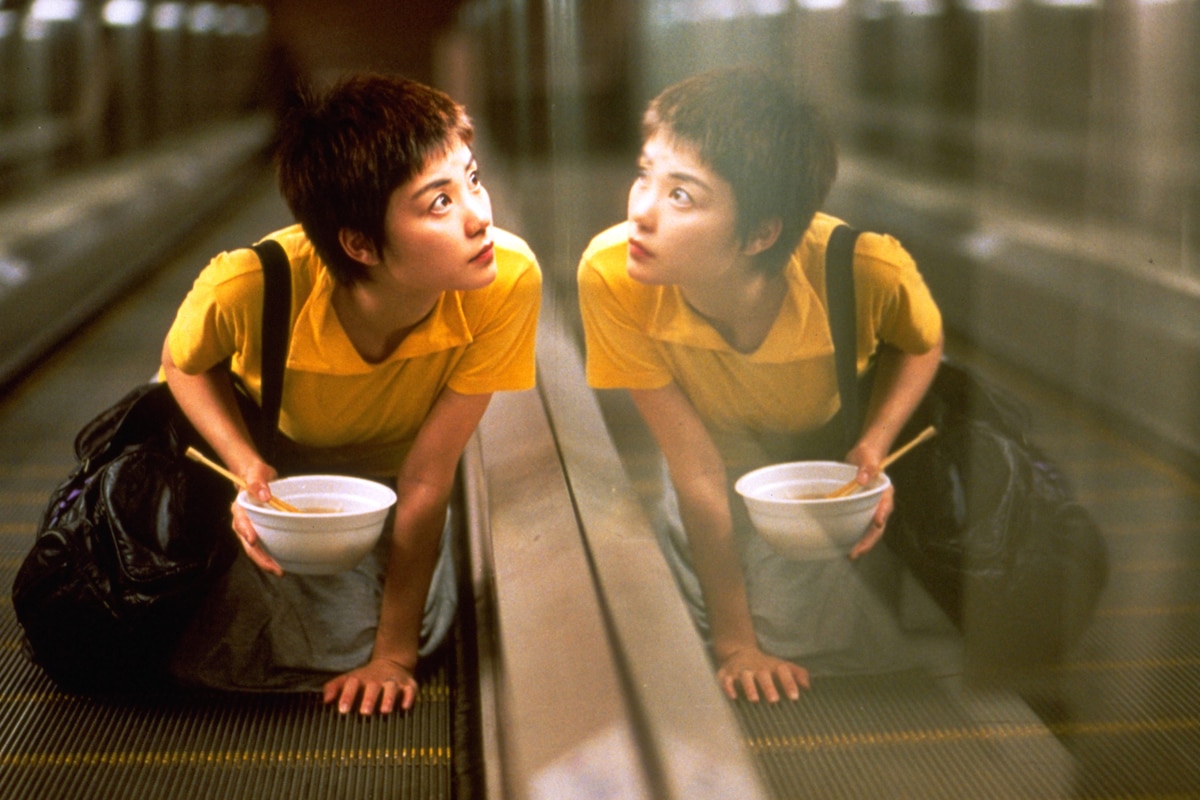
The film, set in nighttime Hong Kong, is comprised of two distinct stories, each revolving around characters who meet by chance--or fate. In the first, a blonde female drug dealer oversees a smuggling job while a cop suffers the loss of a girlfriend. In the second, another lovelorn cop, recently dumped by a flight attendant, crosses paths with a restaurant cook. "The story is about people living in a very lonely city," said Wong Kar-Wai. "They have to entertain themselves. They don't reveal their feelings to other people. Instead, they prefer to talk to themselves or to objects."
Chungking Express was released in the United States as the first film under Quentin Tarantino's Rolling Thunder banner, a division of Miramax. Tarantino was a big booster of Hong Kong cinema in general, and this film blew him away when he saw it at a European festival. Wong Kar-Wai, he said, "is the most exciting director that's come along since I've been a professional filmmaker... When I saw Chungking Express, I felt we were going down the same road."
The film's blend of urban disconnection, melancholy romance, tongue-in-cheek humor, edgy visual style and hyperkinetic editing all registered with critics as well. Variety said it "recalls the freshness of the French New Wave in its cinematic playfulness." Sight and Sound called it "rapturous entertainment... one of the first films of the '90s to feel genuinely fresh and original... The level of invention in the plotting and the film language is almost profligate."
Due to scheduling conflicts, the two halves of Chungking Express were shot by two cinematographers: the first, by Andrew Lau, and the second, by the Australian Christopher Doyle, who has worked in Hong Kong cinema for decades and with Wong Kar-Wai many times. Doyle said he used lenses as long as 200mm to compress the frame and make people look closer than they were, mirroring the dynamics of the characters themselves.
By Jeremy Arnold
Chungking Express
by Jeremy Arnold | May 18, 2017
SIGN UP FOR OUR NEWSLETTERS

CONNECT WITH TCM