Clarence Brown directed some of the most famous names in movie history, from Greta Garbo to Joan Crawford, both multiple times, and a list of his films is like reading a list of the biggest movies of the thirties and forties but, sadly, his name is not well known outside movie fans. Near the end of his career, he had the pleasure of working with the great Paul Douglas and produced two religiously inspired comedies, both a hit, and both starring Douglas. The first one, Angels in the Outfield (1951), had a successful series of remakes some decades later but the better of the two, When in Rome (1952), stands alone as both a buddy movie comedy and sincere tale of one man finding personal solace through faith.
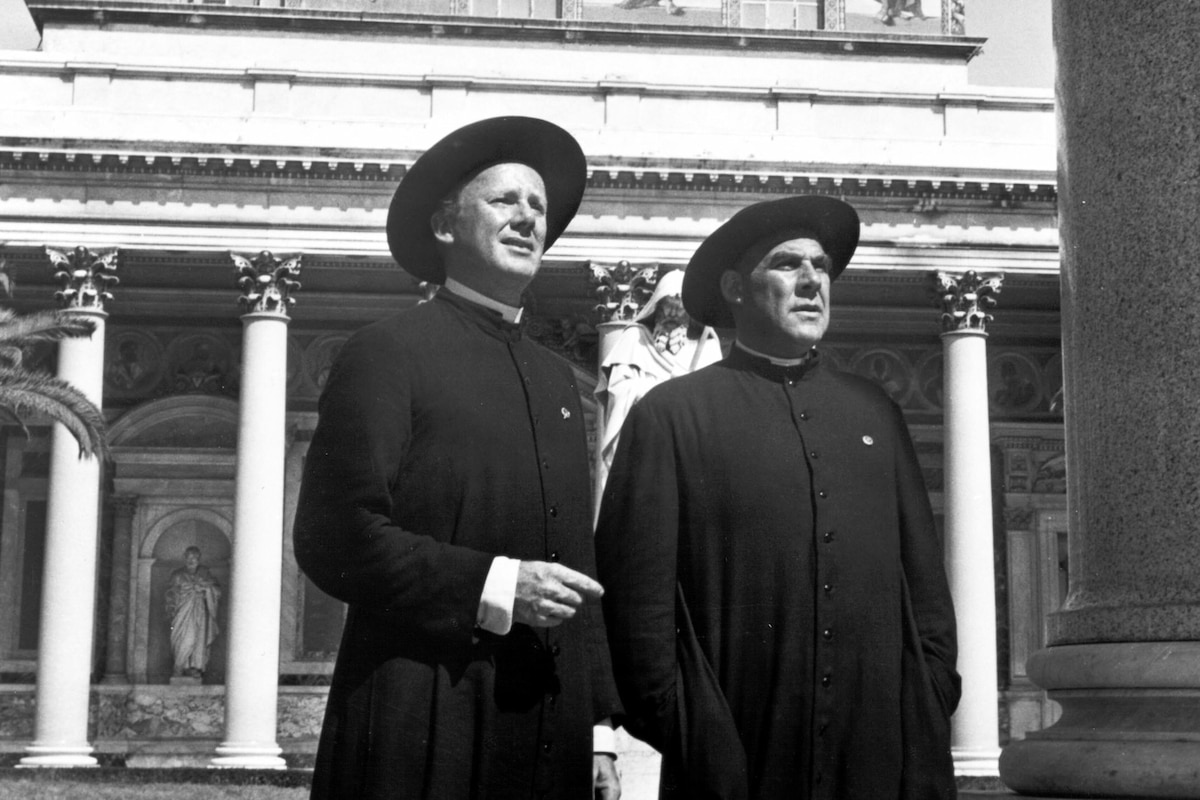
The film opens with a title card informing the audience that 1950 saw the Holy Year celebrated in Rome and at the Vatican, with millions of people making the pilgrimage. One of those people is Father John X. Halligan (Van Johnson), visiting for obvious reasons, and the other is Joe Brewster, for reasons best described as leading the fugitive lifestyle. He's trying to evade capture for crimes committed and ends up, of course, on the same boat headed for Genoa as Father Halligan.
Halligan gets to that boat by way of Coaltown, PA, where we first meet him saying farewell to his flock. They give him saint medals to be blessed by the Pope and wish him well. Once he meets up with Joe Brewster, those plans begin to fall apart. Upon arriving in Genoa, Brewster takes Halligan's clothes so he can pose as a priest in order to better to evade capture. Halligan finds him and helps him evade the police on one condition: He join Father Halligan on the pilgrimage.
Van Johnson made a name for himself in the forties as the All-American boy, playing war heroes and generally all-around good guys. His choice to play Father Halligan was an easy one, if not a particularly challenging one. Two years after the film, Johnson was dropped by MGM as his career had taken off like studio execs they hoped it would. He would give his best performance shortly thereafter in The Caine Mutiny, prompting many to consider his acting talents had been underused.
Paul Douglas was a character actor whose star was going nowhere but up. After his first big success in A Letter to Three Wives (1949), he found himself in one success after another. His work with Clarence Brown on Angels in the Outfield became his most successful film, finding himself the star of President Dwight D. Eisenhower's favorite movie. The President reportedly watched it so many times the White House staff got sick of it and began dreading movie night with the President.
While Angels in the Outfield was a box office success, When in Rome lost money at the box office. Of course, movies like When in Rome were never big hits, not enough to justify a trend at least, but they got made, here and there, in the heyday of Hollywood, by both Hollywood liberals and conservatives who hadn't yet found a way to politicize faith. One of its key writers was Dorothy Kingsley, who was herself a devout Catholic and took Robert Buckner's story to heart. She would rarely get sole screenwriting credit since she was usually brought in to doctor scripts started by others. It's clear that this was one such job she was more than happy to do. When in Rome may harken back to a different era of gentler films but it still packs a punch with its tale of redemption.
Director: Clarence Brown
Screenplay: Dorothy Kingsley, Charles Schnee, Robert Buckner (Story)
Producer: Clarence Brown
Music: Carmen Dragon
Cinematography: William H. Daniels
Film Editor: Robert J. Kern
Art Director: Edward Carfagno, Cedric Gibbons
Cast: Van Johnson (Father John X. Halligan), Paul Douglas (Joe Brewster), Joseph Calleia (Aggiunto Bodulli), Carlo Rizzo (Antonio Silesto), Tudor Owen (Father McGinniss), Dino Nardi (Commissario Genoa), Aldo Silvani (Cabby with horse and buggy)
By Greg Ferrara
When in Rome
by Greg Ferrara | May 17, 2017
SIGN UP FOR OUR NEWSLETTERS

CONNECT WITH TCM