Both a rare color film and a rare western for director Edgar G. Ulmer (his previous western had been 1934's Thunder Over Texas), The Naked Dawn (1955) has gained in significant stature since its first release.
Independently produced but released by Universal, the low-budget film had its unlikely genesis in an 1895 short story by Russian author Maxim Gorky. Screenwriter Julian Zimet had been blacklisted and was living in Mexico when he read Gorky's story Chelkash, about a tramp who hires a peasant to help pull off a robbery, leading to the peasant becoming consumed by greed. Zimet changed the tramp to a Mexican bandit named Santiago, the peasant to a farmer named Manuel, and added a third character in Manuel's wife, Maria. He titled his script The Bandit.
Because he was blacklisted, Zimet used the names of his sister and her husband (Nina and Herman Schneider) as fronts: the screenplay was attributed to them, and they sold it for Zimet to independent producer Sol Lesser. Lesser in turn sold it to Josef Shaftel, who produced it with James Radford. The producers set up a negative pickup deal with Universal, meaning they would make the film and Universal would distribute. The studio, however, still exercised some control over post-production and changed the title to The Naked Dawn.
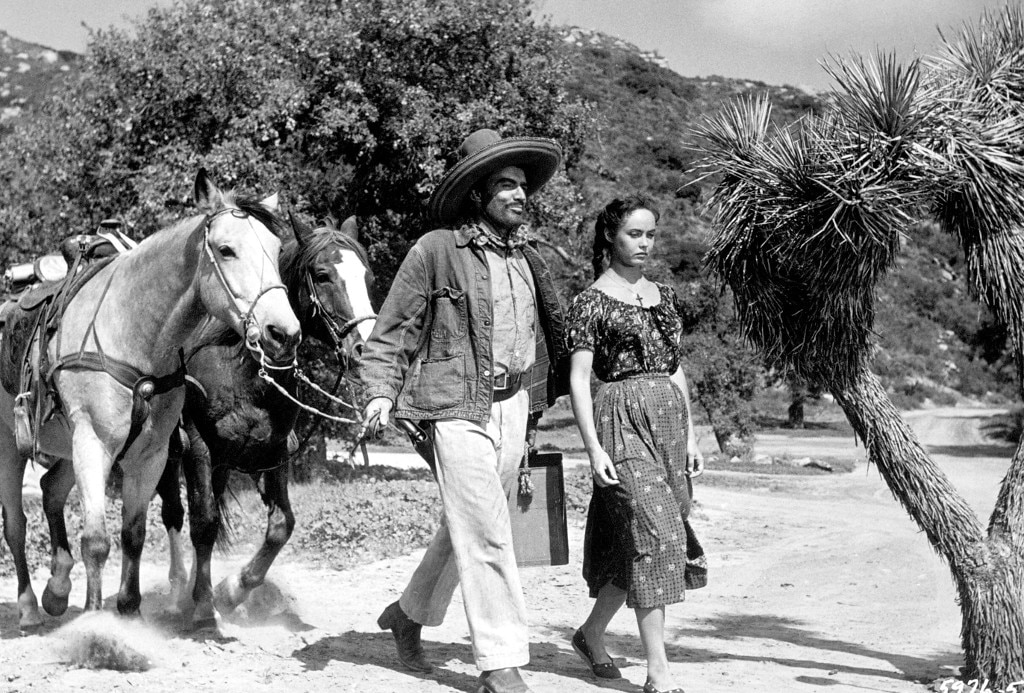
Arthur Kennedy, usually a secondary leading man, took the lead part of Santiago, Puerto Rican actor Eugene Iglesias was cast as Manuel, and Betta St. John played Maria. St. John (born Betty Jean Striegler) is best remembered for originating the role of Liat in the original Broadway production of South Pacific, but she also had a screen career. After some child parts in the 1930s and early '40s, her Broadway success reignited a film career as an adult, with prominent roles in such pictures as Dream Wife (1953), High Tide at Noon (1957), The Snorkel (1958) and two Tarzan movies opposite Gordon Scott.
Talented cult director Edgar G. Ulmer, who was just coming off the film noir Murder Is My Beat (1955) and had a serious knack for injecting strong personal style into the lowest of low-budget movies, took the reins and found rich material in the interpersonal triangle of these three interesting characters grappling with layers of morality.
The picture was shot at the Corriganville Movie Ranch in Simi Valley, Calif., in the spring of 1954, in about two weeks. According to several sources, Ulmer didn't change a word of the script. He later said: "I have one big fault. I fall in love with a character or a situation, and I improvise from that. In The Bandit, I fell in love with the young man. We had no hope for him until he arrived on the set--I didn't think he could play the part. But suddenly he woke up, and Kennedy gave him a hand."
Ulmer's wife later recalled that when Universal took control of the film, they awkwardly inserted close-ups into the first dance sequence, which had been shot as two long takes. Nonetheless, the scene retained real style, with striking shifts in color and lighting and a montage of male and female legs.
The Naked Dawn did not register much in America upon release. Variety deemed the "tempo too slow for popular taste," and The Hollywood Reporter said the film "would look a lot better if it were clothed in a few box office values." But now the picture is regarded as one of Ulmer's best.
In France, where it was released as The Bandit, Ulmer's film was acclaimed from the moment it opened. Francois Truffaut said it greatly influenced his own later Jules and Jim (1962). He wrote: "Talking about The Naked Dawn is equivalent to drawing a portrait of its author, because we see him behind every image and feel we know him intimately when the lights go back on. Wise and indulgent, playful and serene, vital and clear, in short, a good man like the ones I've compared him to. The Naked Dawn is one of those movies we know was made with joy; every shot shows a love of cinema and pleasure in working in it. It is also a pleasure to see it again and to talk to friends about it. A small gift from Hollywood."
In 1997, the Writers Guild of America voted to change the on-screen writing credit to its rightful occupant, Julian Zimet.
By Jeremy Arnold
SOURCES:
Bernd Herzogenrath, The Films of Edgar G. Ulmer
Noah Isenberg, Edgar G. Ulmer: A Filmmaker at the Margins
Bill Krohn, "The Naked Dawn: Production, Sources, and Mise-en-Scene," in
Edgar G. Ulmer: Essays on the King of the Bs, edited by Bernd Herzogenrath
The Naked Dawn
by Jeremy Arnold | May 17, 2017
SIGN UP FOR OUR NEWSLETTERS

CONNECT WITH TCM