The Korean conflict provided little upbeat material for war movies. Hollywood seized on the curious story of Col. Dean Hess, a church minister who had been a bomber pilot over Germany. Returned to active service in Korea, Hess was credited with evacuating more than a thousand war orphans to safety in a highly publicized airlift dubbed 'Operation Kiddy Car.' Hess then became Director of Air Force Information Services, where the idea of an inspirational film seems to have been hatched: Battle Hymn was a screenplay before it became Hess's inspirational autobiography. Universal handed the film project to director Douglas Sirk, who had recently broken box office records with his remake of John M. Stahl's spiritually-themed soap opera Magnificent Obsession.
The screenplay by Charles Grayson and Vincent B. Evans makes Hess seem a cross between Sergeant York and Oskar Schindler. Wracked with guilt over his accidental bombing of a German orphanage, Col. Hess is troubled by air support missions in Korea that put civilians at risk. At first helping a Korean woman (Anna Kashfi) take care of a few orphans, he establishes a large care center, and then makes a monumental effort to safeguard the children from the communist onslaught. Director Sirk broke his leg on location early in the picture, and complained that he had to deal with Col. Hess, who was on the set supervising at all times. The Colonel was pleased to see himself portrayed by the glamorous Rock Hudson, but Sirk felt the star was unsuited for the contradictory role of a devout flying parson, whose combat nickname was, 'Killer.' With American airmen portrayed as paternal babysitters, the real-life effort to save the orphans comes off as an attempt to put a happy face on a miserable war.
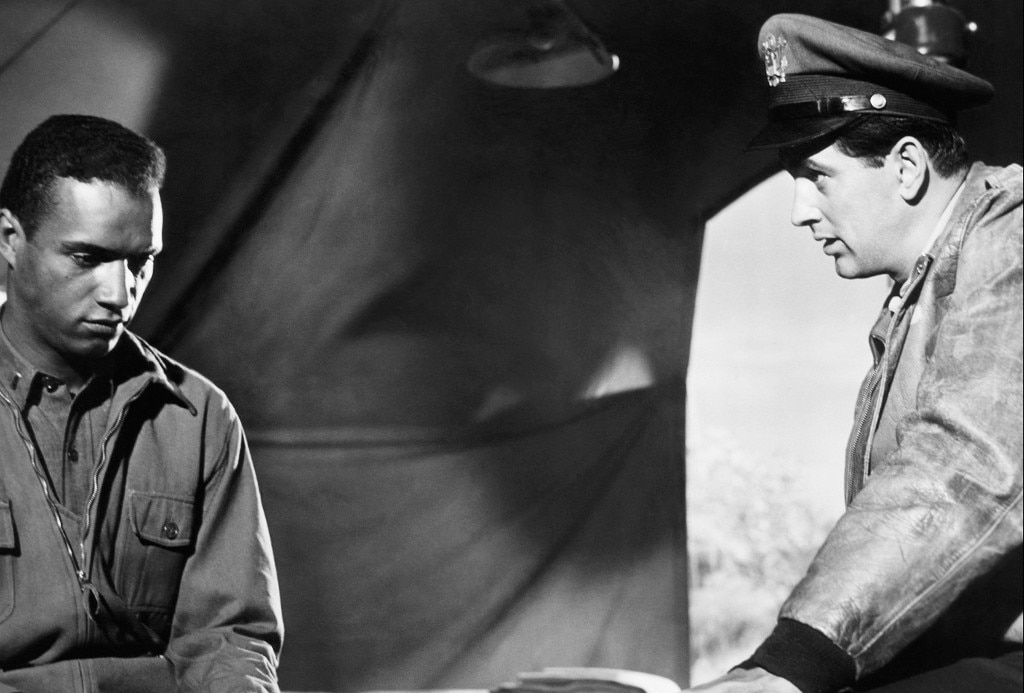
Hudson's Hess finds spiritual optimism in almost every scene, as when he assures a dying comrade (Don DeFore) that he is taking "a wonderful step from darkness to light." Adding racial discomfort to the film's arguments, Hess counsels gospel-singing Lt. Maples (James Edwards) after the black flier accidentally strafes a column of civilian refugees. Anna Kashfi's character falls in love with Hess, only to discover that he has a wife back home (Martha Hyer). The New York Times' Bosley Crowther was quick to note that mixed-race relationships still end badly for the non-white love interest. Perhaps discouraged by the wall of sanctimony around the real Col. Hess, historical critics waited over forty years to charge that he falsified his role in the evacuation of the orphans. Yet it is reported that Hess used his Hollywood fees to fund more charity work in South Korea. Filmed in CinemaScope and Technicolor, Battle Hymn is still remembered for its impressive aerial combat scenes featuring shiny P-51 Mustang aircraft. The Korean pictograms on Hess's plane read, "By Faith I Fly." Director Sirk would film another remake of a John M. Stahl weepie, Interlude (1957), and then return with Rock Hudson and even more impressive aviation thrills in The Tarnished Angels (1957).
By Glenn Erickson
Battle Hymn
by Glenn Erickson | May 02, 2017
SIGN UP FOR OUR NEWSLETTERS

CONNECT WITH TCM