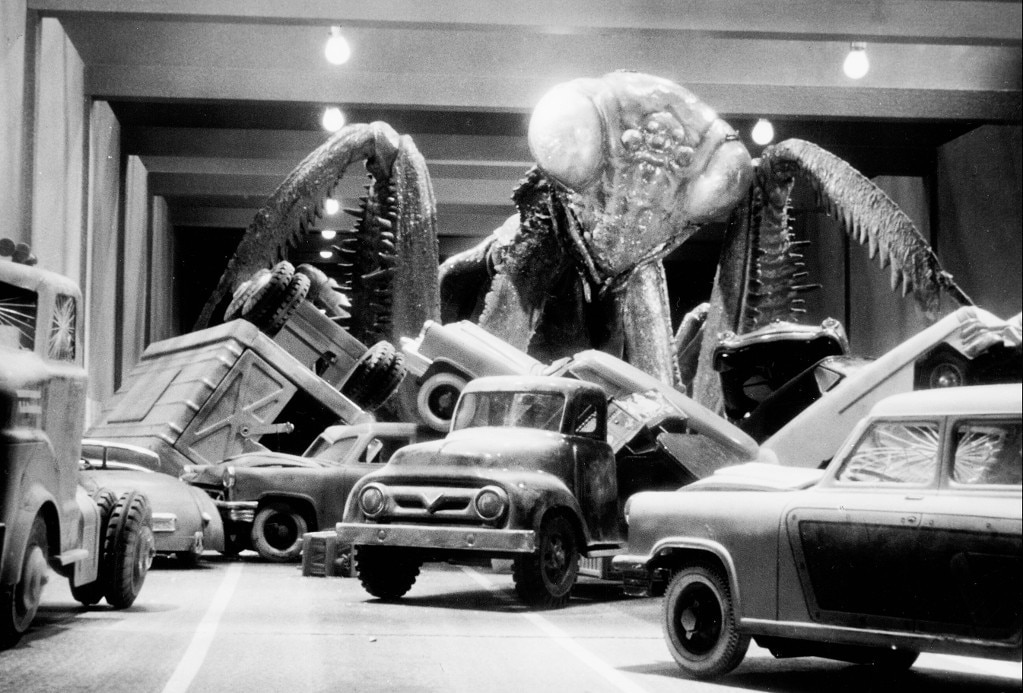
The 1950s brought the monster movie into the atomic age with a roar that Hollywood heard all the way from Japan, where Godzilla (1954) crawled out of the ocean to rampage through Tokyo. In the U.S., prehistorical creatures were revived by atomic tests in such films as The Beast from 20,000 Fathoms (1953) and It Came from Beneath the Sea (1955), and insects and arachnids were supersized from radiation in Them! (1954) and Tarantula (1955). The Deadly Mantis (1957) combines the two with a prehistoric insect of gargantuan proportions released from its glacier prison in the North Pole and travels south to warmer climes and easier foraging. This carnivorous insect preys upon humans.
Produced by William Alland, the man who brought Universal's legacy of science fiction and monster movies into the atomic era of the 1950s with such classics as It Came from Outer Space (1953), Creature from the Black Lagoon (1954), and This Island Earth (1955), The Deadly Mantis came at the tail end of the giant insect fad. Alland's original treatment was inspired by the giant ant hit Them!. Martin Berkeley, a veteran of Alland's Tarantula (1955) and Revenge of the Creature (1955), scripted. Rex Reason, the star of Alland's This Island Earth, was originally cast as the hero but he turned down the role. "I knew that the monster would be the star, and I knew I was worth a little more than just to support a praying mantis," he explained in an interview years later.
Craig Stevens (TV's suave Peter Gunn) takes the lead, playing the Air Force Colonel who follows the mysterious radar readings to Arctic military outposts and Eskimo villages left in ruins by some unidentified threat that leaves enigmatic tracks behind. William Hopper (private detective Paul Drake in TV's Perry Mason) is the paleontologist who works for a Smithsonian-like institution and identifies the only physical remnant left behind by the creature, the tip of what could be a giant claw the size of a small child, as something from the insect world, specifically a mantis. "In all the kingdom of the living, there is no more deadly or voracious creature than the deadly mantis," he explains with great gravity. Former Miss Georgia Alix Talton is the institution publicist and photographer who sees a scoop in this story and heads north to investigate the scene of the attacks with the scientist and is romanced by Stevens as they track the buzzing creature to New York and Washington D.C.
The Deadly Mantis was made on a much smaller scale than Universal's previous monster movies. Stock footage of arctic radar stations and military bases and scenes of Eskimos fleeing a native fishing village (repurposed from the 1933 film S.O.S. Iceberg) fill out much of the first act, and the rest of the film was shot quickly and inexpensively on a 14-day shooting schedule. A marionette-like model was created for the attack sequences but the most vivid image of the creature comes from an actual live mantis crawling up a tiny model of the Washington Monument, a scene so well-lit and photographed that it belies its true scale.
Producer William Alland began as an actor for and assistant to Orson Welles, first with the Mercury Company in New York on stage and on the radio, and then in the movies, playing the reporter in Citizen Kane (1941) in front of the camera and serving behind the scenes as Welles's assistant on Citizen Kane, The Magnificent Ambersons (1942), and Macbeth (1948). It proved to be an excellent training ground in practical filmmaking for his years producing films for Universal.
Austrian-born filmmaker Nathan Juran was an Oscar-winning art director (for John Ford's How Green Was My Valley, 1941) before he graduated to the director's chair, turning out low budget westerns and crime films before Alland drafted him for The Deadly Mantis. It sent Juran's career in a new direction. He went on to make such minor classics of fantastic cinema as 20 Million Miles to Earth (1957), The Seventh Voyage of Sinbad (1958), and First Men in the Moon (1964), as well as the notorious cult movies The Brain from Planet Arous (1957) and Attack of the 50 Foot Woman (1958), both of which he signed as Nathan Hertz. He also went on to helm episodes of such cult TV shows as Voyage to the Bottom of the Sea, The Time Tunnel, Lost in Space, and Land of the Giants.
Sources:
Introducing the Deadly Mantis, Genevieve Rajewski. Rosen Publishing Group, 2007.
"Move Over, Godzilla! Killer Bugs, Babes, and Beasts in 1950s Drive-in Cinema," Mark A. Vieira. Bright Lights Film Journal, May 12, 2014.
Keep Watching the Skies! American Science Fiction Movies of the Fifties, Bill Warren. McFarland & Company, 2010.
IMDb
By Sean Axmaker
The Deadly Mantis
by Sean Axmaker | April 20, 2017
SIGN UP FOR OUR NEWSLETTERS

CONNECT WITH TCM