Before Altered States (1980) put its scientist protagonist into an isolation tank and regressed him back to Primordial Ooze, this British release from nearly two decades earlier used the device to explore the possibilities for brainwashing, a subject getting some attention at the time. The Manchurian Candidate (1962) had been released several months before, and the beginning of this picture appears to put it in the same cold-war thriller category until its plot takes on elements of domestic drama.
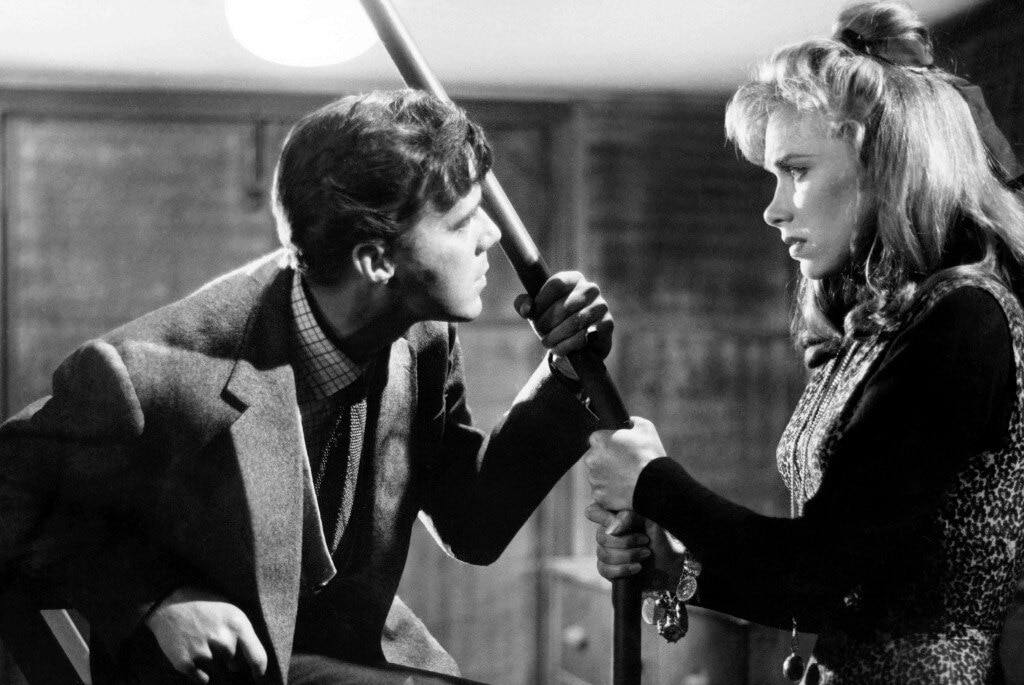
Dirk Bogarde plays a doctor, Longman, out to prove that his colleague, who had been conducting sensory deprivation experiments on himself before committing suicide, was not a willing Communist double agent. Longman begins sensory deprivation chamber sessions to show it can be used to make one susceptible to brainwashing. To determine if the technique can convince someone to act against his deepest personal feelings, he designs his experiments to allow others to convince him he hates his wife.
The picture was a critical and commercial failure on its UK release but fared better in the U.S., at least with reviewers. Variety said, "Under Basil Dearden's firm direction, the cast absorbingly captures suspense and gruesome space age qualities frequently generated by [the] script." Later reviews have also been more favorable. TV Guide called it "a strange movie that leaves a deeper impression than one might expect due to the originality of the plot and the tense direction."
Those praiseworthy elements can be attributed to writer James Kennaway and to Dearden, one of postwar Britain's busiest and most successful directors. Kennaway received Academy Award and BAFTA nominations for his screen adaptation of his own novel, the Alec Guinness military drama Tunes of Glory (1960). His original screenplay for The Mind Benders was published as a novel shortly after the film's release under the title The Mindbenders.
Dearden had been writing, producing, and directing since the late 1930s and came to this picture after notable work on several films, including he classic horror anthology Dead of Night (1945); Sapphire (1959), a drama about racial unrest that won him and leading lady Yvonne Mitchell BAFTA Awards nominations (Dearden won for Best British Film); and Victim (1961), a landmark drama about the blackmailing of a closeted gay man (Bogarde). Dearden's biggest international success was the period war epic Khartoum (1966), starring Charlton Heston and Laurence Olivier.
Bogarde was certainly having a good year in 1963. The actor was eager to move beyond the screen idol status he had achieved at Rank studios, particularly in his role as dreamy Dr. Simon Sparrow in five popular comedies. He appeared in the last of these, Doctor in Distress (1963) a few months after The Mind Benders was released, but his other films this same year took him further toward expanding his range: opposite Judy Garland in the musical drama I Could Go on Singing (1963) and in his chilling performance as the manipulative title character in The Servant (1963), with James Fox, brother of Edward Fox, who made his film debut in The Mind Benders.
The music for this film was written by Georges Auric, a well-known composer (and friend to Eric Satie and Jean Cocteau) before he turned his talents to the cinema. His first film score was for René Clair's À Nous la Liberté (1931) followed by Cocteau's The Blood of a Poet (1932). He created music for British films (Dead of Night, 1945; The Lavender Hill Mob, 1951) and the occasional Hollywood production (Roman Holiday, 1953; Heaven Knows, Mr. Allison, 1957) while continuing to work in his native France for some of the world's great directors, including Max Ophuls (Lola Montes, 1955), Henri-Georges Clouzot (The Wages of Fear, 1953), and most of Cocteau's major films.
The credits for this film say the story "was suggested by experiments on 'THE REDUCTION OF SENSATION' recently carried out by certain Universities in the United States."
Fans of arcane pop music trivia will enjoy noting that the title of the movie inspired the name of the band Wayne Fontana and the Mindbenders, best known for their #1 hit of 1965 "The Game of Love."
Director: Basil Dearden
Producer: Michael Relph
Screenplay: James Kennaway
Cinematography: Denys Coop
Editing: John D. Guthridge
Art Direction: James Morahan
Music: Georges Auric
Cast: Dirk Bogarde (Dr. Henry Longman), Mary Ure (Oonagh Longman), John Clements (Major Hall), Michael Bryant (Dr. Danny Tate), Wendy Craig (Annabella)
By Rob Nixon
The Mind Benders
by Rob Nixon | March 30, 2017
SIGN UP FOR OUR NEWSLETTERS

CONNECT WITH TCM