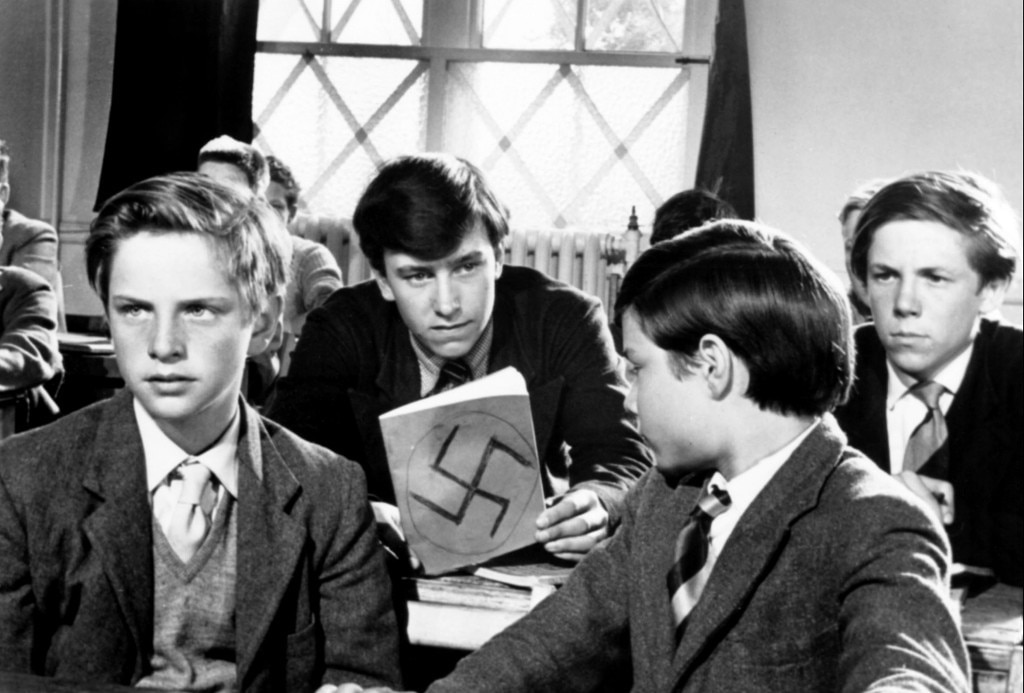
Often compared to The Lord of the Flies in its themes and story-telling power, the rarely seen Reach for Glory (1962) is a British film drama based on John Rae's 1961 novel The Custard Boys, another story of teenage English boys who regress to a tribal mentality with harrowing results. In this case the youngsters have been evacuated for safety from World War II London to a town on the Suffolk coast. Hoping that the war won't end before they are old enough to fight, they join their school's Army Cadet Force and engage in fierce war games with local teenagers.
One of the boys, John Curlew (Martin Tomlinson), is torn between his commitment to the games and his deepening friendship with a young Austrian Jewish refugee, Mark Stein (Oliver Grimm). John is also uncertain about what the reaction might be if the other boys learn that his older brother is not in the armed forces, but is living in London as a conscientious objector.
There are suggestions of a homoerotic undercurrent in the relationship between John and Mark. At first rejected by the others because of his gentle ways and "Germanic" heritage, Mark is finally accepted into the homemade "army" but runs away during a fight over ownership of an antique war medal. Labeling Mark a coward and a "sissy," the others arrange a "court martial" and plan a fake execution that goes tragically awry. A reviewer for Variety wrote that "themes of racism, war hate and its effect on youth, conscientious objection and the consequences of parental weakness on youth are all touched upon."
Reach for Glory was Martin Tomlinson's only screen credit. Oliver Grimm had been a popular child star in Germany before being cast as Mark, and his career continued on and off through 2000. Also prominent in the cast are Harry Andrews and Kay Walsh as John's parents and Michael Anderson as Lewis Craig, the bullying leader of the gang. This was the final film credit for prolific British character actor Allan Jeayes, who plays the role of Crabtree. Reach for Glory won a United Nations Award for "excellence in public service."
The film is directed by Philip Leacock (1917-1990), who began his career in his native England as a director of documentaries before switching to fiction films. In the late 1950s he moved to the U.S., where he continued making feature films before turning to television. As evidenced by Reach for Glory, Leacock had a gift for working with child actors - a talent also displayed in such films as The Kidnappers (1953, known in the U.S. as The Little Kidnappers), which brought honorary juvenile acting Oscars to two of its performers, Jon Whiteley and Vincent Winter; and The Spanish Garden (1956), starring Dirk Bogarde. Leacock once again showed his skill with youngsters by directing segments of the American TV series Eight Is Enough (1977-81).
John Rae (1931-2006), the British author of the novel, was an educator as well as a writer, serving as headmaster of Taunton and Westminster Schools. Rae makes a cameo appearance in Reach for Glory. The Custard Boys was adapted into another film in 1979, this time retaining the novel's original title, with screenplay and direction by Colin Finbow.
By Roger Fristoe
Reach for Glory
by Roger Fristoe | March 22, 2017
SIGN UP FOR OUR NEWSLETTERS

CONNECT WITH TCM