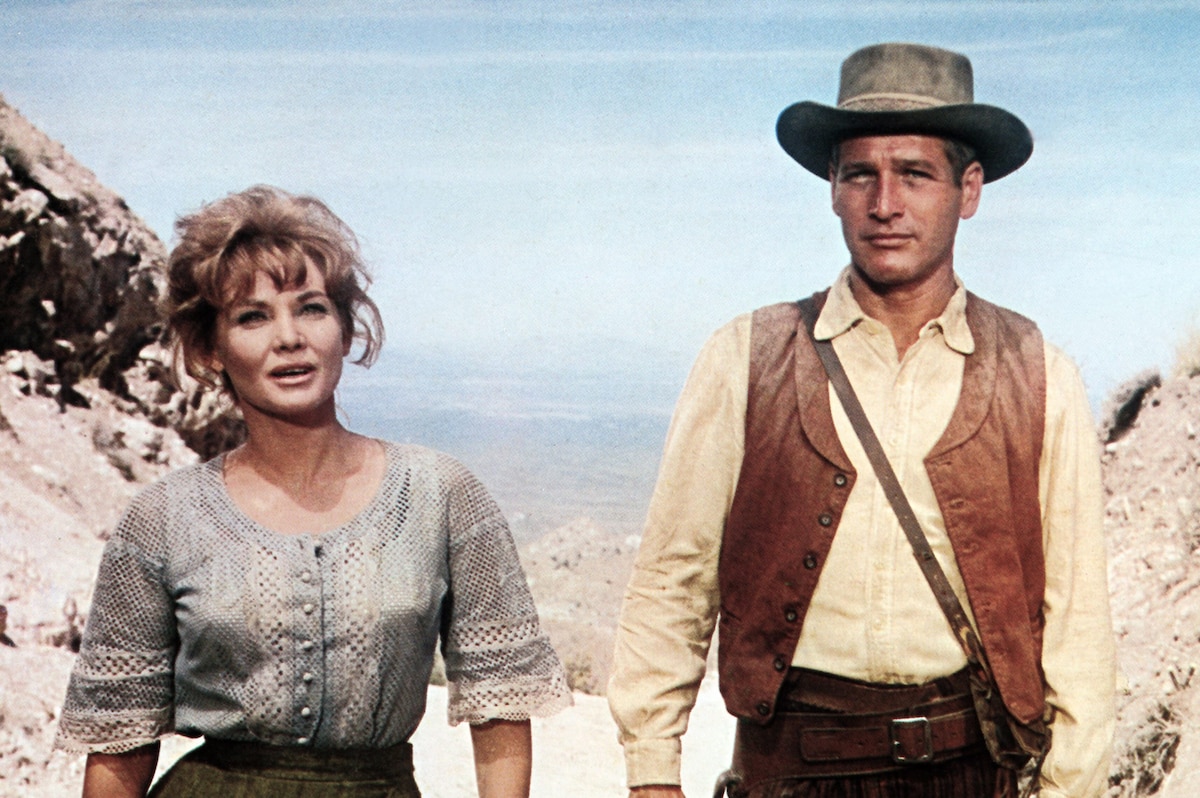
Paul Newman plays the eponymous main character of Hombre, a taciturn white man who was raised by Apaches and far prefers the Native American community to a dominant culture he sees as coddled, cowardly and cruel. As usual, Newman gives a solid and subtle performance, but equally important to the success of the 1967 Western is the crisp, no-nonsense artistry of director Martin Ritt, who also co-produced the picture. A hallmark of Hombre is the keen social conscience found in all of Ritt's best films and in many of Newman's best pictures as well.
When we first meet John Russell, as the hero is called by white acquaintances, he's a rough-and-tumble Arizona horse dealer with long Apache-style hair and a ruddy complexion that could belong to either a natural-born Indian or a white person who lives and works outdoors in all seasons, as he does. Although the exact year of the story isn't specified, it's a time when the Old West is entering the modern age building the railroads that are squeezing stagecoach lines out of business. This poses new challenges for people like Russell who catch and train horses for a living.
In a stroke of bittersweet luck, Russell's father dies, and even though the old man hardly knew his son, he has left Russell the boarding house he owned in town. Russell promptly decides to sell the place for a herd of horses, which means caretaker Jessie Brown (Diane Cilento) and her handful of tenants will have to move. Before long, Russell is traveling to a new destination on the same stagecoach as Jessie, along with a squabbling young couple named Billy (Peter Lazer) and Doris (Margaret Blye), who lived in the rooming house, and haughty government official Alexander Favor (Fredric March) and Audra Favor (Barbara Rush), his equally snobbish wife. Also on board is mean-spirited Cicero Grimes (Richard Boone), who practically wears a sign announcing that he means nobody any good. Sure enough, much of the film centers on a lengthy standoff between the decent characters and Grimes's gang, which includes Jessie's boyfriend, Frank Braden (Cameron Mitchell), a sheriff who has turned to the dark side.
Ritt is often omitted from lists of great Hollywood auteurs, but his long directorial career - which started in 1950s television and continued until shortly before his death in 1990 - produced a number of minor classics, such as the labor-union drama Norma Rae (1979), which reoriented Sally Field's career in a new and serious direction, and the anti-racist boxing drama The Great White Hope (1970), which earned James Earl Jones his only Academy Award nomination. He directed Newman in no fewer than five movies, starting with The Long, Hot Summer in 1958, and critic Roger Ebert described him as "the key director in Paul Newman's career, shaping the way we and other directors were to see him." Ritt and Newman also shared a steady concern with social issues, such as the racial and class prejudices that simmer just below the suspenseful surface of Hombre.
Adapted by Harriet Frank, Jr. and co-producer Irving Ravetch from Elmore Leonard's 1961 novel of the same name, Hombre was photographed by James Wong Howe, a highly gifted cinematographer who had the same attitude as Ritt when it came to expressing a personal vision in Hollywood movies. They both regarded filmmaking as a thoroughly cooperative enterprise in which all creative contributions feed into the finished product. The landscapes in Hombre are distinctive and memorable - rough, forbidding, exotic, beautiful, and sometimes all those things at once - but their impact can't be traced exclusively to Ritt or Howe, or to the location scouts or Mother Nature, for that matter. Like the best qualities in all good movies, everything from the story outline to the mountainsides owes its effect to the genius of the Hollywood system that gives it dramatic power on the screen.
Hombre has a topnotch cast, weakened only by the shortage of three-dimensional roles for Native Americans and Mexicans in a story that directly engages with those ethnicities. The film partly compensates for this lapse by way of Cilento's forceful performance, making Jessie the kind of strong, independent-minded woman too rarely found in Hollywood westerns. The other women of the story have less going for them - young Doris is relatively vulnerable, and pretentious while Audra is basically an empty shell - but Jessie is straightforward and refreshing whenever she appears.
The same goes for Newman, who creates a fully rounded character without a speck of heroic posturing or excess dialogue, making it clear and understandable why a person in Russell's position would violently defend an innocent Indian against a white bigot but not necessarily intercede in a quarrel between two mismatched white men. Boone makes a very scary villain, even though his long run as the good guy on TV's excellent Have Gun - Will Travel was only a few years behind him, and March ably conveys the shiftiness of the government agent with a secret. Among the other supporting players, Martin Balsam is warm but unsentimental as an old Mexican friend advising Russell to settle down in the white community, and Cameron Mitchell gives a quietly impressive performance as the sheriff who goes bad.
Hombre has been compared to John Ford's legendary Stagecoach (1939), and the comparison makes sense, partly because the films obviously involve stagecoaches and partly because they're both road movies where diverse characters are forced into confined situations that bring out the best and worst aspects of their personalities. Stagecoach is a greater achievement, but Hombre is a worthwhile runner-up, giving Newman and Ritt a smart and meaningful showcase when they were at the top of their game.
Director: Martin Ritt
Producers: Martin Ritt and Irving Ravetch
Screenplay: Irving Ravetch and Harriet Frank, Jr.; from the novel by Elmore Leonard
Cinematographer: James Wong Howe
Film Editing: Frank Bracht
Art Direction: Jack Martin Smith, Robert E. Smith
Music: David Rose
With: Paul Newman (John Russell), Fredric March (Favor), Richard Boone (Grimes), Diane Cilento (Jessie), Cameron Mitchell (Braden), Barbara Rush (Audra Favor), Peter Lazer (Billy Lee), Margaret Blye (Doris), Martin Balsam (Mendez), Skip Ward (Steve Early), Frank Silvera (Mexican Bandit), David Canary (Lamar Dean), Val Avery (Delgado), Larry Ward (Soldier)
Color-111m.
by David Sterritt
Hombre
by David Sterritt | February 15, 2017
SIGN UP FOR OUR NEWSLETTERS

CONNECT WITH TCM