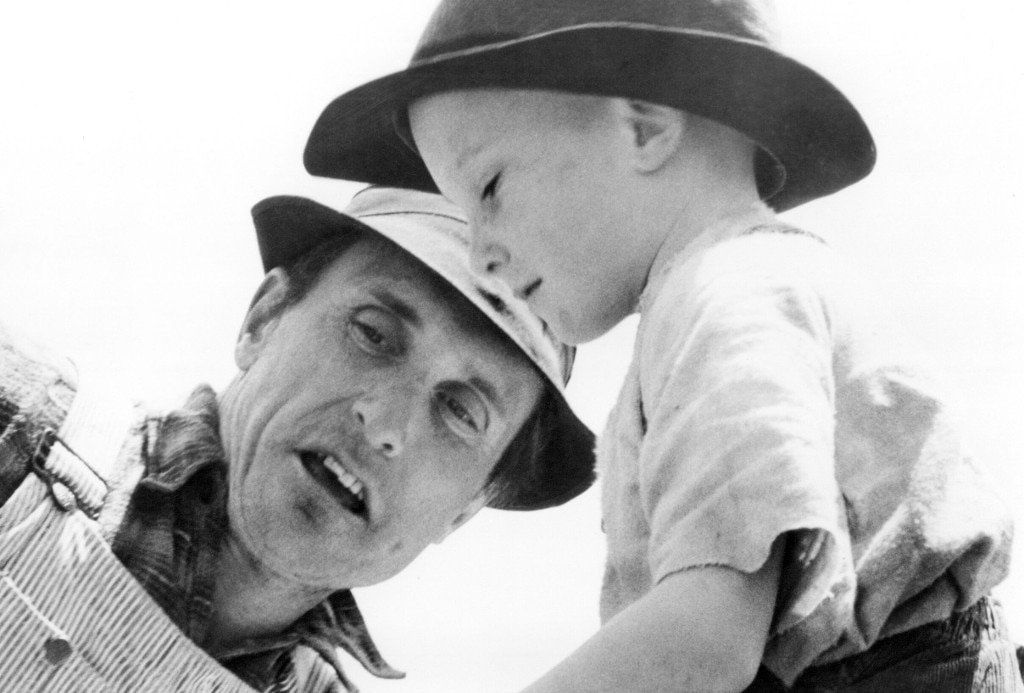
Playwright Horton Foote got his foot in the door of early television drama with his play The Trip to Bountiful. He was soon writing more original scripts for TV and film, and adapting the work by other authors such as Harper Lee (To Kill a Mockingbird, 1962) and John Steinbeck (Of Mice and Men, 1992). Foote first adapted William Faulkner's story 'Tomorrow' in 1960 for TV's Playhouse 90, a much-praised broadcast directed by Robert Mulligan and starring Richard Boone, Kim Stanley and Charles Bickford. Stage director and actor Joseph Anthony had directed big, stellar Hollywood adaptations of the plays The Rainmaker (1956) and The Matchmaker (1958), but his feature film adaptation of Tomorrow (1972) is a tiny independent production, filmed in B&W. Remaining true to Faulkner's story, the poor, soft-spoken sharecropper Jackson Fentry (Robert Duvall), takes in Sarah (Olga Bellin), a sickly pregnant woman abandoned by her husband and her kinfolk. Fentry raises the son as his own, but is frustrated when the law gives the boy back to the very relatives that treated his mother so badly. The story is framed by a flashback from a trial; where an attorney (Peter Masterson) marvels at Fentry's loving dedication in the face of such hardship and heartbreak. Although criticized for a slow pace, Tomorrow was praised as capturing the complexity and humanity in William Faulkner's story. Robert Duvall is impressive as the quiet man whose feelings run deep. Fentry's commitment to Sarah and her boy is as moving as a story from the Bible. Stage actress Olga Bellin made a number of dramatic appearances on television but this was her only feature film. Sudie Bond is the wise midwife, who unhappily describes Sarah as 'played out' after giving birth. As expected, the slow and sad subject matter was not a plus in the commercial market. Duvall's Fentry remains a stoic presence almost to the end. Time magazine criticized the B&W photography as gray and dull compared to Peter Bogdanovich's The Last Picture Show of the previous year. But Variety's praise was unequivocal: "This one does credit to the film medium." Horton Foote had first worked with Robert Duvall on Lillian Hellman & Arthur Penn's The Chase (1966); they would collaborate again, most successfully on Tender Mercies (1983).
By Glenn Erickson
Tomorrow
by Glenn Erickson | January 05, 2017
SIGN UP FOR OUR NEWSLETTERS

CONNECT WITH TCM