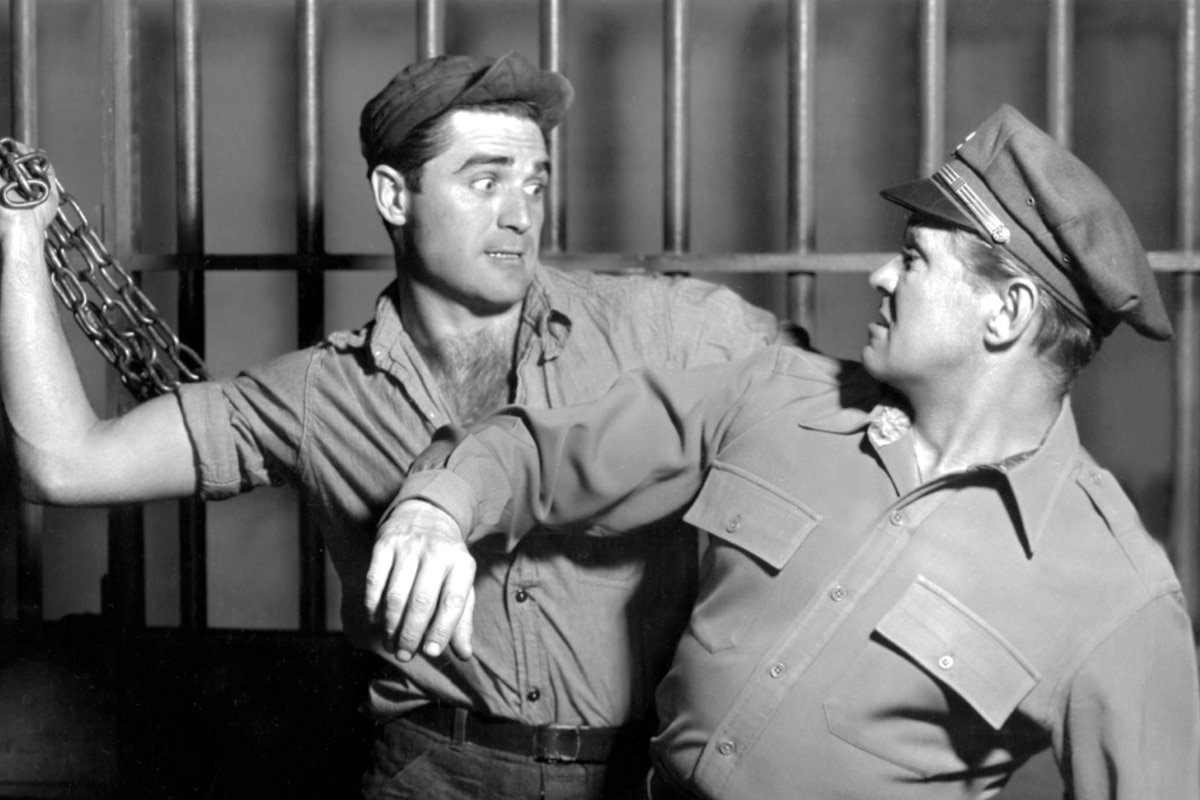
The most critically admired '50s prison picture is Don Siegel's 1954 Riot in Cell Block 11, that alters the old Law 'n' Order formula by asserting that prison problems are systematic, not the isolated actions of bad convicts or villainous guards. Perhaps initiated to give Warner Bros.' tough-guy contract players Steve Cochran and David Brian a solid action story, Inside the Walls of Folsom Prison (1951) avoids present-day issues by telling a story of prison reform from the 1920s. Sadistic warden Ben Rickey (Ted de Corsia of The Naked City, 1948) and his brutal guards have made Folsom into a hellhole. Rickey allows his new reform-minded assistant Mark Benson (David Brian) to institute more humane policies, but conspires to undermine the effort, so he can go back to beating and abusing the prisoners. A cooperative prisoner (Philip Carey) informs on an escapee to save lives, but Rickey refuses to protect him from the wrath of his fellow inmates. When the man is murdered, Rickey uses the incident to rescind all of Benson's reforms. Hard-boiled prisoner Chuck Daniels (Steve Cochran) then leads an all-out prison riot.
By placing its story in the past, the show pretends that all the problems in the story have been solved, and thus does not carry on the Warner Bros. tradition of social exposé. But as an effective prison picture Inside the Walls of Folsom Prison is one of the best, thanks to sharp work by writer-director Crane Wilbur, the writer of the powerful He Walked by Night (1948) and The Phenix City Story (1955). Steve Cochran, David Brian and Ted de Corsia are the Alpha Male bruisers in the show, but Philip Carey, Dick Wesson, Paul Picerni and William Campbell make for a dynamic group of desperate prisoners. Wilbur's screenplay also manages to slip in roles for actresses Dorothy Hart and Mari Aldon, without resorting to strained gimmicks, like the flashbacks that were used in Jules Dassin's Brute Force (1947). But Wilbur's film ends almost as bleakly for the prisoners, in an explosive finale. Inside the Walls of Folsom Prison was filmed on location, and the iron doors and stone walls of the California fortress indeed look formidable. Working among the inmate population, the actors were told not to fraternize with prisoners, but talked with them anyway. It took an hour each day for the film people to get through security, which prompted the production manager to suggest that the actors wear tunics with special numbers, so the guards could pass them through the gate without delay. The warden blocked that notion with good common sense: some actor would surely get hit over the head, and the shirt taken right off his back.
By Glenn Erickson
Inside the Walls of Folsom Prison
by Glenn Erickson | December 14, 2016
SIGN UP FOR OUR NEWSLETTERS

CONNECT WITH TCM