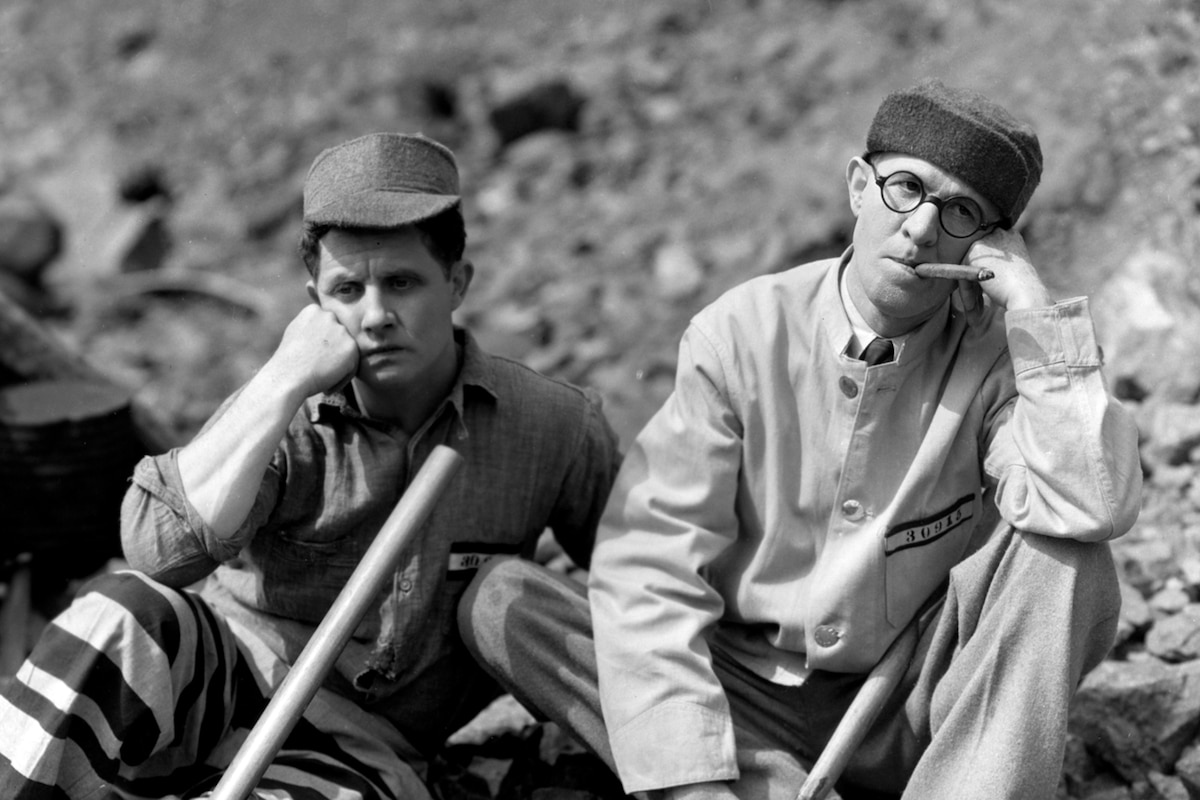
Remember Robert Aldrich's rough 'n' vulgar prison football comedy The Longest Yard (1974), with Burt Reynolds? Just to prove that nothing is new under the sun, it's quite a bit like Wheeler and Woolsey's early talkie Hold 'Em Jail (1932), a wild comedy about a prison where football is more important than anything, including the law. Four screenwriters labored on the script and more writers contributed jokes for the radio stars Bert Wheeler and Robert Woolsey's foray into football comedy, a genre much in favor in the Great Depression. The silly story sees joke shop salesmen Curly Harris (Wheeler) and Spider Robbins (Woolsey) fooled by crooks that swap their joke guns for real hardware. A conviction for robbery lands them a stretch in Bidemore State Penitentiary. Working as blacksmiths, they accidentally aid in an escape but owing to the screwball logic of the prison, are unaccountably rewarded with jobs as trustees. Bidemore's warden Elmer Jones (slow-burn comic Edgar Kennedy) is hard pressed to find good footballers to oppose Lynwood Penitentiary on the gridiron, especially when his best players are receiving inconvenient pardons. Curly and Spider help out while romancing Elmer's daughter Barbara (a sixteen-year-old Betty Grable) and his sister Violet (venerable Edna May Oliver). The film's second half is a desperate football game that provides a steady stream of slapstick gags. Our boys use chloroform to render the opposing team unconscious. Helping out with the lowbrow laughs is the stuttering comedian Roscoe Ates; the joke is that he's the game's signal caller. Director Norman Taurog had just graduated from comedy shorts but proved adept in various genres; he worked on films for W.C. Fields and Eddie Cantor and scored in prestigious shows for MGM, among them Boys Town (1938), Young Tom Edison (1940) and Words and Music (1948).
By Glenn Erickson
Hold 'Em Jail
by Glenn Erickson | December 14, 2016
SIGN UP FOR OUR NEWSLETTERS

CONNECT WITH TCM