Hong Kong director Wong Kar-wai had been making movies for over a decade by the time of In the Mood for Love (2000), the one that truly put him on the map as a top international filmmaker. The acclaim for this movie was widespread and ecstatic, and it is still regularly cited by critics as one of the best films of the twenty-first century so far.
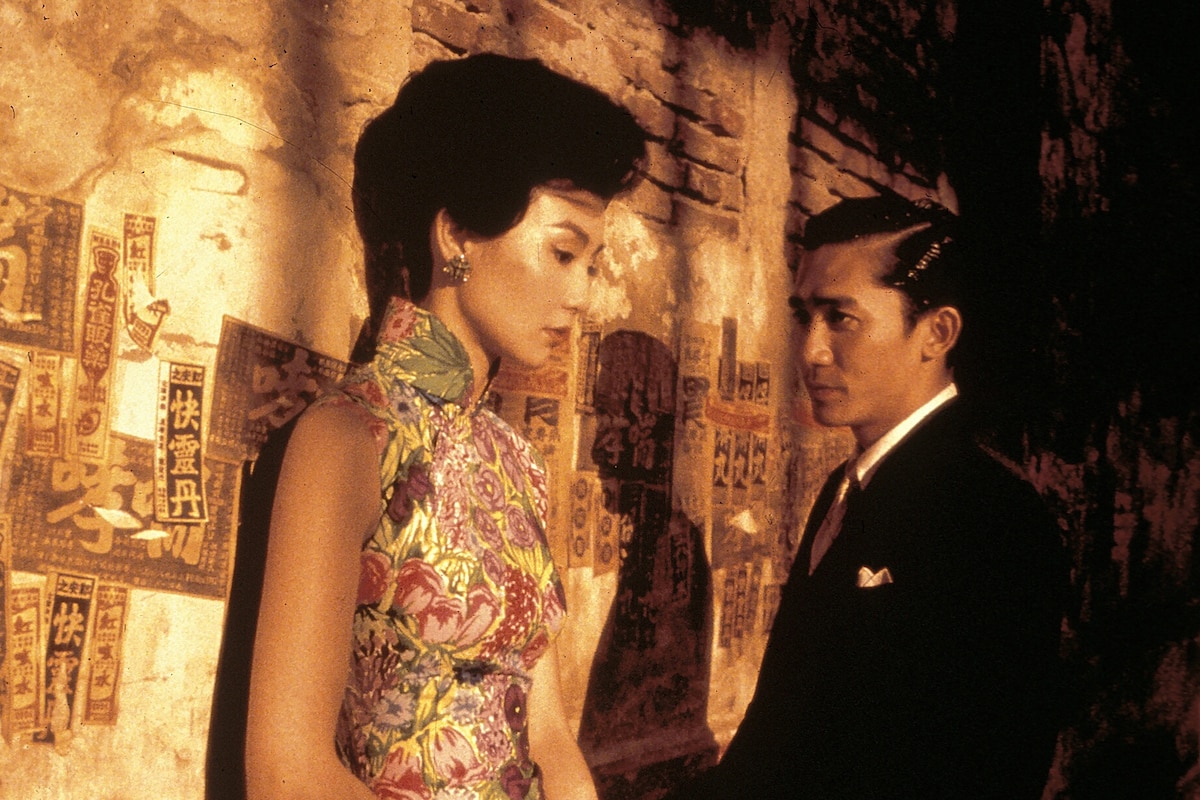
Set over a few years beginning in 1962 in Hong Kong's Shanghai community, In the Mood for Love centers on a journalist (Tony Leung) and a secretary (Maggie Cheung) who live next door to each other in an apartment building. They are each married, and as they come to realize that their spouses are having an affair with each other, they start to fall in love themselves. Consummation, however, is another matter, as their morality keeps them from sharing a bed. But they both deeply want to, and the movie thus becomes a tale of longing, loneliness and desire, with its eroticism heightened by lush visuals; color, sets, décor, costumes and make-up all take center stage to convey the emotional substance of the film itself. Wong Kar-wai actually shot a sex scene, but he did not include it in the final cut--a decision perfectly in keeping with the mood of the story.
The director made In the Mood for Love as an unofficial sequel to his 1990 picture Days of Being Wild, in which Maggie Cheung plays a character with the same name, but the plot sprang from a four-page Japanese story written in the 1960s. This was given to the actors in lieu of a script; every day, they would receive scenes with dialogue to be shot later that day, and they were encouraged to improvise.
''Sometimes we would shoot the same scenes with the dialogue between myself and Tony reversed,'' Maggie Cheung told a reporter. ''Or we would film the same dialogue but on a different set." The painstaking methods, coupled with an Asian financial crisis that interrupted the flow of money to the production, meant that In the Mood for Love took fifteen months to shoot.
The schedule overrun forced cinematographer Christopher Doyle to depart mid-production; he was replaced by Mark Lee Ping-bin. The film shot almost entirely in Bangkok, with just a couple of actual Hong Kong locations. Hong Kong's rapid urban transformations meant that in 2000 very little of it even remotely resembled the Hong Kong of 1962. An epilogue was also filmed at the magnificent Angkor Wat temple complex in Cambodia.
Maggie Cheung required four hours of makeup and costuming each morning; she wears a different Chinese dress, or cheongsam, in each scene, with fabrics that purposefully complement or clash with the décor around her. Art director and film editor William Chang Suk-Pin said that The Umbrellas of Cherbourg (1964) was a big influence in terms of design. "The colors I am using," he said, "are very vivid, to contrast with the characters' restrained emotions. These contradictions are also in the lines they speak. Everything that Maggie and Tony say to each other can also mean its opposite. Are they rehearsing their love, or is it real? It's quite complex.
''We're always seeing them through doors, windows, or corridors,'' he added. ''There's no direct contact with the characters. We're looking at things from afar. It gives you space to think and feel rather than just identifying with the actors.''
Wong Kar-wai echoed this point when he later said, ''I sometimes treat space as a main character in my films. Chungking Express (1994) is about a Hong Kong street corner. The same with In the Mood for Love. I had to know the apartments and the streets intimately. They are the silent witness to the whole story.''
The New York Times deemed In the Mood for Love "a sweet kiss blown to a time long since over, a time that may have existed only in the movies, with ballads recorded in mono while hand-sewn clothing lay perfectly over the bodies of the stars... Wong Kar-wai is one of that gifted new breed of moviemakers who think through the lens, and he uses that talent to give the film a heated, rapturous quality; the camera floats along, sneaking a look at the performers out of the corner of its eye. Narrative has rarely been a motivating factor for him; instead his heart spills out onto the screen."
By Jeremy Arnold
In the Mood for Love
by Jeremy Arnold | December 13, 2016
SIGN UP FOR OUR NEWSLETTERS

CONNECT WITH TCM