It was said of Marilyn Miller, subject of the fictional Warner Bros. musical biography Look for the Silver Lining (1949), that there were better singers, better dancers and better actresses - but that no one else of her era combined those abilities in so captivating a manner. Miller (1898-1936) was born Mary Ellen Reynolds in Evansville, IN. and was performing with her family in a variety act called the Five Columbians by the time she was four. As an adult she became a star in the Follies of Florenz Ziegfeld, alongside Eddie Cantor, Will Rogers and W.C. Fields. For a time, she was the highest-paid star on Broadway singing her classic Jerome Kern numbers, "Sunny," "Who?" and "Look for the Silver Lining." She appeared in only three movies, which failed to match her huge onstage successes, and refused a recording contract because she felt singing alone could not capture her appeal.
Miller generally played Cinderella-type characters that sprang from rags to riches to find lasting happiness - an image in contrast to a private life marked by tragedy, divorce and illness. Her first husband, Frank Carter, was killed in a car crash a year after their marriage; her second, Jack Pickford (brother of film star Mary), was an alleged drug and alcohol abuser divorced by Miller after five years of marriage; and her third, Chester Lee O'Brien, was a chorus boy several years Miller's junior who would later become an actor on Sesame Street. Plagued by sinus problems for years, Miller died at age 37 after complications following surgery on her nasal passages.
Miller's charm and vivacity were legend and had an influence on stars of later generations. In MGM's all-star musical bio of Jerome Kern, Till the Clouds Roll By (1946), Judy Garland appeared as Miller and sang "Sunny," "Who?" and "Look for the Silver Lining." Marilyn Monroe allegedly was named after Miller by talent scout Ben Lyon. (After her marriage to playwright Arthur Miller, Monroe for a time actually became Marilyn Miller!) An Emmy-winning television biopic, Ziegfeld: The Man and His Women (1978), featured Pamela Peadon as Miller, who was rumored to have been Ziegfeld's mistress.
In preparing their musical based on Miller's life, Warner Bros. considered casting the star part with Joan Leslie, Ann Miller or Vera-Ellen (reported by Louella Parsons to be "heartbroken" when she lost the role). There were also rumors that Rita Hayworth might be borrowed from her home studio, Columbia Pictures. But in 1947 Parsons announced that the part would be played by June Haver, a musical-comedy performer who had been groomed by 20th Century-Fox for stardom in the style of Alice Faye and Betty Grable. Her similarity in performance to the latter star was such that the 5'2" Haver was sometimes referred to by studio co-workers as the "Pocket Grable."
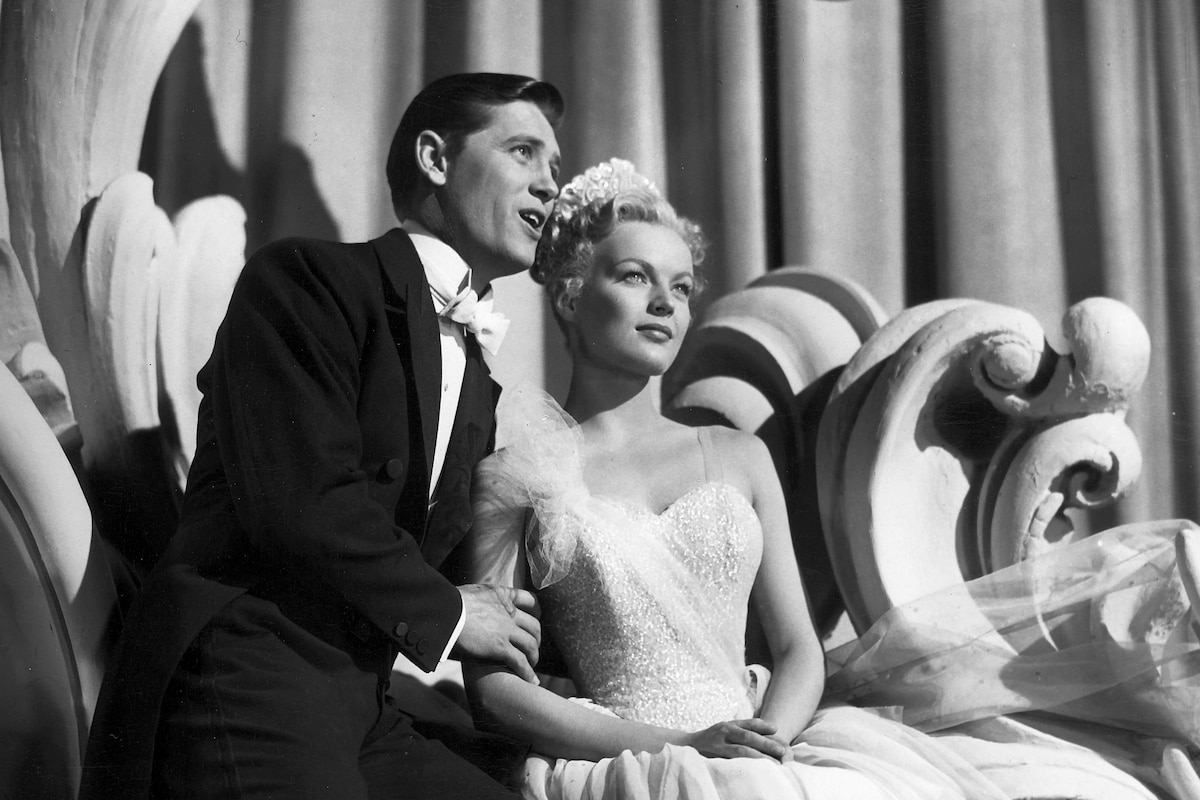
Haver (1926-2005) began performing as a child and by her teens was working as a band singer. She was first signed by Fox in 1943 and eventually starred in some half-dozen musicals for that studio including The Dolly Sisters (1945), in which she appeared alongside Grable. But her two most memorable roles came through Warner Bros., both costarring Gordon MacRae: The Daughter of Rosie O'Grady (1950) and Look for the Silver Lining. The latter film was generally considered her best movie showcase, and it also provided an entertaining workout for costar Ray Bolger as dancer Jack Donahue, Miller's real-life mentor and performing partner.
The screenplay for Look for the Silver Lining , written by Phoebe and Henry Ephron (parents of Nora Ephron) and Marian Spitzer, is a somewhat sketchy and sanitized version of Miller's life. The film's story begins around 1913 as Marilyn's father (Charles Ruggles), mother (Rosemary DeCamp) and sisters (the twins Lee and Lyn Wilde) are performing in the family vaudeville act. They aren't eager for little Marilyn to join them, but when all four are quarantined by measles, Donahue invites Marilyn onstage during his act and gives her a chance to prove her talent in a tap-dancing routine.
After Marilyn becomes a stage star, she falls in love with another costar, Frank Carter (MacRae, given his first chance in films to show off that rich baritone). After he serves in the Army during World War I, they are married. When Frank fails to show up after one of her opening-night performances, she learns that was he killed in an automobile accident while on his way to join her. Although it's clear that Marilyn adores the Bolger character, they are not romantically involved. Her other love affairs and marriages are not dealt with; nor is her considerable reputation as a high-living party girl. The movie ends before Miller's untimely death, and the only indication of her health problem is a scene in which she feels a dizziness that the script indicates may have been caused by overwork.
Haver, who dances en pointe in a ballet number, delivers sprightly performances of "Sunny" and the title song. Her version of Kern's "Wild Rose," a highlight of the real Miller's film career in Sally (1929), is staged as a major production number in which Haver is backed by a male chorus. Haver shares a love duet, Vincent Youman's "Time on My Hands," with MacRae, and dances as he delivers Victor Herbert's "A Kiss in the Dark."
"Who?" becomes Bolger's most important solo number, the one that best shows off his comic, eccentric dance style. At one point he spills sand onto a drum-like platform to add sound effects to his tap dancing - a device also used by Fred Astaire in Top Hat (1935) and The Belle of New York (1952). Bolger also cavorts delightfully to Walter Donaldson's "Carolina in the Morning." S.Z. Sakall is on hand with some of his patented blustering comedy, and Will Rogers, Jr. has an uncredited walk-on as Will Sr.
Haver- petite, blonde and pretty like Miller- reportedly spent an extra hour each morning in special makeup sessions that heightened the resemblance. Despite her best efforts, some of her reviews of the day were harsh, including the comment by The New York Times' Bosley Crowther that "she does show a certain modest grace, but it would never be mistaken for the brilliance of the lady she's supposed to be." (Comparing film clips today, Haver seems to measure up not only to Miller but to Grable and Faye - if not to the incomparable Judy Garland.) Crowther did offer praise to Ray Bolger, pointing out the "beautiful speed and style" of his dancing and noting that, "If anyone could capture the dexterity and warmth of Jack Donahue, that person is Mr. Bolger."
Look for the Silver Lining was directed by David Butler, who also guided Haver through The Daughter of Rosie O'Grady and would later direct several Doris Day musicals including the 1953 standout Calamity Jane. Look for the Silver Lining was given an elaborate production as designed by Art Director John Hughes, with sparkling Technicolor cinematography by Peverell Marley and expressive costumes by Travilla and Marjorie Best. An Oscar nomination went to Ray Heindorf for Best Scoring of a Musical Picture. (Roger Edens and Lennie Hayton won for On the Town.) At the box office, Look for the Silver Lining was a modest success.
Haver continued to make films through 1953, although never reaching the level of stardom of a Faye or Grable. That same year she decided to become a postulant nun with the Sisters of Charity in Leavenworth, Kansas. After several months, she left the convent, citing "poor health." The following year Haver took former costar Fred MacMurray as her second husband. The couple adopted twin daughters and remained married until MacMurray's death in 1991.
By Roger Fristoe
Look for the Silver Lining
by Roger Fristoe | December 07, 2016
SIGN UP FOR OUR NEWSLETTERS

CONNECT WITH TCM