John Dillinger has appeared many times as a film character, beginning with Lawrence Tierney's performance in Dillinger (1945) and continuing through the years with, among other actors, Nick Adams, Robert Conrad, Mark Harmon, Ralph Meeker and more recently Johnny Depp in Public Enemies (2009). The legendary outlaw's popularity is not surprising. Like Bonnie and Clyde, the notorious bank robber became a folk hero in the Depression, feared, reviled and ultimately lionized by the poorest segment of the population, those who felt victimized by the banks and financial interests who were Dillinger's targets. Like any legend, his exploits and life circumstances were often wildly exaggerated or just plain invented.
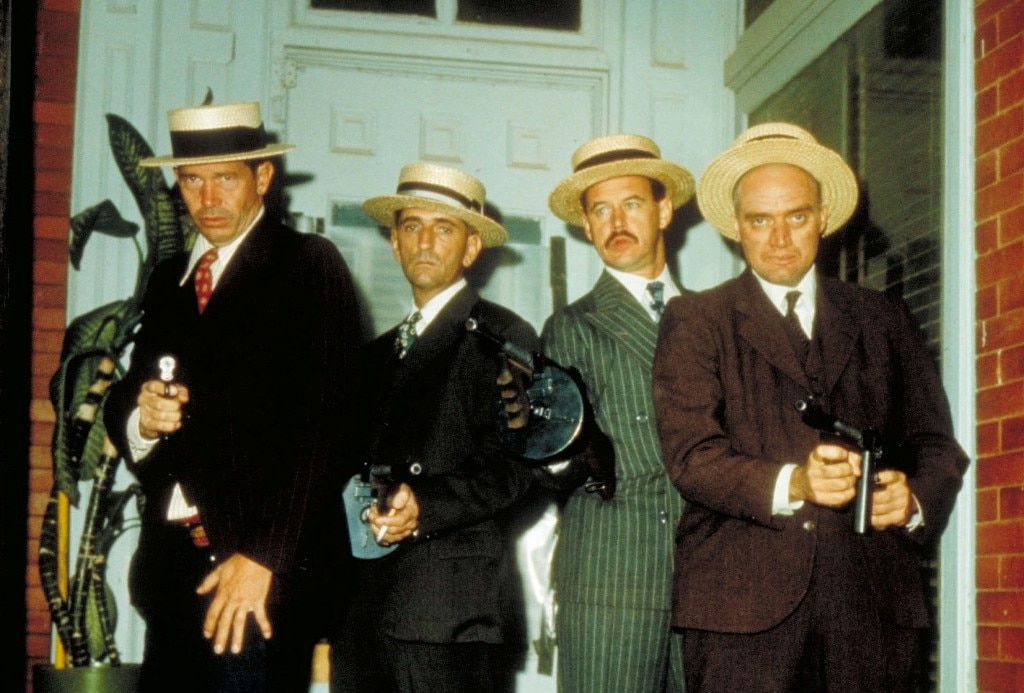
This 1973 take on the legend by John Milius takes various liberties with the facts. Characters and events are conflated, dates and locations altered and deaths attributed to other individuals. For instance, the depiction here of the famous April 1934 shootout between law enforcement and Dillinger's gang at Little Bohemia Lodge in rural Wisconsin implies four of Dillinger's men were killed and about ten federal agents were casualties. In fact, the first three people shot were bystanders - two Civilian Conservation Corps workers and a local man - with one FBI agent killed and another agent and a constable wounded. Also Ben Johnson, as Melvin Purvis, the agent who became almost as much of a legend as his famous prey (including Dillinger, Baby Face Nelson and Pretty Boy Floyd), was about twice the age of the real Purvis during the events depicted in this film. But as the line from The Man Who Shot Liberty Valance (1962) famously put it: "When the legend becomes fact, print the legend."
Writer-director Milius was certainly the right man to handle this tough, violent story. If behind-the-camera tales are to be believed, Milius always had specified in his contracts that he would be given a rare and expensive firearm in addition to his salary. As Roger Ebert noted in his review of Dillinger, the movie was clearly made "by a man with a thing for guns."
In the early 1970s, John Milius was a sought-after and highly paid screenwriter on such films as Jeremiah Johnson (1972), The Life and Times of Judge Roy Bean (1972) and an uncredited draft of Dirty Harry (1971), to which he said he contributed "a lot of guns, and the attitude of Dirty Harry being a cop who was ruthless." Milius was unhappy with how the films turned out and yearned to direct his own work. American International producer Samuel Z. Arkoff offered him the chance to direct this film if he would also write the screenplay for a fraction of his usual price. Milius jumped at the chance, noting that by making a movie about "the greatest criminal that ever lived," he was proudly fulfilling his father's prediction that he would end up in prison someday.
Milius also got to fulfill another goal: casting Warren Oates in a leading role. He wanted Oates for the title role of Roy Bean, but the studio opted for the far more bankable Paul Newman. "I write all my things for Warren Oates or young John Wayne types," he once said. It helped that Oates also bore a striking resemblance to the real-life Dillinger.
The timing was right, too. Bonnie and Clyde (1967) had set the tone and style of making myths out of the notorious criminals of the 1930s echoed in subsequent pictures like Bloody Mama (1970), about the murderous Ma Barker and her boys.
"I've made a myth out of him but not a romantic myth like Bonnie and Clyde. Dillinger is a tough guy; he's a Cagney. I'm not at all concerned with showing his early life or explaining how he got that way. What I'm interested in is the legend. That's what this movie is, that's exactly what it is. It's not a character study or a Freudian analysis; it's an American folk tale."
Despite Milius' intentions, echoes of the earlier film have been detected in Dillinger. Ebert pointed out the similarities between Bonnie and Clyde's first meeting with Frank Hamer and the scene in this film in which Dillinger takes his girlfriend to dinner in Chicago and is spotted from across the room by Purvis, who decides not to interrupt the evening and sends Dillinger a magnum of champagne and his card instead. Ebert also noted that "a visit to the farm of Dillinger's father never could have been filmed had Arthur Penn not directed his famous confrontation between Bonnie and her mother."
Cinematographer Jules Brenner also contradicted Milius' statement about avoiding romanticism, noting "the visual elements, the colors, compositions and photographic concept of the film was to further the idea of doing a 'romance' of a historical figure." He also noted that the character is "typical of a Milius hero; Dillinger was a larger than life individual who lived his life according to his own instinctive drive and carved out a full chapter in the annals of legend."
The film was shot primarily in Oklahoma, although there was reportedly footage, now considered lost, from Tucson, Arizona. The budget wasn't large, preventing Milius from doing crane shots or tracking shots longer than about six yards. As a result, looking back on it in 2003, he said, "I look at it today and I find it very crude, but I do find it immensely ambitious."
Director: John Milius
Producers: Samuel Z. Arkoff, Lawrence Gordon (executive producers), Buzz Feitshans (producer), Robert Papazian (Associate producer)
Screenplay: John Milius
Cinematography: Jules Brenner
Editing: Fred R. Feitshans, Jr.
Art Direction: Trevor Williams
Music: Barry DeVorzon
Cast: Warren Oates (John Dillinger), Ben Johnson (Melvin Purvis), Michelle Phillips (Billie Frechette), Cloris Leachman (Anna Sage), Harry Dean Stanton (Homer Van Meter), Richard Dreyfuss (Baby Face Nelson)
By Rob Nixon
Dillinger (1973)
by Rob Nixon | November 28, 2016
SIGN UP FOR OUR NEWSLETTERS

CONNECT WITH TCM