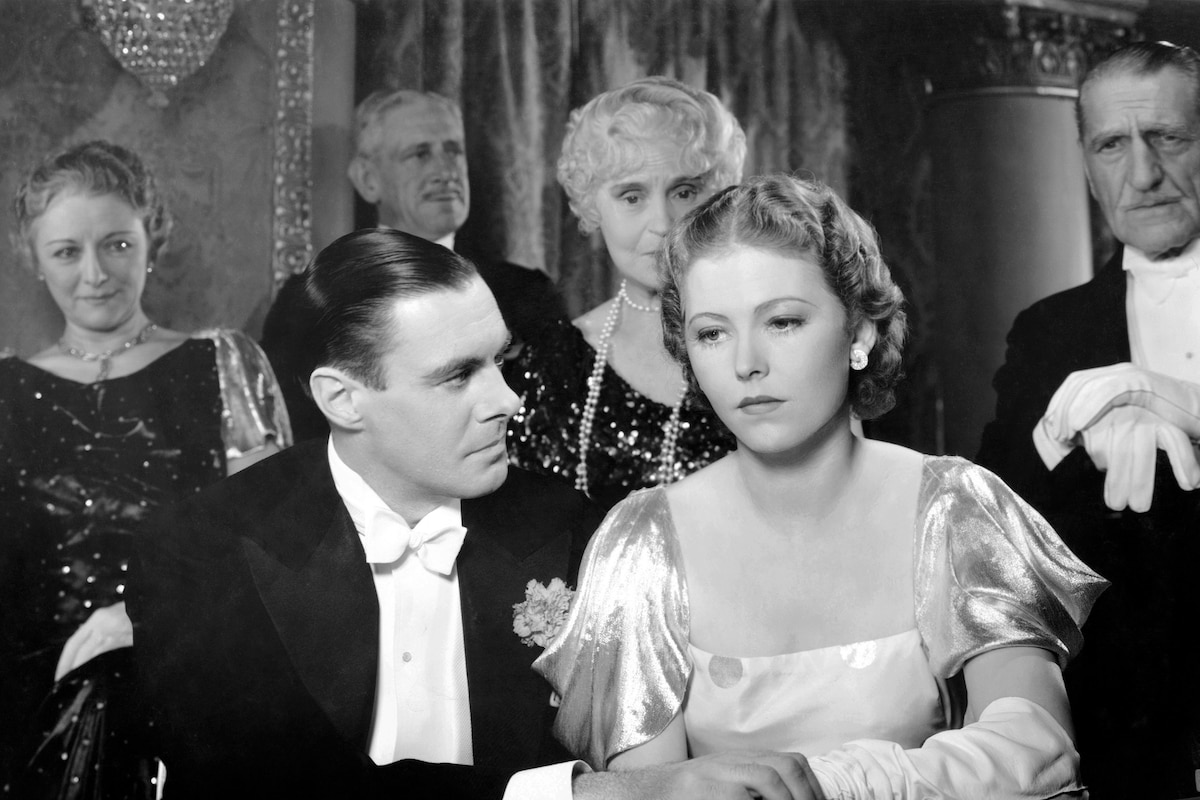
W. Somerset Maugham's books and plays have often attracted producers and stars looking for deep drama: 'Rain', 'The Letter,' 'Of Human Bondage,' 'The Painted Veil,' 'The Razor's Edge.' For a 1929 early talkie, Warner Bros. adapted The Sacred Flame, Maugham's sober play about a love triangle that ends in a mercy killing. Conrad Nagel plays a man paralyzed on his wedding day, and whose bride falls in love with his brother, creating a cruel romantic situation. Re-titled The Right to Live, the property was re-made in 1935 as a showcase for stage actress Josephine Hutchinson. She plays Stella Trent, the wife tied down to a bedridden husband. All-purpose male escort George Brent plays Colin, the brother who rushes back from his coffee plantation in Brazil when he hears the news and soon falls in love with the unhappy Stella. The plum role of Maurice, the wealthy English war hero who loses the use of his legs, was wisely given to Colin Clive, the angular actor who always seemed vaguely tortured, even when relaxed. When Maurice is discovered dead one morning, the balance of the story plays out as a grim whodunit of family secrets. Did Stella and Colin give Maurice an overdose, so they could run away to Brazil, as accuses the nurse (Peggy Wood)? Adjustments to make the 1935 remake palatable to the Production Code Office demonstrate how the Code warped and distorted serious works of drama. In the 1929 film Maurice's mother commits the killing to spare him the trauma of seeing his wife leave him with his own brother. The Code- approved remake adds a moral complication: instead of telling Maurice the truth about his paralysis, the family doctor chooses to lie to him with the false claim that an operation may restore his legs. Maurice's death is changed to a mere suicide, removing the entire subject of mercy killing. But the basic story premise should have seemed false even back then: despite the title's assertion that all life is sacred, all three versions subscribe to the idea that a paralyzed man who cannot perform as a normal husband, is better off dead. While stating that the movie is too tragic to be popular, Variety noted the film's moral whitewash of a play that was at least a little ambiguous about its sensitive subject matter. After the Maugham original was bowdlerized to please the church-oriented censors, Catholic critics downgraded the film anyway, with the idea that movie entertainment is unsuited to address troublesome issues. But it is no wonder that The Right to Live doesn't satisfy, for the problem of mercy killing remains a moral quicksand today, even more prickly than the Right to Die issue.
By Glenn Erickson
The Right to Live
by Glenn Erickson | November 23, 2016
SIGN UP FOR OUR NEWSLETTERS

CONNECT WITH TCM