NOTE: The version of Little Annie Rooney airing on TCM October 4, 2016 (as part of TCM Spotlight: Trailblazing Women--Actresses Who Made a Difference) is the world television premiere of a new 4K HD restoration with a new score by composer Andy Gladbach. Here are a few notes on the restoration:
The original tinted nitrate print in Mary Pickford's personal collection at the Library of Congress, made from the camera negative in 1925, was brought to the Academy of Motion Pictures Arts and Sciences archive in Los Angeles.
Through the Mary Pickford Foundation's extraordinary, multi-year partnership with AMPAS, the Academy Film Archive preserved the film photochemically, creating new 35mm preservation masters and prints.
The preservation master was then scanned at 4K high definition so that the MPF, in cooperation with AMPAS, could create a digital version, evaluating the film frame by frame, removing dirt and other signs of deterioration to perfectly match the original nitrate tints and tones.
Then, through the MPF Composition Program at Pepperdine University, an extremely gifted young composer, Andy Gladbach, was chosen to create a new sound track for the film. Mentored by professionals, Gladbach was joined by a 16 piece orchestra that included three percussionists, as well as a conductor and engineers, to record his original music.
For years Mary Pickford claimed the title of "America's Sweetheart" for her
embodiment of innocent charm and ebullient optimism. These qualities are
abundantly evident in Little Annie Rooney (1925), one of the
performances that defines her cinematic persona.
The genesis of the film began as Pickford was one night wandering through a
deserted urban set on a Hollywood backlot. She thought it might be
effective to play a rough-and-tumble Irish girl of the pavements. Seeking
further advice from someone with a distinctly Irish-American perspective,
she called silent comedienne Mabel Normand, who simply suggested, "I'd get
an Irish title...and write something to go with it."
In the titular role, Pickford is an inner-city ragamuffin who stirs up
trouble in the tenements during the day, while in the evening tending to
her father, a burly, firm-but-fair Irish cop (Walter James). The senior
Rooney keeps a watchful eye on Annie's brother Tim (Gordon Griffith), who
has fallen in with a band of streetcorner loafers teetering on the edge of
criminality. Annie harbors a not-so-secret crush on Tim's pal Joe (William
Haines), a handsome tough who seems destined to follow in the footsteps of
Spider (Hugh Fay), the neighborhood ex-con.
During a brawl at a neighborhood dance, Officer Rooney is shot by one of
Tim's delinquent sidekicks (Carlo Schipa), who casts the blame on Joe.
Devastated by her father's death, Annie clings to the belief that Joe must
be innocent and endeavors to save him, even as her brother takes gun in
hand to avenge the murder of his father.
Haines, who plays Annie's would-be love interest, was a popular leading man
in the silent era, but is most famous today for being one of the first
major Hollywood stars not to hide his homosexuality. Ultimately Haines's refusal to
forsake his lover, Jimmie Shields, damaged his acting career, but for
decades he remained a respected and beloved member of the Hollywood
community. (Joan Crawford called Haines and Shields "the happiest married
couple in Hollywood.")
One of the founding members of United Artists, Pickford was perhaps the
most powerful woman in Hollywood at the time, not only a top-drawer
box-office star but the head of her own production company. Tired of the
sausage-curled sweetheart that she had been playing since the early 1910s
under D.W. Griffith, Pickford used her independence to escape the wholesome
waif stereotype. "I hate these curls!" she once said. "I'm in a dramatic
rut eternally playing this curly-headed girl. I loathe them!"
After such departure films as Frances Marion's The Love Light (1921)
and the costume picture Dorothy Vernon of Haddon Hall (1924, which
she co-directed with Marshall Neilan), she felt obliged to provide her fans
with a quintessential Pickford performance. So, as Variety reported
in its review of Little Annie Rooney, "Gone are the long velvet
robes, the flowing plumes, the brocades and white powdered wigs, and Mary
is again a smudgy-faced gamin of the streets. She's dirty-hands,
dirty-face and all that sort of things, and the fans are going to love her
to death."
Pickford's decision to star in Little Annie Rooney was not a total
concession to the public's desires. Instead of the much-despised sausage
curls, she allowed her hair to dangle in two waist-length braids. At the
time she made the film, Pickford was 32 years old, but was still able to
blend in with actors a third her age, testament not only to her diminutive
size but to her gifts of mimicry.
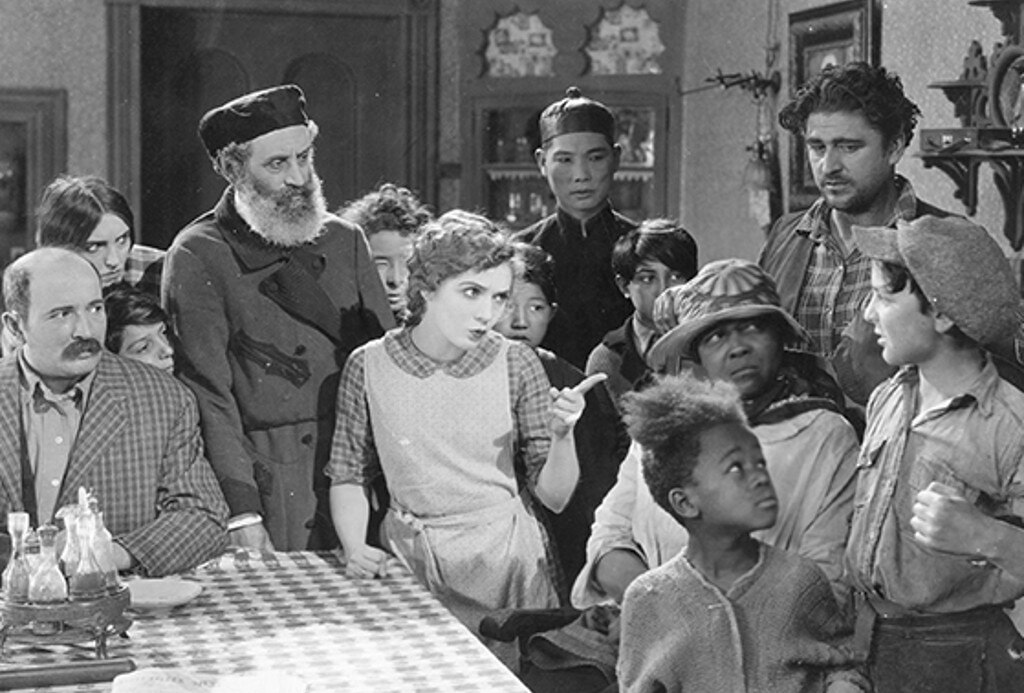
Her juvenile co-stars were probably based on the successful "Our Gang" kids,
who had been assembled by producer Hal Roach circa 1922. But the Our
Gang chums inhabited a more idyllic world than the gritty urban setting of
Little Annie Rooney. Presaging the dour setting of 1937's Dead End
(which spawned the "Dead End Kids"), Pickford's film places its
dirty-faced waifs in a crime-ridden asphalt jungle. Regardless of
the dour socio-economic circumstances that surround them, the multi-culti
rascals maintain their pluck and childish innocence. Only in a Hollywood
reconstruction of tenement life could Irish, Greek, Jewish,
African-American, Italian and Chinese children wage war with volleys of
bricks and bottles, all in the spirit of wholesome fun. So bright is the
overriding charm of Pickford that the audience is blind to the story's
potentially depressing setting. A year later, she further challenged
audience optimism by leading a group of orphans through an
alligator-infested swamp in Sparrows (1926), and again succeeded.
Both Little Annie Rooney and Sparrows were directed by
William Beaudine, who was essentially a Hollywood workhorse with a gift for
strictly adhering to budgets and schedules. In the course of his
fifty-year career he directed approximately 250 films and numerous TV
shows, ranging from high-profile star vehicles to skid row comedies (such
as Bela Lugosi Meets a Brooklyn Gorilla, 1952). Beaudine was canny
enough to know what the audience expected of Little Annie Rooney,
and he kept the camera focused on Pickford as much as possible. In one scene of
unmitigated pathos, the camera is riveted to Pickford's face as Annie
responds to news of her father's death -- releasing a torrent of tears and
woeful expressions of little-girl grief. Few actresses could stand up to
such a demanding task, but Pickford does so with grace and power. The
painfully prolonged close-up becomes the emotional core of Little Annie
Rooney, and reminds viewers of the remarkable acting talent possessed
by Pickford, a genuine mastery of the art that might easily be overlooked
amid the woman-child playfulness for which she is more famous.
As if the challenge of depicting Annie's grief were not difficult enough,
Beaudine broke the proper mood by yelling, just before the take, "All right
boys, get out the rubber boots, Mary has got to cry!" After Pickford got back
into character, the shoot was interrupted by Rudolph Valentino, who
appeared on the set for an unexpected visit. "At any other time his
presence would have been thrilling and welcome," Pickford later wrote in
her autobiography Sunshine and Shadow, "but that afternoon it threw
me emotionally off balance. It took me hours to get back into the mood of
the tragedy of that little girl of twelve. Had it been make-believe and
nothing more, I could have turned it on and off at will. But I really was
that bereaved little orphan."
Pickford may have tapped into a vein of stress that was running deep
through her own life at the time. Police had uncovered a plot to kidnap
the actress, but could not arrest the culprits until they actually
attempted to abduct her. Watched by a bodyguard, often accompanied
by police escort, sometimes employing a decoy "double," the actress was
required to maintain her usual acting/producing schedule while always
wondering when the kidnappers might strike. Eventually the men were
apprehended and sentenced to ten to fifty years at San Quentin
prison.
Producer: Mary Pickford
Director: William Beaudine
Screenplay: Louis Lighton and Hope Loring
Based on a story by Katherine Hennessey
Cinematography: Charles Rosher and Hal Mohr
Production Design: John D. Schulze
Principal Cast: Mary Pickford (Annabelle Rooney), William Haines (Joe Kelly),
Walter James (Officer Rooney), Gordon Griffith (Tim Rooney).
BW-95m.
By Bret Wood
Little Annie Rooney
by Bret Wood | November 25, 2002
SIGN UP FOR OUR NEWSLETTERS

CONNECT WITH TCM