"I don't know what it is that gives me a queer feeling when I look at
you."
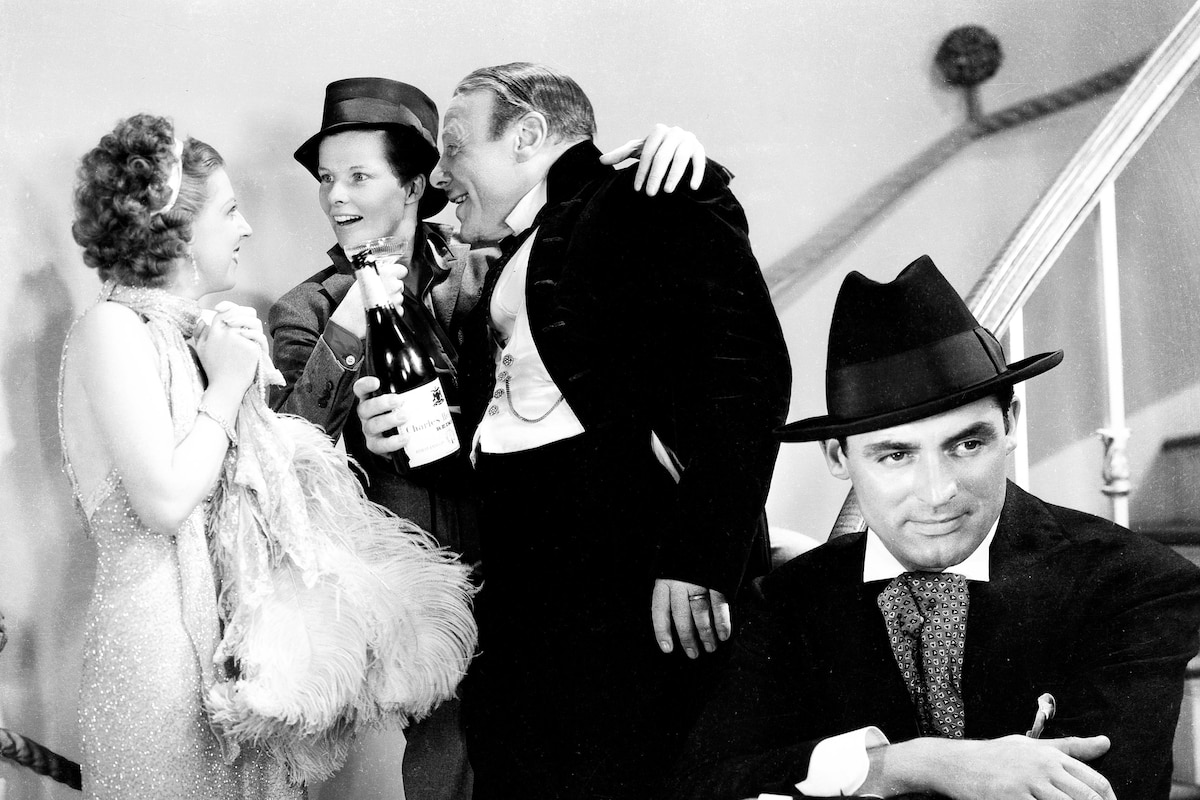
Brian Aherne admitting his attraction to Katharine Hepburn, disguised as
a boy, in Sylvia Scarlett.
Director George Cukor and star Katharine Hepburn were years ahead of their
time when they brought the cross-dressing comedy-romance Sylvia
Scarlett to the screen in 1935. Though they would pay for their
forward thinking at the box office, the film would later be hailed as a
decidedly advanced treatment of sexual politics and one of the biggest cult
favorites of Hollywood's golden years.
For years, Cukor had dreamed of filming Compton MacKenzie's 1918 novel about
a female con artist who dresses as a boy to elude customs inspectors. He
had proposed the project at MGM, where he was currently under contract, but
studio head Louis B. Mayer had turned him down. Then Cukor's friend
Hepburn, who had just scored a hit at RKO with Alice Adams (1935) proposed
the film as her next project. The role seemed a natural for her; she had
already set tongues wagging as one of the first women in the U.S. to wear
trousers in public. Not only did she make a very convincing young man with
her hair cut short, but Time Magazine's reviewer would quip that
"Sylvia Scarlett reveals the interesting fact that Katharine Hepburn
is better looking as a boy than as a woman."
To play Hepburn's partner in crime, a Cockney crook named Jimmy Monkley,
she suggested Cary Grant, whom she had only recently met through their
mutual friend Howard Hughes. Grant was then under contract to Paramount
Pictures, where he was languishing in vapid leading man roles that called
for little more than charm. Under Cukor's guidance, he learned to relax on
screen as never before. Moreover, his role gave him a chance to draw on
his lower-class roots and his early experience in the circus to give a
performance that would showcase his versatility as an actor.
Originally, Cukor wanted British novelist Evelyn Waugh to write the
screenplay. When that didn't work out, he turned to John Collier, a noted
author of bizarre short stories who had never written a film before.
Keeping close to the spirit of MacKenzie's novel, he crafted a rambling
screenplay that veered between comedy and tragedy freely in a manner that
would anticipate the youth-oriented road films of the '60s and '70s. He
also explored the sexual ramifications of Hepburn's cross-dressing,
including a scene in which an amorous maid (Dennie Moore) tries to seduce
her and an otherwise heterosexual artist (Brian Aherne) finds himself
falling for the young "man."
But after taking a chance on the untried author, Cukor panicked and brought in two established screenwriters to tone down some of Collier's more outrageous ideas. Where Collier had started
the film with Hepburn already pretending to be a boy, they added a sentimental prologue in which, while mourning her mother's death, she cuts off her hair to initiate the masquerade. They also created a new ending, tying together all of the film's plots in the final, rather confusing, 15
minutes. Years later, the director would admit that he would have had a
better film had he stuck with Collier's original adaptation.
But all that was in the future. The film was shot on location in Laurel
Canyon and along the Pacific coast north of Malibu, where Cukor had also
shot the seaside scenes for David Copperfield earlier that year.
For cast and crew, the location shoot was like an extended holiday, with
afternoon tea breaks and long ocean swims. Cukor and Hepburn's personal
cooks kept them eating well; they even competed to see who could produce
the best meals. And they even enjoyed a surprise visit from Hughes, who
was smitten with Hepburn at the time (though later biographers would
suggest that he was also attracted to Grant). The only problem occurred
when they tried to shoot a suicide scene for Natalie Paley, who played
Aherne's rejected mistress. As scripted, Grant was supposed to rush into
the surf to save her, leading to a romance between the characters. When
the time came, however, Grant protested that the water was too cold.
Frustrated with the delay, Hepburn dove into the water to save the woman,
creating a scene that further played up the film's sexual
confusion.
After the delightful shoot, the preview was like a cold blast of reality.
The audience hated the film, hooting and jeering at it. Moreover, when the
seductive maid kissed Hepburn, three quarters of the audience walked out.
Afterwards, producer Pandro S. Berman was furious. Realizing they had a
flop on their hands, Cukor and Hepburn begged him to destroy the film,
offering to make another picture in its place for free. But he wasn't
having any of that. He yelled, "I never want to see either of you again,"
and stormed out. His threat held true where Cukor was concerned. The
director would never work at RKO again. Hepburn still had a contract
there, however, though later films would do little to repair the damage
done by Sylvia Scarlett. Within a few years, she left Hollywood a
failure, branded "box office poison" by exhibitors. Although the film
would eventually win a devoted cult audience, it has yet to show a profit
on its $1 million budget.
Producer: Pandro S. Berman
Director: George Cukor
Screenplay: John Collier, Gladys Unger, Mortimer Offner
Based on the Novel The Early Life and Adventures of Sylvia Scarlett
by Compton MacKenzie
Cinematography: Joseph August
Art Direction: Van Nest Polglase, Sturges Carne
Music: Roy Webb
Principal Cast: Katharine Hepburn (Sylvia Scarlett),Cary Grant (Jimmy
Monkley), Brian Aherne (Michael Fane), Edmund Gwenn (Henry Scarlett),
Natalie Paley (Lily), Dennie Moore (Maudie Titt).
BW-95m. Closed captioning.
by Frank Miller
Sylvia Scarlett
by Frank Miller | November 25, 2002
SIGN UP FOR OUR NEWSLETTERS

CONNECT WITH TCM