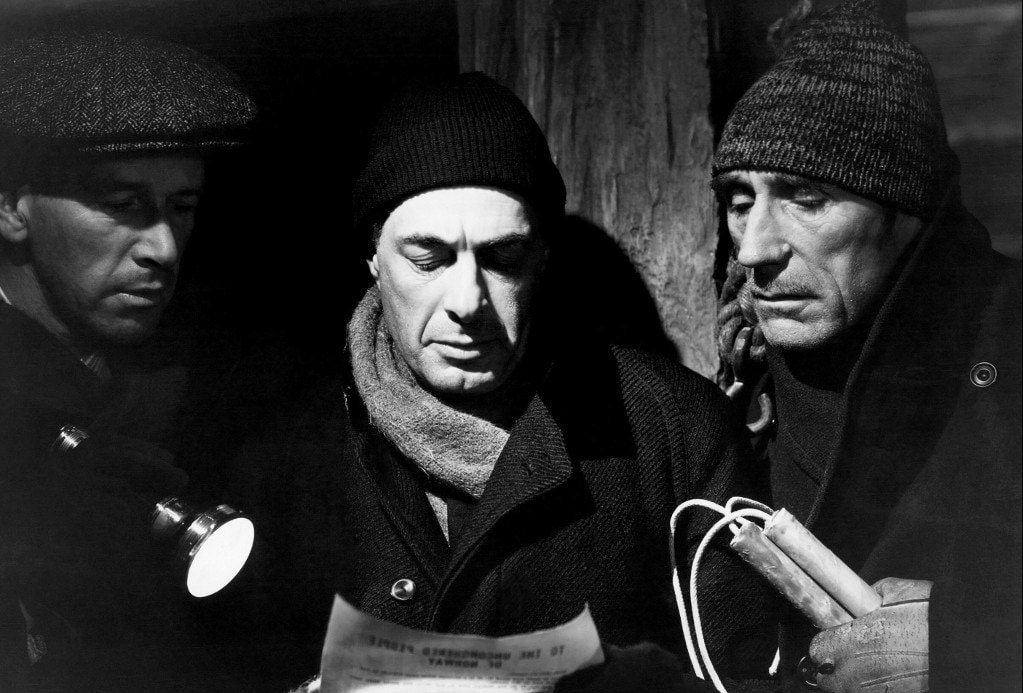
The Moon is Down (1943) was an adaptation of John Steinbeck's best-selling 1942 novel about German soldiers occupying a Norwegian town and their struggle to maintain order as the townspeople are torn between collaboration and resistance. 20th Century-Fox paid Steinbeck a hefty $300,000 for the film rights, which was the highest fee paid by a studio to date. The novel was written as an assignment from the Foreign Information Service, which was part of the Office of Strategic Services, as a way of combating Nazi propaganda in the U.S. Oscar Serlin purchased the theatrical adaptation rights, and the resulting play was later nominated by the New York Drama Critics' Circle as best play in 1942.
Former actor Irving Pichel directed Sir Cedric Hardwicke, Henry Travers, Lee J. Cobb, Dorris Bowdon and Jeff Corey in the 1943 film, which also had in its cast a very young Natalie Wood and future Hogan's Heroes star John Banner as Lt. Prackle. Banner, of Jewish descent, had been acting on tour in Switzerland when Hitler aligned with his home country of Austria in 1938. Although he would survive, most of Banner's family perished in the concentration camps while he was in Hollywood playing Nazis.
This would be Bowdon's final film. A star of Fox's The Grapes of Wrath (1940), she retired after marrying Nunnally Johnson, who adapted Steinbeck's novel for the film and acted as producer. It was John Steinbeck himself who suggested that his personal friend Johnson do the adaptation, instructing him to "tamper with it," to make up for what Steinbeck felt were the cinematic limitations of the novel. He would later admit, "pictures are a better medium for this story than the stage ever was."
Irving Pichel shot this film both on the Fox lot in Los Angeles and on the same sets Fox created for How Green Was My Valley (1941) at Brent's Crags in Ventura County, California two years previously. For the mountain scenes, Pichel and his company trekked up to the ski resorts of Big Bear and Lake Arrowhead, east of Los Angeles.
The film premiered in Toronto, Canada on March 13, 1943 before opening in New York on March 26th. The New York Times film critic Bosley Crowther wrote in his review that Johnson as producer and screenwriter "has a picture which is the finest on captured Norway yet and a powerful expression of faith in the enduring qualities of a people whose hearts are strong. With the help of Irving Pichel's superlative direction and a generally excellent cast, he has realized the listless bewilderment of the Norwegians at the first shock of their fall, the surge of their bitter hostility and the slash of their resistance in the dark. Through the sober and dignified reasoning of the old Mayor of the invaded town, Mr. Johnson (and Mr. Steinbeck) has exposed the moral outrage of Nazi deeds. [...] In short, Mr. Johnson has made a picture which penetrates the mind with the most persuasive philosophical indictment of the "new order" that the screen is ever likely to contain. "
The Moon is Down was later broadcast on radio on the Screen Guild Theater program with Cedric Hardwicke reprising his role. Although Steinbeck was unaware at the time, resistance movements in Europe had secretly distributed copies of his novel during the war and later credited it with helping them stay strong while fighting the Nazis despite terrible reprisals.
By Lorraine LoBianco
SOURCES:
Cozad, W. Lee, More Magnificent Mountain Movies
Crowther, Bosley "The Screen: 'The Moon is Down,' the Film Version of Steinbeck's Novel and Play, Starring Sir Cedric Hardwicke, Opens at Rivoli" The New York Times 27 Mar 43
The Internet Movie Database
Schultz, Jeffrey D. and Li, Luchen Critical Companion to John Steinbeck: A Literary Reference to His Life and Work
http://www.tcm.com/tcmdb/title/83929.The-Moon-Is-Down/trivia.html
The Moon Is Down
by Lorraine LoBianco | November 16, 2016
SIGN UP FOR OUR NEWSLETTERS

CONNECT WITH TCM