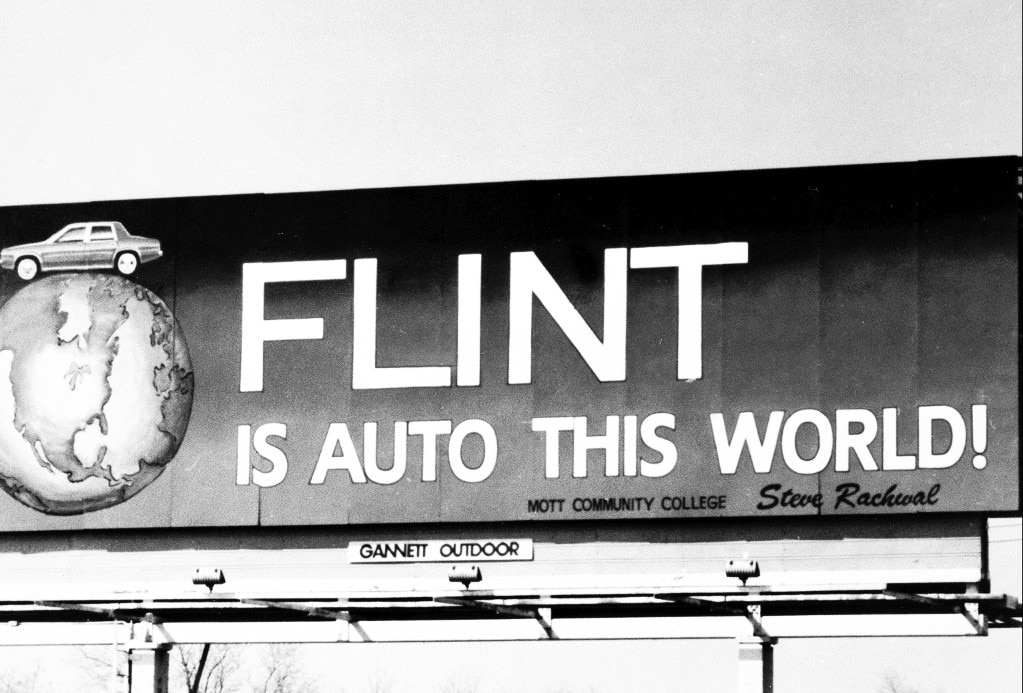
When filmmaker Michael Moore's hometown of Flint, Michigan was devastated by General Motors' decision to close its auto manufacturing plants and ship the jobs to Mexico, throwing thousands out of work, he decided to confront the elusive CEO, Roger Smith, to get some answers. The result was a landmark documentary, Roger & Me (1989), which Esquire recently called "less like a documentary and more like a work of prophecy." In it, Moore shines a light on both the economic destruction of Flint and the seeming indifference by the wealthy executives who caused it.
Moore, the former editor of Mother Jones magazine (and whose father worked on an auto assembly line), left his day job and independently financed the film himself, beginning in 1986. It took two years to shoot Roger & Me, and while Moore ultimately managed to track Smith down, the chairman would not speak with or accompany Moore to Flint to see the pain and suffering he had caused. Roger & Me by turns induces laughter and anger, but was it completely factual? When the film was released in 1989, Moore was accused of manipulating chronological events for dramatic purposes by Harlan Jacobson, then co-editor of Film Comment .
In his article, Jacobson charged that Moore "created the impression of a direct sequence of events that didn't happen in Flint in the one-to-one casual fashion his documentary implies." For example, while Ronald Reagan did appear in Flint, eating pizza with laid off workers and suggesting that they move to Texas, it did not happen while he was president, but while he was still a candidate. The creation of the doomed Auto World amusement park (built to recreate the glory of old Flint and the auto industry, right down to a fake Main Street, while the real Main Street was being shuttered), which cost and lost millions, happened before GM closed the plants, not after. Moore was further accused of overstating the amount of actual jobs lost by 20,000. Pauline Kael, in her review for The New Yorker eviscerated the film, calling it "an aw-shucks, cracker-barrel pastiche" that was created by "a slick ad exec [who] comes on in a give-'em hell style, but he breaks faith with the audience."
Moore's response to his critics was that "no documentary is in linear chronological order. If you're looking for that, watch C-SPAN. [...] I wanted to paint a portrait of this town in the '80s. I never said that the film began in 1986. I consciously avoided using dates. Everything depicted did stem from the closing of the plants. [...] People never heard of a docucomedy but I tried to make a film people want to see." And see it they did. Despite the controversy, Moore sold the rights to Warner Bros. for a reported $3 million, and was the darling of the film festival circuit. He has gone on to win numerous awards for his hard-hitting looks at subjects like gun violence, capitalism, and the events surrounding the attacks on 9/11. Most recently, he has starred in a one-man show Michael Moore in TrumpLand (2016) about the current election cycle and the division it has caused in the United States.
SOURCES:
Dutka, Elaine "Will Controversy Cost 'Roger' an Oscar?" The Los Angeles Times 17 Jan 90
Ebert, Roger "Attacks On 'Roger & Me' Completely Miss Point Of Film" Chicago Sun-Times 11 Feb 90
The Internet Movie Database
Marche, Stephen "Michael Moore's Roger & Me at 25: Still the Best Movie About the U.S. Economic Collapse: Why you should re-watch the 1989 documentary about corporate greed" Esquire 19 Dec 14
By Lorraine LoBianco
Roger & Me
by Lorraine LoBianco | November 14, 2016
SIGN UP FOR OUR NEWSLETTERS

CONNECT WITH TCM