Producer David O. Selznick waged war on the home front, with two offscreen
marriages as the casualties, in Since You Went Away (1944), his sprawling canvas of American life during wartime. He set out to outdo the grandeur of his classic Gone With the Wind (1939), and though he didn't quite succeed in that, he created a memorable view of life among the wives and children left behind during World War II. He also created the
first of his great obsessive epics, proving that sometimes the producer can
be a film's auteur.
Selznick was looking for a project to follow his two-in-a-row Best Picture
Oscars® for Gone With the Wind and Rebecca (1940) when he came
across Margaret Buell Wilder's novel, a series of letters written by a wife
to her husband off serving in the war. He brought Wilder to Hollywood to
write the screenplay, then sent her home when he decided he could do it
better himself, leading her to appeal unsuccessfully to the Writer's Guild
for credit. On his own, Selznick had turned her series of incidents, in
which the wife was the only fully defined character, into a contemporary
version of a Dickens novel, filled with compelling characters and incidents
that re-created the day-to-day life of a family keeping the home fires
burning.
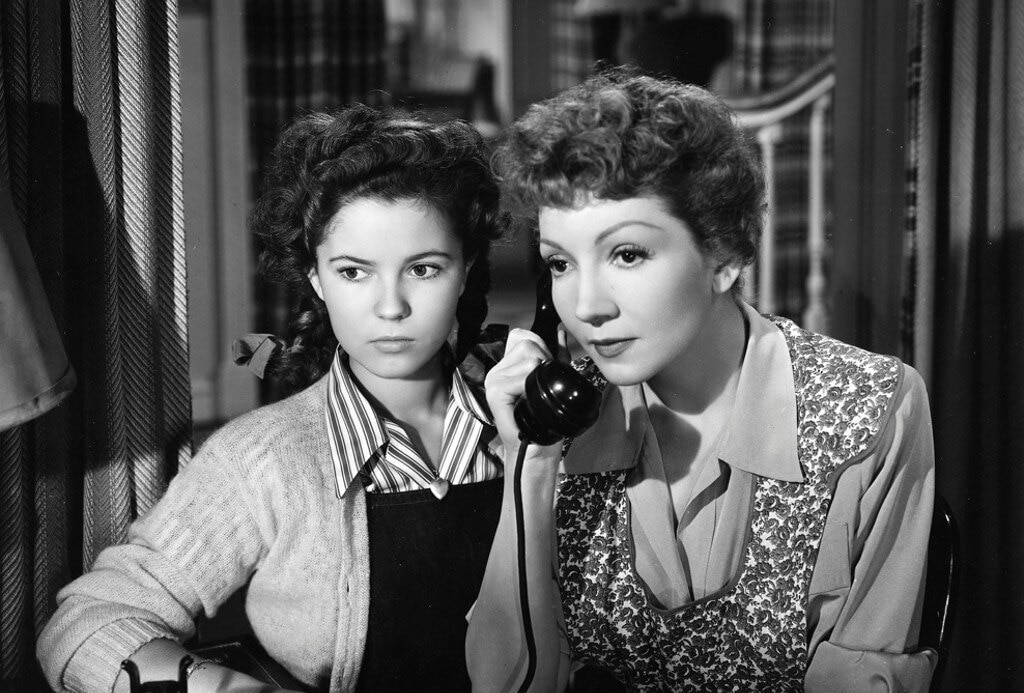
Stage star Katharine Cornell, who had only previously appeared on screen as
herself in Stage Door Canteen (1943), campaigned for the leading role, but
Selznick tactfully advised her that some of the day-to-day details might
seem too mundane for an actress of her stature. Instead, he chose
Claudette Colbert, a proven fan favorite who wasn't afraid to play her own
age (38) as the mother of a 16-year-old. To add to the film's box-office
appeal and importance, he set out to assemble an all-name cast, calling it
the strongest since his own Dinner at Eight in 1933. In addition to
his own contract players Joseph Cotten (as Colbert's lifelong admirer) and
Shirley Temple (as her younger daughter), he cast Monty Woolley as a
boarder they take in, Agnes Moorehead as Colbert's catty friend, Lionel
Barrymore as a minister and Hattie McDaniel as the family maid. He even
found room for another stage legend, Russian diva Nazimova, who played a
factory worker. In small roles, he cast two of his younger contract
players, Guy Madison, in his film debut, and Rhonda Fleming. Former silent
screen heartthrob Neil Hamilton (later Commissioner Gordon on the TV series
Batman) filmed scenes as Colbert's husband, but eventually they were
cut, so that all that remained of him were photographs.
For the older daughter, who loses her first love to the war, he cast his
protegee Jennifer Jones. She had just played her first important part on
loan to 20th Century-Fox for The Song of Bernadette (1943), and Selznick
wanted her to follow that spiritual role with a more down-to-earth
character. Thinking it would be good publicity, he cast Jones' husband,
Robert Walker, as the serviceman she loves and loses. But though they
worked together well on-screen, offscreen it caused major problems.
Selznick had been infatuated with Jones since he'd discovered her two years
earlier during a New York talent search. For a while, they stayed on
opposite coasts, as he kept her in New York to continue her acting lessons.
When she came west for The Song of Bernadette, however, they
started getting closer. He moved from mentor to lover during the filming
of Since You Went Away. At the same time, she and Walker decided to
separate, though they kept it out of the press for fear of tarnishing her
image as St. Bernadette. By the time they shot their big love scenes, he
had already moved out of their home. They didn't announce their divorce
until the day after Jones won the Oscar® for The Song of
Bernadette. Selznick would try to keep his own marriage together until
1947.
Selznick hadn't started on the screenplay until August 1943, a month before
shooting was due to start. For a while he even considered directing the
film himself, but his advisors convinced him that he would be
over-extending himself, so he hired John Cromwell; the latter was an expert at directing
women who had worked for Selznick on The Prisoner of Zenda (1937) and In
Name Only (1939). Still, everybody knew that Selznick was the real power on
the picture. For the first time, he insisted that no scene be shot until
he had seen it rehearsed. Of course, that kept him busy when he could have
been writing. As a result, he was finishing scenes barely in time to film
them. And as he wrote, he added more characters and incidents so that the
cast was never exactly sure what the plot was. He also took the
opportunity to build Jones' role into a miniature showpiece, though he
never took the focus entirely from Colbert. Selznick's meticulous
attention to detail -- which included using his son's baby shoes as part of
the set dressing and handwriting notes from the absent husband -- extended
shooting to an amazing five months.
What emerged was an epic soap opera (almost three hours in length) that hit home for wartime
audiences to the tune of more than $7 million at the box office on a cost
of $3.257 million. The film scored nine Oscar® nominations --
including Best Picture, Best Actress (Colbert), Best Supporting Actress
(Jones) and Best Supporting Actor (Woolley) -- but only won for Max
Steiner's score. This was a disappointment for Selznick, who had hoped it
would be the highest-grossing film released since Gone With the
Wind. But he could take consolation in the quality on screen and a
particularly glowing personal notice from writer and frequent collaborator
Ben Hecht: "The film rings out like a song of America. It's a panorama
with a heartbreak that will reach the theaters. You have wrangled on to
the screen the amiable and indestructible face of democracy." (In
Showman: The Life of David O. Selznick by David Thomson, New York:
Alfred A. Knopf, 1992).
Producer: David O. Selznick
Director: John Cromwell
Screenplay: David O. Selznick
Based on the novel by Margaret Buell Wilder
Cinematography: Stanley Cortez, Lee Garmes
Art Direction: William L. Pereira
Music: Max Steiner
Principal Cast: Claudette Colbert (Anne Hilton), Jennifer Jones (Jane
Hilton), Joseph Cotten (Anthony Willett), Shirley Temple (Bridget "Brig"
Hilton), Monty Woolley (Colonel Smollett), Lionel Barrymore (The
Clergyman), Robert Walker (William G. Smollett II), Hattie McDaniel
(Fidelia), Agnes Moorehead (Emily Hawkins), Guy Madison (Harold Smith),
Keenan Wynn (Lt. Solomon), Nazimova (Zosia Koslowska), Dorothy Dandridge
(Officer's Wife), Florence Bates (Dowager), Doodles Weaver (Convalescent),
Albert Basserman (Dr. Sigmund Gottlieb Golden), Craig Stevens (Danny Williams),
Ruth Roman (Envious Girl), Rhonda Fleming (Girl at Dance), John Derek
(Extra), Neil Hamilton (Tim Hilton-Photograph).
BW-177m. Closed captioning.
by Frank Miller
Since You Went Away
by Frank Miller | February 27, 2003
SIGN UP FOR OUR NEWSLETTERS

CONNECT WITH TCM