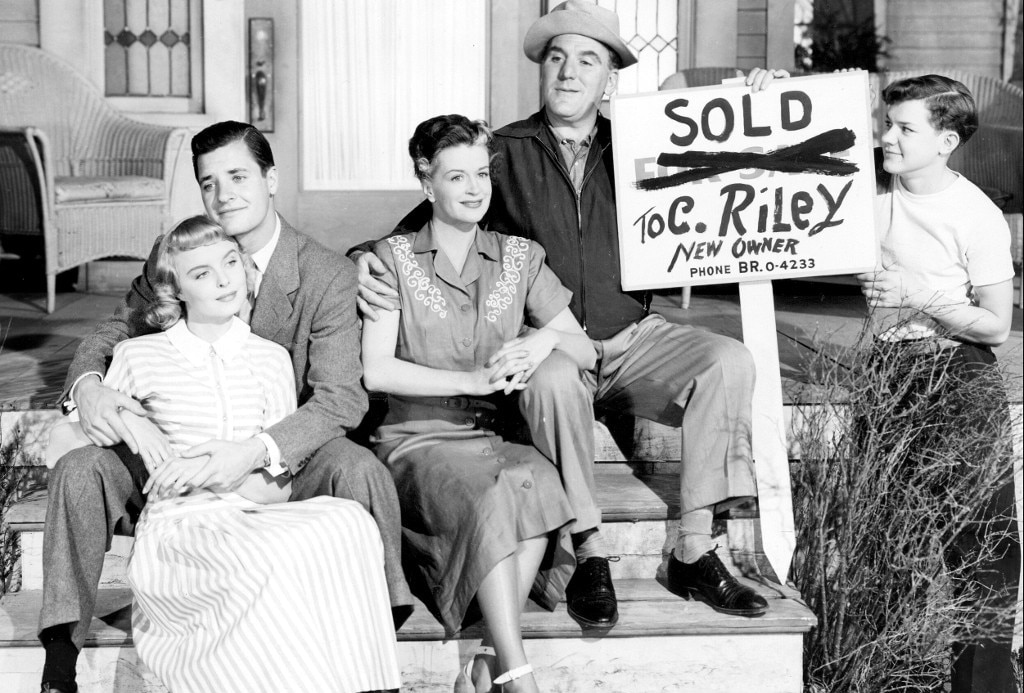
William Bendix came to the attention of the public in the 1944 Alfred Hitchcock film, Lifeboat , playing a dim-witted sailor who doesn't survive the ordeal. Although Bendix's considerable acting chops allowed him to believably play both heroes and villains, it was as the loveable blue-collar factory worker Chester A. Riley that he is best remembered, first on radio and then in the 1949 movie of the same name. The Life of Riley (1949) co-starred Rosemary DeCamp, James Gleason, Beluah Bondi, Richard Long and John Brown as "Digger O'Dell" the friendly undertaker, a role that he also played on the radio program. Not all of the radio cast made the transition to film; Paula Winslowe and Barbara Eiler were replaced with DeCamp and Meg Randall as Riley's wife, Peg, and daughter, Babs respectively.
The idea for the radio program had originated as a sitcom for Groucho Marx called The Flotsam Family , but Groucho was Groucho and the sponsor couldn't accept him as a family man. Irving Brecher, who would direct the film adaptation of Life of Riley, had seen William Bendix in a film called The McGuerins of Brooklyn (1942) and knew he'd found his man. The lead character was changed to Chester A. Riley, the title was changed to The Life of Riley and a show and star were born.
Made for Universal Pictures and directed by Brecher, who also wrote and produced the simple plot of The Life of Riley , revolves around Babs (Randall) learning that Riley is about to get laid off. The boss' son (Long), who is in love with Babs, suggests that they get married in order to save Riley's job. When Riley learns that the couple is to spend their honeymoon in separate rooms, he becomes suspicious.
When the film opened in New York at the Loew's Criterion theater in April 1949, Bosley Crowther, film critic for The New York Times turned his nose up at it writing, "As one whom domestic expediency occasionally compels to bear with the Friday night bull-bellowing of one Chester A. Riley on the radio, this reviewer can state with fair authority that no artistic advantage has been gained by making this same Mr. Riley and his family apparent on the screen." No one escaped Crowther's vitriol: Bendix was "an oaf," Lanny Rees, as son, Junior, looked "slightly frightening," Randall as Babs was "just another shapely blonde," and John Brown as Digger was "extremely disappointing in the flesh." Crowther concluded, "[W]e suppose there are millions who will like this sort of truck. And we suspect there'll be more Riley movies. What a revoltin' development, indeed."
Executives, who immediately began production on a television series, did not share Crowther's opinion, but because Bendix's movie contract barred him from doing television (a not uncommon ban in the early days of the medium when studios wanted to discourage audiences from staying home and watching TV), Jackie Gleason played Riley for one unsuccessful season in 1950. Bendix was able to return to the role on NBC from 1953 to 1958, where the program was consistently in the top 25.
SOURCES:
Bareiss, Warren "The Life of Riley" Encyclopedia of Television
"The Life of Riley" The Billboard Magazine Dec 6, 1947
Crowther, Bosley "'The Life of Riley,' With Bendix in the Title Role, Makes Its Appearance at Criterion" The New York Times April 18, 1949.
Cullen, Frank, Hackman, Florence and McNeilly, Donald Vaudeville Old & New: An Encyclopedia of Variety Performers in America Vol. 1
Dunning, John On the Air: The Encyclopedia of Old-Time Radio The Internet Movie Database
By Lorraine LoBianco
The Life of Riley
by Lorraine LoBianco | October 28, 2016
SIGN UP FOR OUR NEWSLETTERS

CONNECT WITH TCM