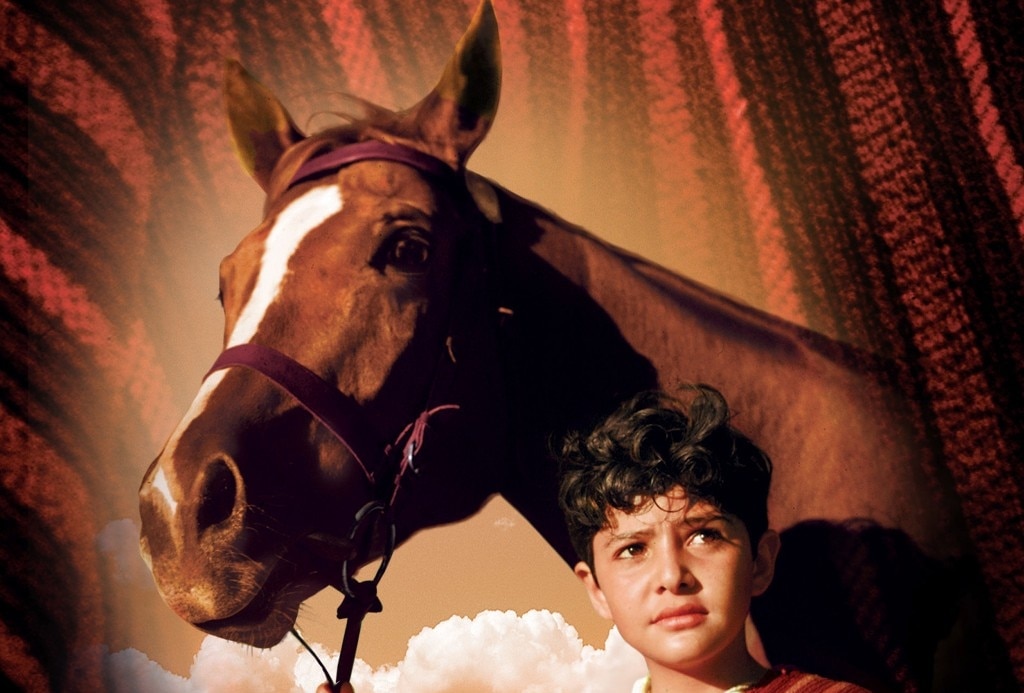
The seventh fully live-action feature film released by Walt Disney - the first had been Treasure Island in 1950 - The Littlest Outlaw (1955) is the tale of a boy and a horse. Pablito (Andres Velazquez), a 10-year-old Mexican stableboy, has a great fondness for a horse named Conquistador that is owned by a general (Pedro Armendariz) - so much so that when Conquistador is set to be destroyed, for throwing the general's daughter to the ground, Pablito steals him. Eventually Pablito himself loses Conquistador, but with the help of a priest (whimsical, against-type Joseph Calleia), he finds him again about to get killed in a bullring. Once more Pablito makes a rescue, a spectacular one this time, leading to an inevitably heartwarming denouement with the general.
The Littlest Outlaw started as an original story idea by Larry Lansburgh, who had been working for Walt Disney for ten years. In that time, he had developed a specialty in stories involving animals. He directed animal-centered shorts like Stormy, the Thoroughbred (1954) and Beauty and the Bull (1954), and a few years later he would win two Academy Awards for a short film and a documentary about animals. Disney approved Lansburgh's feature idea and gave him the green light to produce it. Screenplay chores went to Bill Walsh, another longtime Disney hand who would go on to land Oscar nominations for writing and producing Mary Poppins (1964).
Lansburgh's experience with documentary-like naturalism probably helped The Littlest Outlaw achieve similar atmospheric effects, especially in the bullfighting scenes. These were singled out by many critics for their authentic feel, even if the critics otherwise were lukewarm to the movie overall.
The picture was filmed in Technicolor on location in Mexico, mostly at the historic city of San Miguel Allende, in two versions: English and Spanish. Virtually the entire cast was Mexican, as was the director, Roberto Gavaldon.
Film historian Leonard Maltin later wrote that "the secret of this charming film is in the way it was shot. The story is so slight that it would have been pointless unless it had seemed real. By filming it entirely on location, using interior and exterior sites alike, and getting natural, winning performances from the cast, producer Lansburgh and director Roberto Gavaldon succeeded in their goal."
The Littlest Outlaw opened just before Christmas in 1955 to mixed reviews. The New York Times echoed other prominent outlets by calling it "often hackneyed" and much more for kids than adults, but Variety found it "moving" and full of "genuine heart-tug... Gavaldon's scenes never descend into maudlin sentimentality." Of young Andres Velazquez, the trade paper declared his performance "has seldom been equaled by a child thesp."
By Jeremy Arnold
SOURCES:
Leonard Maltin, The Disney Films (4th ed.)
Dave Smith, Disney A to Z
The Littlest Outlaw
by Jeremy Arnold | October 19, 2016
SIGN UP FOR OUR NEWSLETTERS

CONNECT WITH TCM