"I have a sense that we are all moving into one of those rare
productions when everything touched becomes alive."
Arthur Miller
Arthur Miller couldn't have been further from the truth when he wrote those
words during the early days of bringing The Misfits (1961) to the screen.
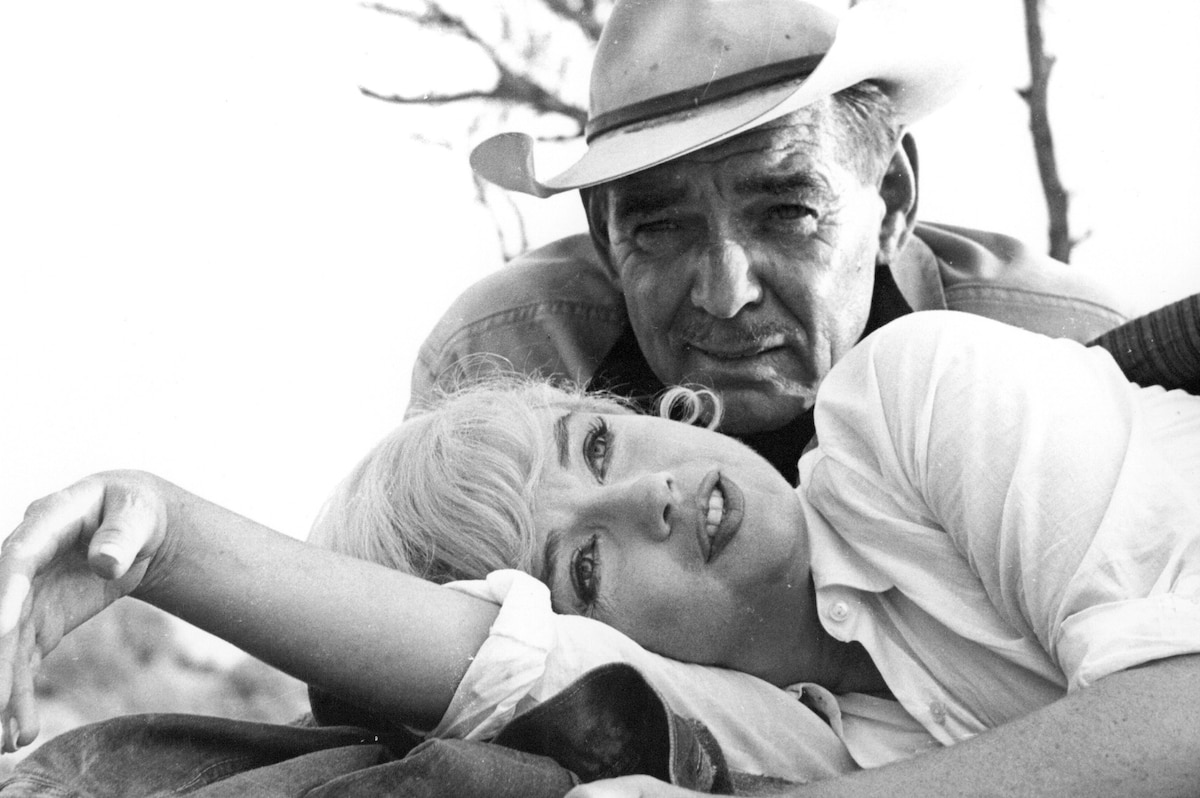
The tortured production -- once a classic flop, now considered a minor
classic -- marked the last completed film for both of its stars, Marilyn
Monroe and Clark Gable. And the debate continues as to whether the film
led to Gable's death from a heart attack at the still-young age of
59.
The Misfits began life as a 1957 short story in which Miller
combined his memories of the modern-day cowboys he met while in Reno to
divorce his first wife and his feelings about his second wife, Monroe, who
initially struck him as a pure creature intimately connected to the spirit
of life. In search of a project that would allow the newlyweds to work
together, they pitched a film version to United Artists. They offered the
script to director John Huston, who accepted with a one-word cable,
"Magnificent." Huston wanted Robert Mitchum to star as the washed-out
cowboy who becomes involved with a sensitive divorcee in Reno and takes her
along on a job to catch wild horses for a dog food company. Unfortunately,
Mitchum considered the script incomprehensible and dodged Huston's phone
calls until Clark Gable was cast. When he finally spoke to the director,
he warned him about Gable's age and health: "You get him at the end of a
rope, fighting those horses, and that's going to be the end of
him."
The damage may have been done before the horses even entered the picture,
however. Because of Monroe's commitment to make the musical Let's Make
Love (1960), production couldn't start until July 1960, when the Nevada
locations were baked by temperatures climbing to 120 degrees each day.
Delays caused by Monroe's habitual lateness didn't help either. Because of
her sleeping problems, Monroe rarely was called before 11 a.m., and usually
showed up later than that. In her defense, however, she also had to stay up into
the small hours trying to learn Miller's many script changes while trying to deal with the effects of her numerous pain and sleeping medications. Though he
often resented her lateness, Gable went out of his way to help her through
the shoot, enduring retakes while she tried to focus on the lines and
praising her work at every opportunity.
Compounding Monroe's problems was the fact that the film, conceived while
she and Miller were still in the full flush of first love, was filmed as
their marriage was falling apart. During shooting, she moved out of their
shared hotel room to stay with her acting coach, Paula Strasberg.
Moreover, she was heartbroken that a role she had seen as her chance to
prove that she could play something other than "Marilyn Monroe" was being
re-written to include embarrassing elements from her personal life,
including references to her mother's mental problems and the failure of her
marriage to baseball legend Joe DiMaggio. Even Gable's casting
contributed to the autobiographical elements of the film. Miller knew she
had idolized "The King" during her childhood, often fantasizing that he was
her father.
Huston played his own part in the production problems. He was already
developing emphysema after decades of heavy smoking, and several days were
lost when he was too sick to work. And location shooting in the only U.S.
state with legal gambling was a huge mistake for him; he was usually up in
the casinos until five in the morning and kept falling asleep in the
director's chair during filming. United Artists had given him a gambling
allowance. When his losses exceeded that, he had to shut down production
for a week to find the money. So he convinced Monroe's psychiatrist and
doctor to put her in a Los Angeles hospital for a week to deal with her
drug dependency, thereby making her bear the blame for the production
shutdown he had caused.
The most grueling scenes in the film were those near the end in which Gable
and two other cowboys (Montgomery Clift and Eli Wallach) capture wild
horses in the desert and break their leader. Rumors at the time suggested
that the scenes trying to hold back the lead horse contributed to Gable's
heart problems, but a close study of the film reveals that most of these
were done through careful cutting. Gable is rarely in the same shot as the
horse. He did, however, have to shoot a scene in which the horse drags him
across the desert floor. He was actually holding a rope attached to a
truck, with the camera in the bed. But even though he was heavily padded,
he came home from the day's shooting a bloody mess. He tried to lie to his
wife that it had just been an accident, but she knew better, telling him he
was out of his mind.
The film finished shooting with studio work in Hollywood, but Gable was
already too sick to attend the wrap party on November 4. He suffered a
heart attack on the sixth and died ten days later. In a sorrowful
interview, Monroe wondered if she'd contributed to his ill health, while
gossip columnist Hedda Hopper blamed it on Huston. Few at the time even
considered his three-pack-a-day smoking habit or his grief over the death
of good friend Ward Bond just days earlier.
Since Huston had shot in sequence and cut the film as they went along,
Gable had already seen his performance before he took ill and felt it was
his best acting ever. With his death, United Artists tried to get the film
completed in time for the 1960 Academy Awards®, hoping he would snare a
posthumous nomination. But when composer Alex North protested that he
couldn't possibly get the picture scored that quickly, Huston had to agree.
The release was pushed back to a more reasonable February 1 date, when it
fared poorly with critics and audiences. Over time, however, the film has
gained a special luster, particularly when Monroe died two years later
without having finished another picture. Today, The Misfits is
considered a minor classic, with special interest as an example of the loss
of traditional values in the modern Western, as one of Huston's trademark
celebrations of a team of charismatic losers and as the last film from two
of Hollywood's greatest stars.
Producer: Frank E. Taylor
Director: John Huston
Screenplay: Arthur Miller
Based on a Short Story by Miller
Cinematography: Russell Metty
Art Direction: Stephen Grimes, William Newberry
Music: Alex North
Principal Cast: Clark Gable (Gay Langland), Marilyn Monroe (Roslyn Taber),
Montgomery Clift (Perce Howland), Thelma Ritter (Isabelle Steers), Eli
Wallach (Guido), Estelle Winwood (Church Lady), Kevin McCarthy (Raymond
Taber), Marietta Tree (Susan).
BW-125m. Letterboxed.
by Frank Miller
The Misfits
by Frank Miller | July 28, 2003
SIGN UP FOR OUR NEWSLETTERS

CONNECT WITH TCM