The Ipcress File (1965) was a breakthrough film for Michael Caine. Based on the novel by Len Deighton and produced by Harry Saltzman, one of the men behind the hugely successful James Bond films, The Ipcress File was the first in what became a series of films starring Caine as British Intelligence agent, Harry Palmer. The character was unnamed in Deighton's novels--the name was an invention of Saltzman and Caine--but it became so identified with the series that even the novels are referred to as the "Harry Palmer" series. In the film incarnation, he's a smart and sophisticated working class bloke with a criminal past who is blackmailed into service by a manipulative and cold-blooded colonel. It was the first film to put Michael Caine's name above the title and it was a hit. A sequel was inevitable.
Funeral in Berlin (1966), based on the third novel in Deighton's series, sends Harry to Germany to arrange the defection of Colonel Stok (Oskar Homolka), a Russian intelligence officer posted to East Berlin, despite Harry's suspicions of ulterior motives. Working with Johnny Vulkan (Paul Hubschmid), Britain's man in West Berlin, he hires an infamous underworld smuggler to arrange the defection. The entire affair is complicated by Israeli agents on the hunt for a Nazi war criminal and a beautiful model (Eva Renzi) who distracts Harry long enough for his room to be searched. There is much more to the mission than Harry's cagey boss (Guy Doleman) is telling him.
Saltzman found Sydney J. Furie, the director of Ipcress, too difficult to work with, so he turned to Guy Hamilton, director of the hugely successful Goldfinger, for the sequel. Production designer Ken Adams and composer John Barry were also Bond movie veterans but they were careful to create a different world for this film. Funeral in Berlin falls somewhere between the glamor of the James Bond movies and the grim, cynical portrait of Cold War spycraft in The Spy Who Came in from the Cold. Hamilton served with a military intelligence during World War II, according to Caine, and he would adjust scenes to match his experience. In contrast to the glamor and spectacle of the Bond movies, Funeral in Berlin was shot on location on the streets and in the outskirts of Berlin, from the Tempelhof Airport to the cabaret district at night. Things were tenser when they shot near the heavily-patrolled Berlin Wall. "Every time we tried to film near the Wall, the Russians used to bring bright lights and mirrors out and shine them straight into the lenses," recalled Caine. When Harry crossed into East Germany through Checkpoint Charlie, the most heavily guarded route between East and West Berlin, the camera crew kept its distance, using a telephoto lens to shoot Caine's journey across the border.
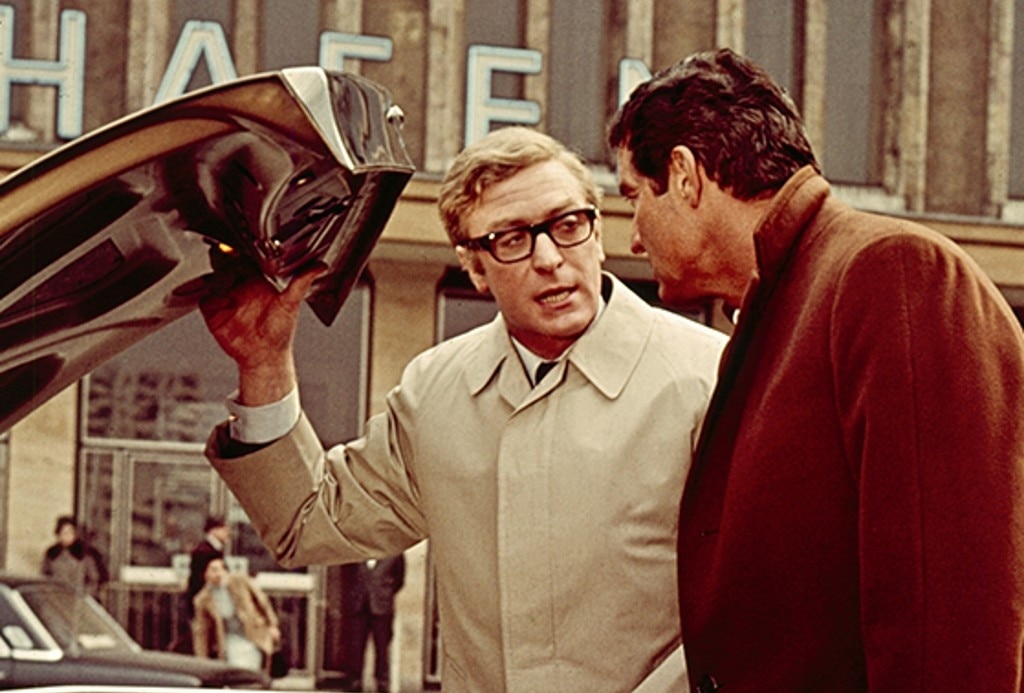
Holding the center, of course, is Caine's Harry Palmer, a man more comfortable hiring crooks to do his investigating than trusting the police or even fellow agents. He's smart, sardonic and a little insubordinate. Clad in horn-rimmed glasses and a rumpled overcoat rather than fitted suits and tuxedos, he looks nothing like the dashing spies in the Bond movie knock-offs. "There is only one other actor I would rather have had than Michael Caine to be my spy," said author Len Deighton. "That's Humphrey Bogart. And he's dead."
Sources:
The Elephant to Hollywood, Michael Caine. Henry Holt, 2010.
Raising Caine, William Hall. Prentice-Hall, 1982.
Man at the Wall, a short promotional documentary, no listed director. Paramount Pictures, 1966.
IMDb
By Sean Axmaker
Funeral in Berlin
by Sean Axmaker | October 18, 2016
SIGN UP FOR OUR NEWSLETTERS

CONNECT WITH TCM