Combat Camera: The Pacific compiles over a dozen vintage newsreels and two short documentaries from the World War II era, all comprised of extraordinary footage from the Pacific theater.
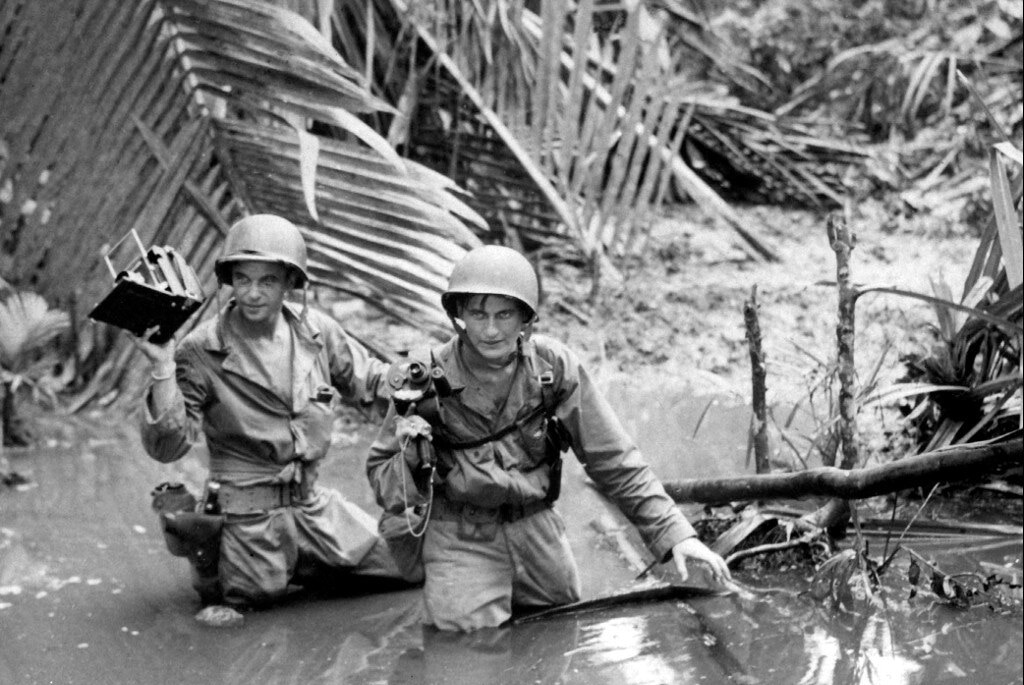
Among the newsreels are "Midway and Coral Sea Battles," "Yanks Invade Marshall Islands," "Battle of the Philippines," "U.S. Marines Capture Tarawa," "MacArthur Liberates Manila" and "Japan's Surrender" - simple titles that give a striking sense of their content. They were produced by various studios' newsreel operations such as Fox Movietone News and Universal Newsreel, which employed civilian camera crews, as well as by the military itself, which trained teams of its servicemen to operate motion picture cameras in the thick of combat. The War Department supervised all these operations, with the Office of War Information (OWI) acting as a conduit between the government and the entertainment industry.
The two documentaries, each about twenty minutes in length and produced by the Navy's Photographic Science Lab in association with the OWI, are stunningly shot and edited: like a good narrative war movie, the effect is equal parts thrilling and sobering. Fury in the Pacific (1945) plunges us into the battles of Peleliu and Angaur, among the bloodiest of World War II, with actor Richard Carlson reading powerful narration. "Some of these Marines were on Peleliu for only a few hours," he tells us. "Some will remain forever." The combat footage is astonishingly up-close and vivid, and it does not shy away from graphic images of the dead that show the price of war.
Even more famous is The Fleet That Came to Stay (1945), a classic of its kind that depicts the bitter fight waged by the American and British fleet at Okinawa to protect a massive supply convoy and to combat Kamikaze pilots - "the most devastating air-sea battle of all time," as the narrator intones. The battle took place over three months in the spring of 1945. Twelve thousand Allied soldiers lost their lives, and over 100,000 Japanese troops and civilians were killed. From one moment to the next, the film presents jaw-dropping images of the battle, including Kamikazes that barely miss their targets and some that strike them. One hundred and three Navy, Marine and Coast Guard cameramen were deployed to shoot this footage, and the finished documentary hit theaters barely a month after the battle ended.
While it lacks on-screen credits, The Fleet That Came to Stay was written and produced by Collier Young, an RKO story editor who would go on to have a significant career (especially in collaboration with his future wife Ida Lupino), and directed by Budd Boetticher, then at the cusp of a Hollywood career that would encompass a series of classic westerns starring Randolph Scott.
The Hollywood Reporter had this to say about Fleet: "The Navy documentary includes many graphic fragments of the fight to protect the convoy; the blazing streaks of rocket batteries, earth-chewing bombardment of the island by Naval big guns, death dives of the Kamikaze pilots, the skies filled with fire from every gun aboard the ships, from five-inch batteries to 20mm Bofors, an American aircraft carrier's deck crash-dived by a suicide pilot... Top honors go to the combat cameramen who photographed this piece of history under fire. But the overall production job, writing, scoring, narration and editing, deserve almost equal credit."
Indeed, from the widest long shots to the most detailed close-ups of men and machines engaged in fierce battle, the work of these cameramen astounds even when seen decades later. Some lost their lives in the process. One was killed while shooting Fleet, and on Fury in the Pacific the photographer casualties were even worse. As Carlson declares starkly on the soundtrack: "Nine fell, taking these pictures."
By Jeremy Arnold
Combat Camera: The Pacific
by Jeremy Arnold | October 17, 2016
SIGN UP FOR OUR NEWSLETTERS

CONNECT WITH TCM