"Stick with your union bunch or you'll get skinned!" So says a poster glimpsed on a wall in Native Land, a 1942 docudrama about struggles faced by the American labor movement in the 1930s. The slogan refers to loyalty and solidarity among workers, and the picture illustrating it - a bunch of ripe bananas - suggests that hanging together to serve common interests should be the most natural thing in the world. But the events depicted in this movie suggests the opposite, showing how corporate pressures, slipshod ethics and simple greed can undermine a union's best efforts to improve the lot of its members.
Native Land was directed by Leo Hurwitz and Paul Strand, two of the period's most politically active filmmakers. They regarded the stakes in the struggle over organized labor to be extremely high, and they open the movie with a statement putting the fight for workers' rights on the same level as the fight to win World War II, which the United States had entered just a few months before the film's premiere. "Since the founding of our country," the opening text declares, "the American people have had to fight for their freedom in every generation. Native Land is a document of America's struggle for liberty in recent years. It was in this struggle that the fascist-minded on our own soil were forced to retreat. And the people gained the democratic strength essential for national unity and for victory over the Axis."
The message here is plain: corporate captains who deny employees the freedom to form unions, hold meetings and engage in collective bargaining are as threatening to democracy as foreign foes, and the experience of battling these unjust employers have given ordinary workers additional reserves of grit, determination and courage that will enable them to win the war abroad. This was an optimistic point of view to espouse in 1942 when combat was raging around the world and violent labor confrontations were fresh in memory, but the filmmakers clearly saw bravery in the face of opposition as a deep-died trait in the American character.
To put across their ideas as compellingly as possible, Strand and Hurwitz swing freely between fiction and nonfiction modes, juxtaposing newsreel footage and fact-filled narration with staged reenactments of indignities and atrocities inflicted on workers refusing to relinquish what they regard as basic human rights. After a prologue celebrating the birth and early growth of the United States, briefly tracing the country's progress from the arrival of the Pilgrims to the upsurge of industry and manufacturing in the first half of the twentieth century, the film presents a couple of disturbing scenes - the sudden death of a peaceful farmer, the discovery of a corpse in a hotel room - that are perplexing until the movie's theme comes into focus. Then we realize that these seemingly random tragedies are linked to the insidious campaign being waged by some unscrupulous executives against wage earners who want to unionize or already have.
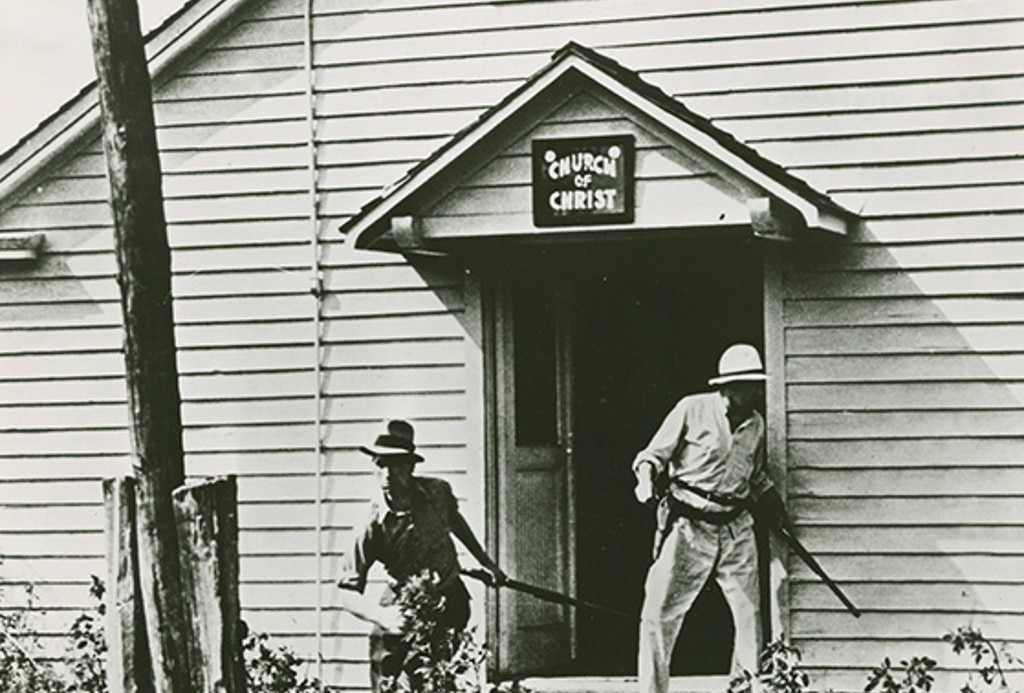
Similar reenacted episodes follow, some with strong racial overtones, as when a rifle-wielding killer shoots down a black man and a white man after they and other sharecroppers gather in an Arkansas church to plan a request for ten cents more an hour so they can feed their poverty-stricken households. Later, scenes show workers engaged in everyday routines - having breakfast with the family, punching in at the time clock, toiling away in heavy industry - but physical and psychological challenges are never far away. In a brief vignette, a management spy is exposed and shamed by his coworkers. In a longer episode, a man is pressured by smug, arrogant bosses to steal a union membership log so they can dole out instant pink slips to everyone involved. Another hard-hitting scene shows a hired thug messing up a grocery store and bullying a little girl, all because the kindly old grocer has been kicking in a bit to the labor cause as a help to his neighbors. Newsreel clips of violence and death also appear, but the film's ultimate mood is one of confidence that the labor movement will persist and prosper because it is fair and righteous in the end.
The impetus to make Native Land came from the La Follette Civil Liberties Committee in the US Senate, which had set forth reports on a long list of abuses - union busting, strikebreaking, bribery, industrial espionage and the like - as a result of investigations and hearings between 1936 and 1941. Along with Hurwitz and Robson, who both belonged to the socially conscious Workers Film and Photo League, the well-known liberals and leftists working on the film included screenwriter Ben Maddow, working under the pseudonym David Wolff, and composer Marc Blitzstein, who penned the stirring music. Howard Da Silva and Art Smith, both of whom were blacklisted during Hollywood's anticommunist purge in the 1950s, are in the cast. Most famous of all is the movie's narrator, Paul Robeson, the extraordinary African-American actor, singer, athlete, scholar and human-rights activist whose career was fatally weakened by his militant support for left-wing causes. He sings on the soundtrack as well.
Native Land is more racially diverse than the vast majority of Hollywood features from its era, although it has a pronounced male bias, devoting little attention to the problems of working women. Not everyone agrees on the validity of its message, and it gets preachy at times - with an actual preacher in a pulpit at one point - but its idealism is infectious. To solve the problems and reap the benefits of 20th century life, Robeson's voiceover says, Americans need to "work together, and therefore...to think together, to move together, to act together." In living up to that obligation, citizens have learned to cultivate cooperation and other values embedded in words like "brother" and "union" and in institutions like community groups, tenant leagues, public forums, committees and clubs. The workers who use these means to achieve gains like old-age pensions, forty-hour workweeks, and adequate health insurance are putting "the Bill of Rights into action" and serving as "new pioneers facing a new frontier." Agree with that sentiment or not, it has a lovely patriotic ring.
Directors: Leo Hurwitz, Paul Strand
Producers: Leo Hurwitz, Paul Strand
Screenplay: David Wolff, Leo Hurwitz, Paul Strand
Cinematographer: Paul Strand
Film Editing: Leo Hurwitz
Music: Marc Blitzstein
With: Paul Robeson (Narrator), Fred Johnson (Fred Hill), Mary George (Mrs. Hill), John Rennick (Hill's son), Amelia Romano (window washer), Housely Stevens (white sharecropper), Louis Grant (black sharecropper), James Hanney (Mack), Howard DaSilva (Jim), Art Smith Harry Carlyle), Richard Bishop (executive), Vaughn King (Mary), Robert Strauss (Frank Mason), John Marlieb (thug), Tom Connors (Joseph Shumaker), Harry Wilson (Eugene Poulnot), Rev. Charles Webber (minister), Virginia Stevens (widow), Clancy Cooper (eulogist), Tom Pedi (Harry)
BW-88m.
by David Sterritt
Native Land
by David Sterritt | October 14, 2016
SIGN UP FOR OUR NEWSLETTERS

CONNECT WITH TCM