With an opening title card that would make P.T. Barnum and William Castle proud, Fantastic Voyage begins its cinematic voyage by informing the viewers: "this film will take you where no one has ever been before." Before explaining that along with some of the amazing things on the horizon--like going to the moon, viewers may one day live to see miniaturized doctors swimming inside human bodies. Or not. Interestingly, that opening phrase sounds a lot like the famous opening of Star Trek released on television just a month after Fantastic Voyage, but completed before either side knew the importance of those words. And, yes, the movie did take viewers where they had never been before and, and with a few exceptions, never went again, which is what makes Fantastic Voyage such a unique movie.
The movie began a couple of years before its release with a story treatment that got expanded by famed science fiction author, Isaac Asimov. In writing the screenplay, Asimov felt there were too many compromises and plot holes with the story and asked if he could write a novel based on the story. While novelizations are now commonplace, at the time it was confusing to many viewers, especially since the novel came out first. The reason was because of multiple delays on the set and the speed with which Asimov put the novel together. Both have the same story, but Asimov's book version explains a few things in detail that his screenplay does not.
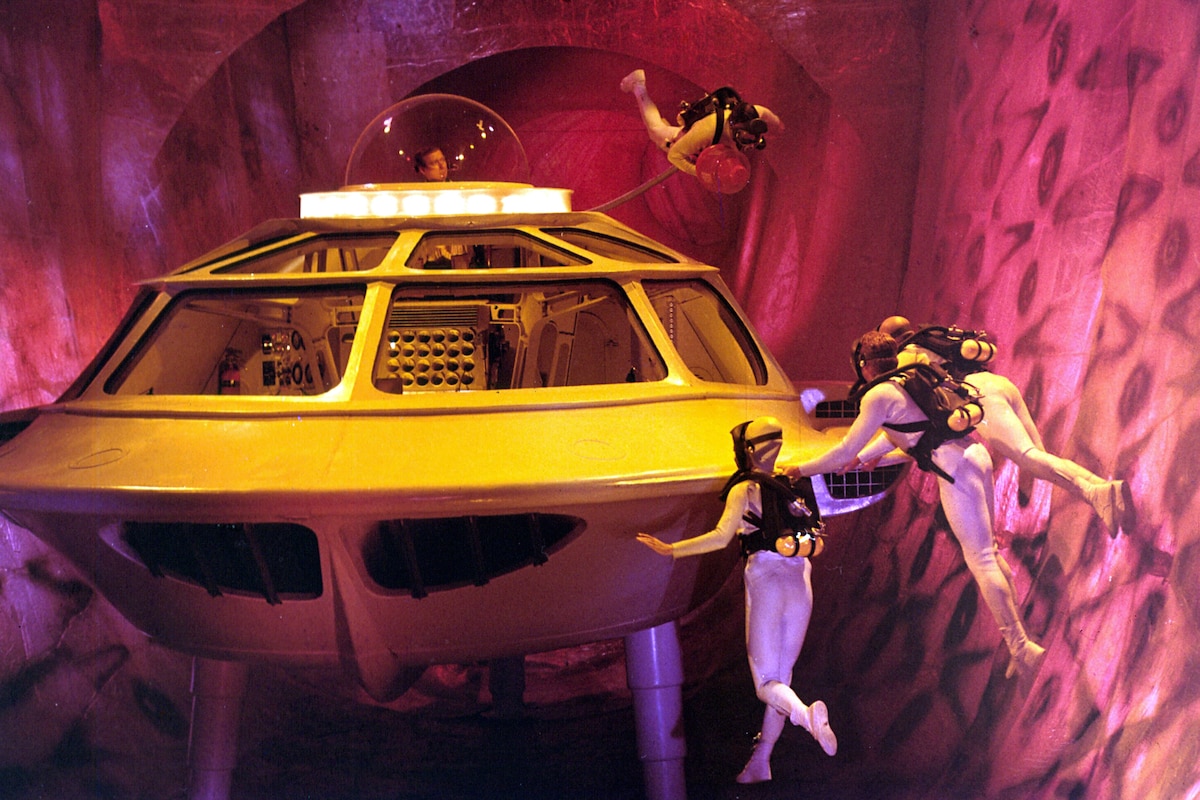
The story of Fantastic Voyage is fantastic indeed. Both the US and the USSR have developed science for miniaturizing people and objects, but in the case of the United States, only temporarily. After a short while, the people revert back to their normal size. However, a Soviet scientist, who holds the secret to permanently miniaturizing people, has escaped the USSR and been recovered by the CIA. An assassination attempt leaves him with a blood clot on the brain. Rather than risk surgery, they miniaturize a team of specialists who take a miniature sub into his body, make their way to the brain and dispatch of the clot, all before reverting to normal size and thus killing the scientist.
As sci-fi plots go, Fantastic Voyage is a very clever retelling of the exploration theme as well as the ticking time-bomb trope. It's a crew of explorers bounding into undiscovered landscapes, but on a mission that has a countdown attached. Taking that idea and turning it inwards to the human body was definitely a new approach to the theme. Although there was an I Dream of Jeannie episode (no, really) released before the movie that had Captain Nelson (Larry Hagman) on the set of a movie about a miniaturized astronaut going into the body of a Soviet spy, the treatment for Fantastic Voyage was already underway. Besides, after the success of The Incredible Shrinking Man, it was only a matter of time before adventurous tales of miniaturized protagonists hit the big screen again.
Playing the roles of the miniaturized biological warriors and coordinating military team was an assorted cast of old pros and fresh newcomers. There was Stephen Boyd, Edmund O'Brien, Arthur Kennedy, Arthur O'Connell, Donald Pleasence and new bombshell sensation, Raquel Welch. At the time, casting Welch was considered the creation of a new Hollywood sex symbol, but as her theatrical career before and after showed, including her successful run on Broadway in Woman of the Year, she was a well-trained actress who comes off extremely well against her more seasoned colleagues.
Pleasence is superb as always, and O'Connell and O'Brien do their level best to take the proceedings seriously without becoming too overheated. O'Connell succeeds for his part, O'Brien gets a little overheated. Boyd and Kennedy provide the steady core of the movie and while no one will ever say it's their best work, it's pretty good nonetheless.
Behind the camera was the talented pro, Richard Fleischer, whom in 1954, put Jules Verne's 20,000 Leagues Under the Sea up for Disney and it still stands as one of the best adventure movies ever made. In fact, the Proteus, the miniaturized sub for Fantastic Voyage,was designed by Harper Goff, the very same artist who designed the Nautilus for 20,000 Leagues Under the Sea. To say Fleischer does an excellent job is to state the obvious, but it still must be remarked that this type of story in the wrong hands can come off as exceptionally silly and amazingly, Fantastic Voyage does not.
There were a few other movies that later explored similar themes, most notably Inner Space (1987) and Osmosis Jones (2001), but none succeeded quite like Fantastic Voyage. The movie's logical flaws (things left behind in the body that should have killed the scientist when they expanded back to normal size) don't detract as much as amuse. And no, we never did see miniaturized doctors swimming around the blood streams of their patients, but we did get to see a story so fantastic it's still a voyage worth taking every time.
Director: Richard Fleischer
Producer: Saul David
Screenplay: Harry Kleiner and David Duncan
Art Direction: Dale Hennesy and Jack Martin Smith
Cinematography: Ernest Laszlo
Editing: William B. Murphy
Original Music: Leonard Rosenman
Principal Cast: Stephen Boyd, Raquel Welch, Edmund O'Brien, Donald Pleasence, Arthur O'Connell, William Redfield, Arthur Kennedy, Jean Del Val
C-100m.
By
Greg Ferrara
Fantastic Voyage
by Greg Ferrara | October 13, 2016
SIGN UP FOR OUR NEWSLETTERS

CONNECT WITH TCM