A deliciously nasty comedy, Kind Hearts and Coronets (1949) pits the British aristocracy against the determination of one man to join its ranks by any means necessary. The movie opens with the aristocratic Louis Mazzini, Duke of Chalfont (Dennis Price), sitting in a prison cell, awaiting execution for murder. Told in flashback as Louis recounts how he climbed from commoner to Duke, the story returns to a turn-of-the-century England sharply divided along class lines. Outraged at his mother's rejection by the aristocratic d'Ascoyne family because she married an Italian opera singer, Louis vows to rise to the top of the d'Ascoyne clan to become the Duke of Chalfont.
First he promises to kill each one of its eight living members. In addition to his plan to avenge his mother, denied a respectable burial in the d'Ascoyne family
plot, Louis also plots to win the hand of his childhood sweetheart, the vain and opportunistic Sibella (Joan Greenwood). But when Sibella marries a wealthier man, Louis's desire to rise from a humble department store clerk to Duke intensifies.
Though Louis is presented as an adversary of the spoiled, cruel d'Ascoynes, it has been pointed out that he also shares their callousness, evident in the casual way in which he commits murder. But at heart, Louis is a rebel who dismantles the unjust British class system via murder, giving vent to the audience's own antisocial impulses.
In his biography, Michael Balcon Presents, the Ealing studio head credited writer/producer Michael Pertwee for the film's unique tone, writing that Pertwee "found a tattered Victorian novel which treated with deadly seriousness the murder of a number of people who stood between a man and a fortune, and it must have been Michael and Robert [Hamer] who had the idea to use the theme for a comedy - surely the first 'black comedy' made in this country."
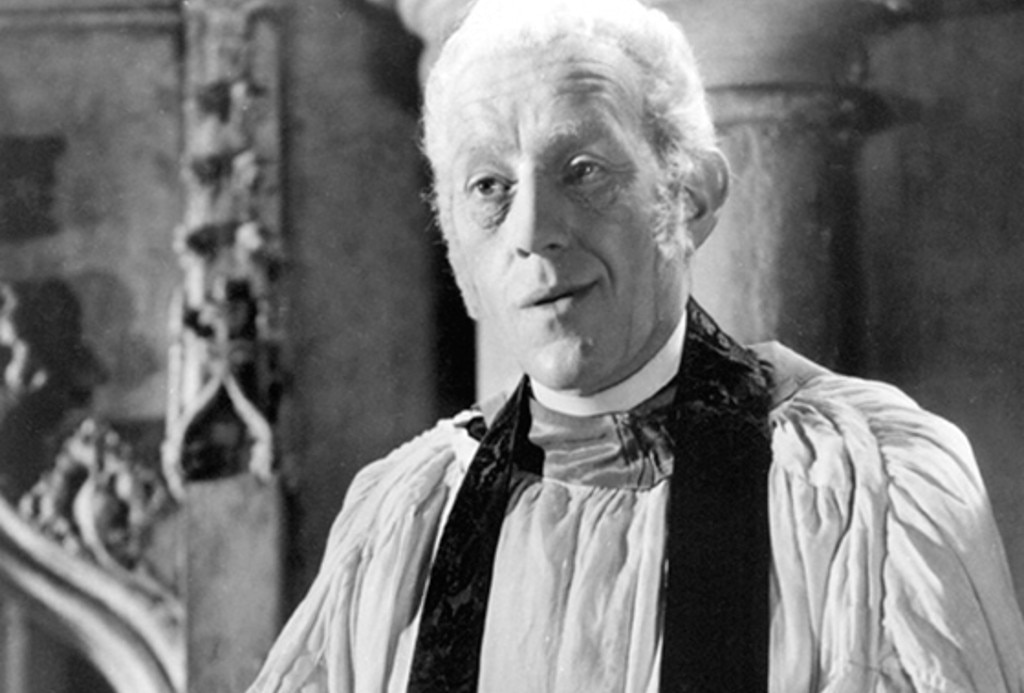
An imaginative, often surreal satire in the style of Stanley Kubrick's Dr. Strangelove (1964), Kind Hearts and Coronets has the entire debauched line of d'Ascoynes - from the furious, window-smashing suffragist Lady Agatha to the drunkard reverend, the
Canon d'Ascoyne - played by the chameleon-like Alec Guinness. Guinness's multifaceted role made the actor an international star whom Balcon believed had "a quality comparable with Chaplin."
The clever casting stunt of using the same actor to play multiple roles is a wry commentary on the cloistered, elitist, nearly inbred nature of the d'Ascoyne clan, while adding a touch of absurd comedy to a storyline that might otherwise seem unrelentingly dark. Equally vital to the film's success is its loop-de-loop narrative, which includes many unexpected twists of fate and a surprise ending. In his biography Blessings in Disguise, Guinness revealed a humorous anecdote about the famous balloon sequence where he was playing Lady Agatha d'Ascoyne: "I was enchanted at the idea of going up in a balloon. The only anxiety I had was about insurance, which I guessed would be inadequate to support my wife and young son should there be an accident. Accordingly I spoke to the producers about it....and when I asked for how much I think they told me 10,000 pounds. I decided it wasn't nearly enough and informed them I wouldn't go up more than fifteen feet in the air unless they raised the insurance...They were very huffy and said, 'You will have Belgium's greatest balloonist concealed in the basket with you so you can't possibly come to any harm.' They refused to increase the insurance so when we came to do the shot I insisted on being let down shortly after we had risen from the ground...Belgium's greatest balloonist was dressed and be-wigged as Lady Agatha and sailed away. And away. At speed. And then out of sight. The wind took over and the poor man was found some fifty miles away, floundering in a long skirt in the Thames estuary where he had been forced to ditch. Smugly at home I sat down to a hot dinner."
As equally captivating as Guinness in Kind Hearts and Coronets is Dennis Price as the self-interested, conniving, amoral antihero of the film who is nevertheless utterly sympathetic and engaging in his murderous quest. The world Price lives in seems in every way equal to his own cruel vantage point, from the scheming of the beautiful but shallow Sibella to the d'Ascoynes themselves, who place "man traps" on their grounds to maim the poor poachers who hunt on their lavish estates and justify any vice with the sense of entitlement great wealth gives.
Director Robert Hamer and John Dighton's mordantly witty script for this classic Ealing Studios comedy was based upon Roy Horniman's Israel Rank. Along with Whiskey Galore!, Tight Little Island and Passport to Pimlico, also released in 1949, Kind Hearts and Coronets sealed the Ealing Studio's reputation for turning out clever, crafted comedies. It was also one of the few notable Ealing comedies not written by Ealing regulars T.E.B. Clarke or directed by Alexander Mackendrick.
Director: Robert Hamer
Producer: Michael Balcon
Screenplay: Robert Hamer and John Dighton, based on a novel by Roy Horniman
Cinematography: Douglas Slocombe
Production Design: William Kellner
Music: Ernest Irving
Cast: Dennis Price (Louis Mazzini), Valerie Hobson (Edith d'Ascoyne), Joan Greenwood (Sibella), Alec Guinness (Duke, Banker, Parson, General, Admiral, Young Ascoyne D'Ascoyne, Lady Agatha), Audrey Fildes (Mrs. Mazzini), Miles Malleson (The Hangman), Hugh Griffith (Lord High Steward).
BW-107m. Closed captioning.
by Felicia Feaster
Kind Hearts and Coronets
by Felicia Feaster | November 25, 2002
SIGN UP FOR OUR NEWSLETTERS

CONNECT WITH TCM