After completing Dracula Has Risen From the Grave (1968), his third movie for Hammer Studios in which he played the world's most famous vampire, Christopher Lee said he was done with the role. "I feel I would almost have to be forced into doing it [again]," he told an interviewer in 1969. But he did come back for another sequel, with another lurid title: Taste the Blood of Dracula (1970).
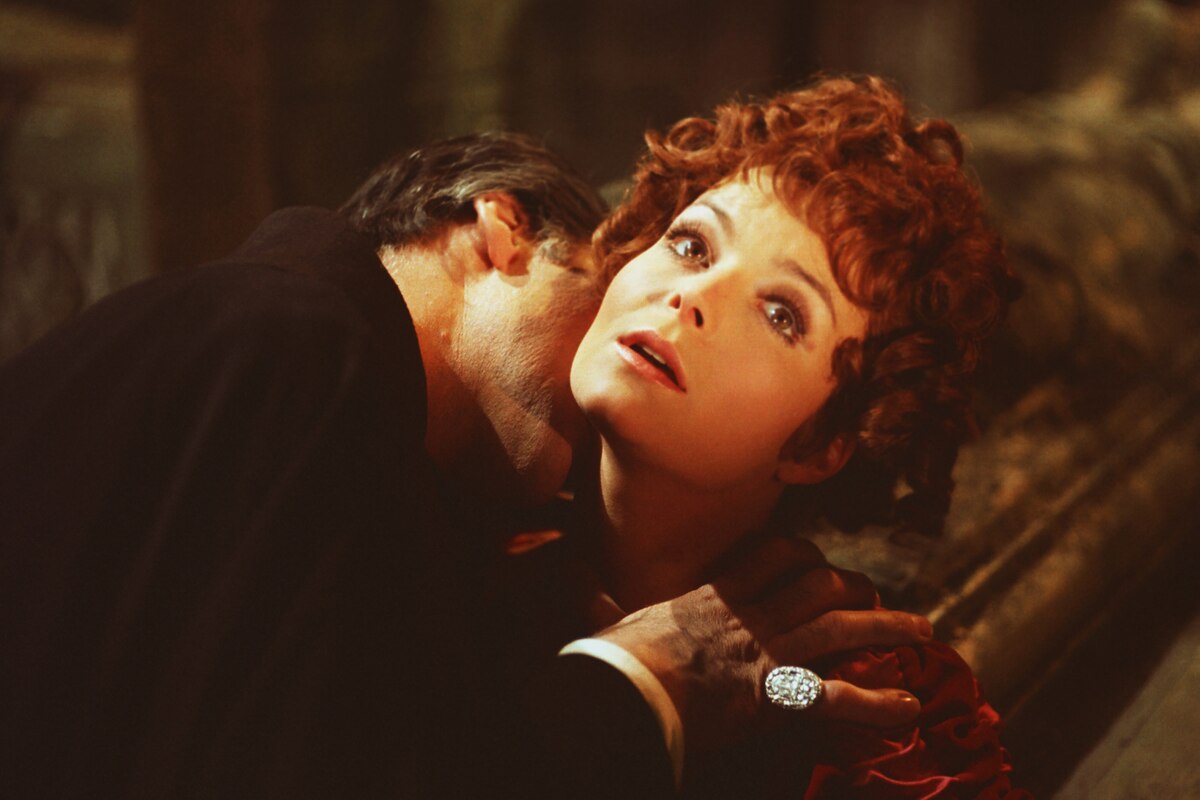
It begins, in fact, with the climactic scenes from the previous film, and picks right up from there. With Dracula dead, a man named Lord Courtley (Ralph Bates) acquires some of Dracula's blood in powdered form. He mixes it with his own blood, drinks the concoction, and is then beaten to death by three men who witnessed the spectacle. Courtley's body then forms a cocoon, out of which emerges a newly reborn Dracula (Lee), who goes on to exact revenge against the three killers mainly via their own children.
The casting of 29-year-old Ralph Bates -- in his first feature after years of television work -- played an important part in this film's production history. Dracula Has Risen From the Grave had been so financially successful that Lee demanded a higher salary to reflect what he thought was fair. The producers refused and simply decided to write him out of the next sequel. Originally, the script by Anthony Hinds had Lord Courtley beaten to death by the three men, only for Dracula's blood to then turn the dead Courtley himself into a new vampire -- played by Bates.
Warner Brothers, however, balked at this idea. The American studio was the co-financier of these films and expected Christopher Lee to continue playing Count Dracula, period; Hammer was forced to renegotiate with Lee and make it happen. An agreement was reached, the script was altered, and filming got underway in October 1969.
Once again, however, Lee vowed that this would be it for him: "I hope [this] will be positively my last film for Hammer," he wrote in a letter to his fans before production started. "The tasteful title is Taste the Blood of Dracula. As usual, words fail me... The only ray of hope is that we have an entirely new director, a young Hungarian called Peter Sasdy. So we can all pray for a fresh approach."
Sasdy had directed much television but this was his first feature. Lee worked with him to remove much of Dracula's dialogue, because, Lee believed, "There are far too many places...where lines are used and only action is necessary." Sasdy also handled well the film's high production values despite a fairly low budget, with attractive sets and cinematography injecting much style. James Bernard's score supplied an additionally lush and even romantic feel.
Filming lasted about seven weeks, and the movie opened in the spring of 1970. Variety observed, "[it] still has the shivery quality which hooks horror addicts," and The Hollywood Reporter deemed it "further proof that blood is thicker than water, that you can't keep a truly bad man down, and that Hammer knows what they are doing." The picture was such a big hit that another sequel, Scars of Dracula (1970), was rushed into production for release by the end of the year. A final chapter, Dracula A.D. 1972, appeared two years later. Both starred Lee, and afterwards he finally did retire the role.
Years later, reflecting upon this film, Lee concluded: "Good cast, good production, good story -- except that Dracula didn't really belong in it! Hammer was making the Dracula pictures too closely together at this time; six or seven years separated the first two, not six or seven months. No wonder audiences got tired of it all. I certainly did."
By Jeremy Arnold
SOURCES:
Donald F. Glut, The Dracula Book
Marcus Hearn and Alan Barnes, The Hammer Story
John Jewel, Lips of Blood
Tom Johnson and Mark A. Miller, The Christopher Lee Filmography
Taste the Blood of Dracula
by Jeremy Arnold | September 20, 2016
SIGN UP FOR OUR NEWSLETTERS

CONNECT WITH TCM