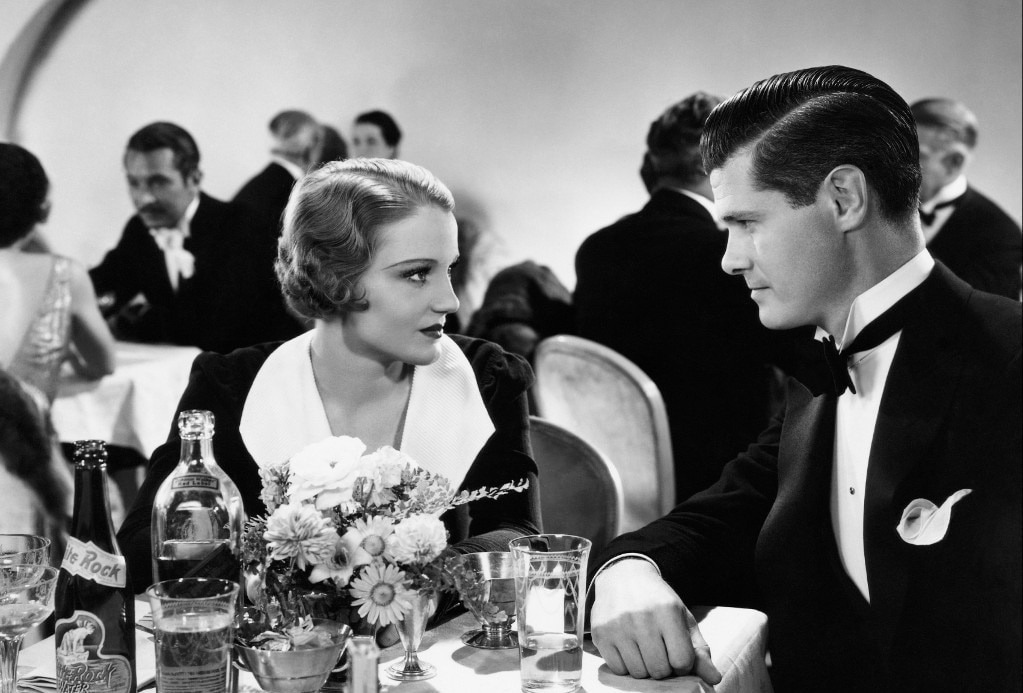
Broadway Through a Keyhole (1933) doesn't actually emanate much "Broadway" atmosphere, but it does boast pleasingly uninhibited pre-Code melodramatics, plus snappy dialogue and elaborate (if sparse) musical numbers. The screenplay, based on an original story idea by gossip columnist Walter Winchell, has a gangster (Paul Kelly) falling for a chorus girl (Constance Cummings), with the chorus girl falling for a crooner (Russ Columbo) -- setting up an angry confrontation with the gangster before both men reveal unexpected shades of character and resolve.
The chorus girl character was in part a thinly disguised take on the life of dancer/singer/actress Ruby Keeler, and Keeler's real-life husband, Al Jolson, did not take kindly to it. When he encountered Winchell at an open-air boxing match in Hollywood in July 1933, after the script was set for production, an argument and fisticuffs ensued; two weeks later, Winchell sued Jolson for $500,000 over the incident. Winchell also drew inspiration for the character, however, from the life of Ruth Etting, and the result was an unofficial composite of sorts. In any case, the incident between Winchell and Jolson reaped producer Darryl Zanuck a publicity bonanza and helped the film's box office. (Zanuck produced the film for his newly-formed 20th Century Pictures, which had a distribution arrangement with United Artists.)
One of the story elements that tied the Constance Cummings character to Ruby Keeler is that the film has Cummings working in the chorus for a club owner named Tex Kaley, played by the legendary speakeasy hostess/promoter/actress Texas Guinan, essentially playing herself. Keeler had previously worked for Guinan in real life. Guinan died shortly after this film's release, at age 49.
There's another famous showbiz personality on hand, too: Blossom Seeley, a veteran vaudeville star making a very rare film appearance, one of just three features she was ever in. She gets the chance to spout off numerous entertaining double entendres.
Leading lady Constance Cummings had already made nearly twenty pictures since starting her film career two years earlier, and in several ways Broadway Through a Keyhole paralleled her own rise to stardom from chorus girl beginnings. Shortly after making this film, she married Benn W. Levy, a distinguished British playwright and screenwriter whose screen credits included Blackmail (1929), Waterloo Bridge (1931), and The Old Dark House (1932). In 1935, after starring in Remember Last Night? (1935), Cummings would re-locate to England and resume her film and stage career there. She died in England in 2005, at age 95.
Cummings's leading man in Broadway Through a Keyhole is Russ Columbo, a highly popular romantic crooner of the era who was just starting what looked to be an impressive acting career. He'd had a few bit parts in recent years but now was being featured and billed prominently, and the industry and critics were taking notice; he garnered uniformly excellent reviews for his fine, sincerely-felt performance here. Sadly, tragedy struck. Ten months after this film's release, on September 2, 1934, Columbo died by accidental gunshot. After a dinner one night, a friend of Columbo's showed him an antique gun, unaware it was loaded. The lighting of a match triggered the explosive charge and a lead bullet was fired; it ricocheted off a table and struck Columbo in the face, and he died instantly. Columbo was romantically involved with Carole Lombard at the time of his death, and she, along with his family members, decided not to tell Columbo's mother what had happened, for fear the news would kill her, as she had recently suffered a heart attack and was in the hospital. Supposedly they kept up the ruse for years, even after Lombard's own death in a 1942 plane crash, until the mother died in 1944, by writing letters and telegrams and making up excuses for Russ not to see her. Columbo's final film, Wake Up and Dream, was released a month after he died.
Also in the cast are an assortment of fascinating bit players. Lucille Ball makes one of her earliest screen appearances, as a chorus girl; Dennis O'Keefe makes one of his almost 200 uncredited bit parts before he'd finally get credit in 1938, with greater success coming in the 1940s; Ann Sothern, as a singer, has her last uncredited bit before starting to get onscreen credit with Let's Fall in Love (1933); and the ubiquitous Charles Lane makes one of his own earliest appearances, though the word "earliest" in his case is relative; he'd already been in nearly twenty pictures since 1930. He'd go on to appear in over 350 total movies and television shows in a career as a character actor that stretched to 1995. He died in 2007 at age 102.
Director Lowell Sherman had had a prominent acting career stretching back to 1914, and in 1930 he started a transition to director. His resume as such includes She Done Him Wrong (1933), Morning Glory (1933), and Night Life of the Gods (1935). Broadway Through a Keyhole was his eleventh directorial effort. He would go on to complete two more films and then start directing Becky Sharp (1935), the first full-length 3-strip Technicolor feature. But during production, in December 1934, he died of pneumonia, and Rouben Mamoulian came on to complete the film. Had he not died, Sherman might well have gone on to a much more significant directing career.
Broadway Through a Keyhole was well received. "Granted that the story is far from wholesome," said The New York Times, "it does capture one's attention, chiefly through the forceful performance of Paul Kelly as Frank Rocci." Variety deemed Russ Columbo to be "surprise of the picture," and said he "may go places. He shows traces of camera shyness and unfinished delivery, but that can be overcome."
Variety also praised the musical numbers but said "more would have been welcome." Indeed, the movie downplays its numbers, though the few that are there are well staged. The songs by Mack Gordon and Harry Revel include "You're My Past, Present, and Future," "When You Were the Girl on the Scooter," "Doing the Uptown Lowdown," and "I Love You Pizzicato."
By Jeremy Arnold
SOURCES:
William M. Drew, At the Center of the Frame
William K. Everson, The New School program notes, July 1976
Michelle Morgan, The Mammoth Book of Hollywood Scandals
Broadway Through a Keyhole
by Jeremy Arnold | September 20, 2016
SIGN UP FOR OUR NEWSLETTERS

CONNECT WITH TCM