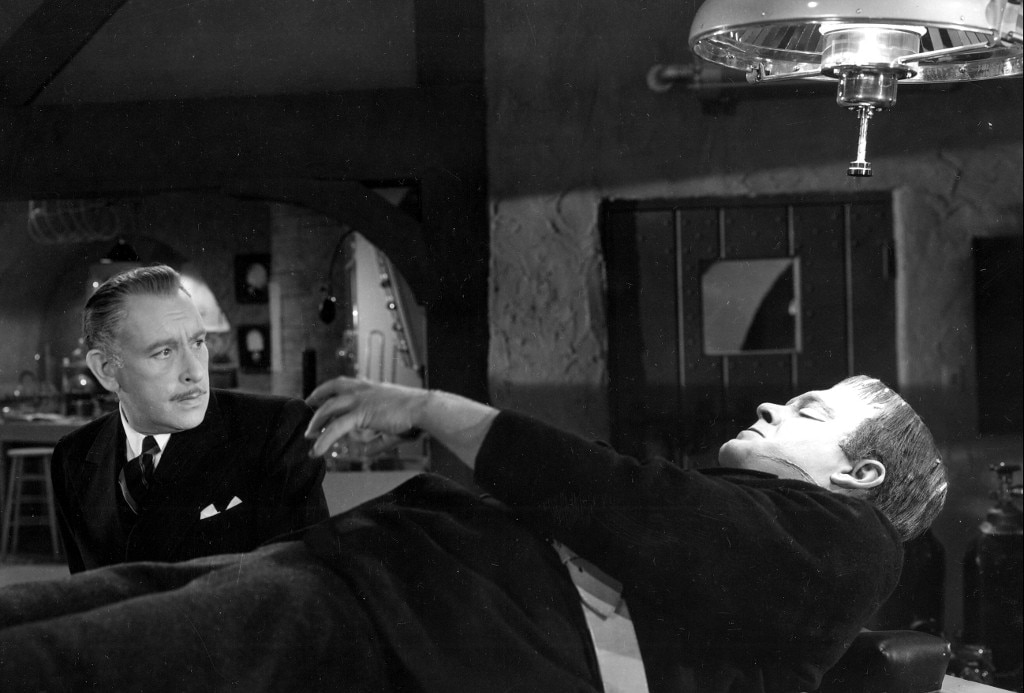
The Ghost of Frankenstein, the fourth film from Universal Studios to feature their defining version of Frankenstein's monster, picks up from where Son of Frankenstein (1939) left off, with the monster presumed dead in the sulfur pit beneath the castle. That's not enough for the angry villagers and they proceed to dynamite the castle to rubble just same, which cracks open the pits and frees the creature. Bela Lugosi reprises the role of the crook-necked Ygor, the doctor's demented assistant who befriends the misunderstood monster, and he leads the stiff, unspeaking creature to yet another son of Dr. Frankenstein, the brain surgeon Ludwig (Sir Cedric Hardwicke). Clips from the original Frankenstein are shown as Ludwig's daughter Elsa (Evelyn Ankers) reads from Henry Frankenstein's journals (now in the possession of her father) but the ghost of the title, a vision of Henry Frankenstein that convinces Ludwig to complete his experiments, is played by Hardwicke himself.
The Ghost of Frankenstein (1942) was the first Universal Frankenstein film that did not star Boris Karloff in role he originally created in the 1931 Frankenstein. In his place was Universal's newest horror star Lon Chaney Jr., the son of the legendary silent movie star Lon Chaney (himself a horror icon for The Phantom of the Opera, 1925, and London After Midnight, 1927). Chaney had appeared in dozens of films before playing Lenny in the big screen version of Of Mice and Men (1939), which immediately elevated his status in Hollywood, and then becoming a horror star in The Wolf Man (1941). For The Ghost of Frankenstein, he donned the heavy costume, elevated boots, and distinctive make-up designed by Universal's make-up wizard Jack Pierce, the man who turned Karloff into the original Frankenstein's monster. By this time Frankenstein's creation had devolved into a lumbering, uncommunicative, unkillable golem but Chaney is given a few scenes of empathy. It's the last film in the classic Universal horror cycle to give the creature a sense of pathos and pity.
Ygor was one of Lugosi's favorite roles and the only iconic horror character the actor created since becoming a star in Dracula (1931). Though he's only fifth-billed in the cast, Lugosi's Ygor dominates the film as both tormented outcast and vengeful villain, cackling with glee while dropping stones on the angry villagers from the castle turret. When Dr. Frankenstein decides to save his father's creation with a brain transplant, Ygor schemes with Frankenstein's bitter assistant (Lionel Atwill) to put his own brain into the hulking, superhuman creature. That twist was played up in the studio marketing, which encouraged theaters to place an empty chair in the lobby with sign reading: "Will you loan me your brain?"
The Ghost of Frankenstein was the final solo Frankenstein sequel. His next appearance was in House of Frankenstein (1944), the first in a series of monster mash team-ups produced on low budgets by the studio's B-movie unit. Ghost is a more modest production than Son and you can see the budgetary constraints in the modest castle in the opening scenes, the less elaborate laboratory set, and the reuse of standing sets. The town square built for All Quiet on the Western Front and recycled for the original Frankenstein is drafted into use once again for the village of Visaria, home to the second son of Frankenstein. And on the subject of recycling, four of the film's stars appeared a year earlier in The Wolf Man (1941), Universal's last original horror hit. Along with Lon Chaney Jr. and Bela Lugosi (who played a small but memorable role as a cursed gypsy), Ralph Bellamy and Evelyn Ankers take on major supporting roles similar. Director Erle C. Kenton, a veteran of Universal's B-movie unit, was a comedy specialist who began as one Mack Sennett's original Keystone Kops, but he did come to the film with a genuine horror movie classic to his credit: the original 1931 Island of Lost Souls.
In the worlds of Lugosi biographer Arthur Lennig, The Ghost of Frankenstein is "a fast-paced, melodramatic sequel that has survived the years satisfactorily... and is the last time that the monster was given the budget, direction, and script that he deserved."
Sources:
The Overlook Film Encyclopedia: Horror, ed. Phil Hardy. The Overlook Press, 1993.
The Immortal Count: The Life and Films of Bela Lugosi, Arthur Lennig. University Press of Kentucky, 2003.
Lugosi, Gary Don Rhodes. McFarland & Company, 1997.
The Frankenstein Files: How Hollywood Made a Monster, documentary directed and written by David J. Skal. Universal Studios Home Video, 2003.
IMDb
By Sean Axmaker
The Ghost of Frankenstein
by Sean Axmaker | August 30, 2016
SIGN UP FOR OUR NEWSLETTERS

CONNECT WITH TCM