"Harakiri," or "seppuku," which originated with the 12th century warrior culture in Japan, is ritual suicide by a sword in the belly. Reduced to its simplest elements, Masaki Kobayashi's 1962 film Harakiri is a samurai story that revolves around the practice of harakiri and its code of death before dishonor, which was epidemic in 17th century Japan when the Tokugawa clan consolidated power in a military dictatorship. During that period, samurai warriors who had been loyal to other clans wandered the country, unemployed, impoverished, and desperate. Tsugumo is one of those "masterless warriors," known as ronin, who arrives at the home of the Iyi clan asking permission to commit seppuku in their courtyard, as others had done before him. But Tsugumo has a complex plan for revenge, and suicide is only part of it.
Kobayashi had served in World War II, which he later called "the culmination of human evil," but he expressed his opposition to the war by refusing to accept promotions in rank. He also spent time as a POW. After the war, he resumed the film career which his military service had interrupted, and his films began to express his pacificist views. He commented on the Japanese warrior code of honor in The Thick-Walled Room (1953), and in The Human Condition trilogy (1959-61). But while those films were set in modern times and actually dealt with the war and its consequences, Harakiri was an allegory with a feudal setting. "In any era, I am critical of authoritarian power," Kobayashi said. "I think it was one of my weightiest films, and also crystallized my aesthetic consciousness."
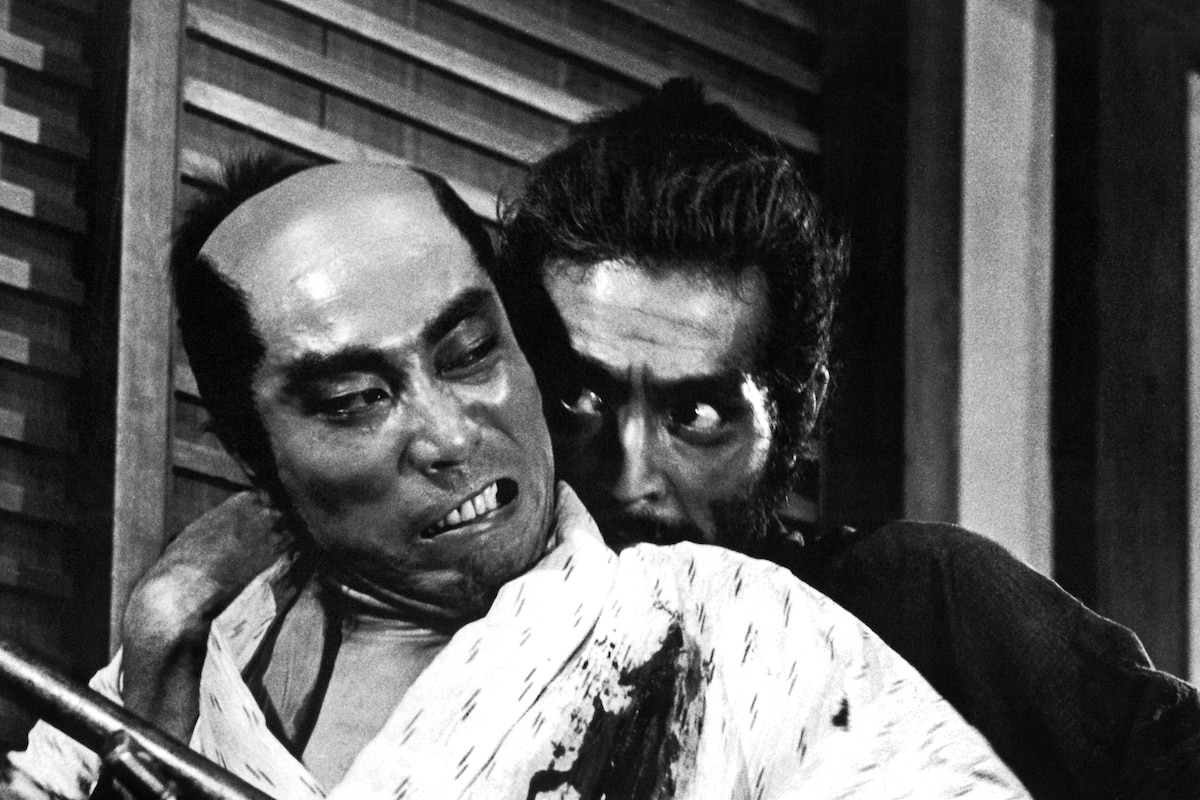
Shinobu Hashimoto, who had written several scripts for Akira Kurosawa, including Rashomon (1950) and The Seven Samurai (1954), both period dramas, wrote the screenplay for Harakiri. "It is about the solitary demeanor of the masterless samurai," Hashimoto said in an interview, and added that he wrote the film quickly, in just eleven days. But while the story and setting of Harakiri are historic, the style of the film is resolutely modern. Kobayashi employs elegant, formalist compositions, but also modern innovative techniques such as zooms and unusual framing, using the film's striking visual style to comment on the rigid, outmoded codes of behavior by which feudal society lived.
Also modern was the film's star, Tatsuya Nakadai, a theater actor who was discovered by Kobayashi in the 1950s and worked with him frequently, as well as with Kurosawa. Nakadai was only thirty when he appeared in Harakiri, and the character is about fifty, but Nakadai's intensity and his haunted, mournful eyes speak of years of pain and sorrow, as well as steely resolve. The actor recalled that Kobayashi stopped filming for three days to carefully choreograph the climactic fight scene with him. Kobayashi insisted on real blades in the scene, and when Nakadai expressed concern, the director dismissed his fears, saying "Just duck, and you'll be fine."
Harakiri was nominated for a Palme d'Or at the 1963 Cannes Film Festival, but lost to the Italian epic The Leopard. However Harakiri took home a Special Jury Prize, and was a huge hit in Japan, launching Kobayashi into the pantheon of Japanese directors of historical epics. Even the fusty, traditional New York Times critic Bosley Crowther, who found the film "curiously obfuscated...and inevitably tedious," admired Kobayashi's "exquisitely stark photography....Mr. Kobayashi does superb things with architectural compositions, moving forms and occasionally turbulent gyrations of struggling figures in the CinemaScope-size screen. He achieves a sort of visual mesmerization that is suitable to the curious nightmare mood."
In the decades since they were made, critical appreciation for Kobayashi's best films has grown, and Harakiri is acknowledged as much more than just a samurai movie. As Michael Sragow wrote in the Baltimore Sun in 2006, "Kobayashi was Kurosawa's peer, not just in style, but in iconoclastic potency. Harakiri upends all expectations...Kobayashi derives as much drama out of facial twitches as he does out of sword fights. And Nakadai delivers a performance that sweeps through the story like a lava flow."
Harakiri
by Margarita Landazuri | August 23, 2016
SIGN UP FOR OUR NEWSLETTERS

CONNECT WITH TCM