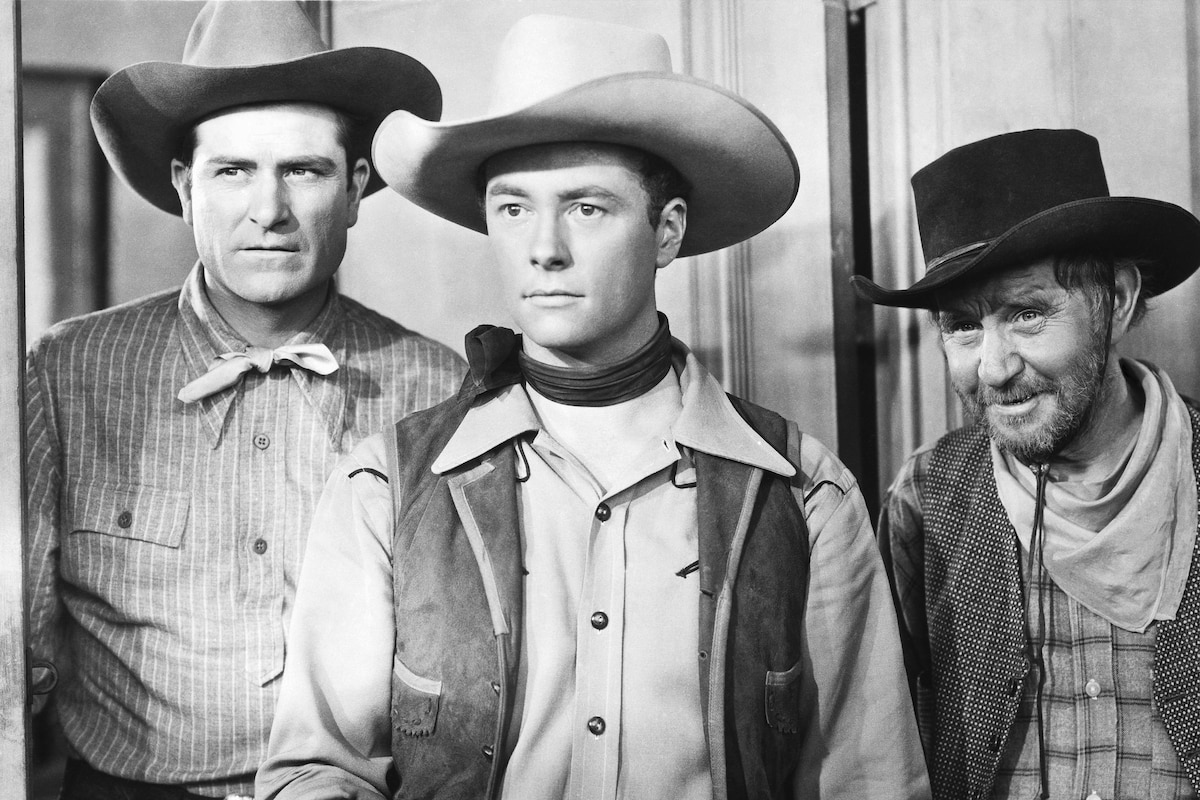
It's interesting that for a lot of people, Tim Holt is primarily known as the star of Orson Welles' second film in Hollywood, The Magnificent Ambersons. Interesting because before it and well after it, he starred in westerns almost exclusively. His other famous role, alongside Humphrey Bogart in The Treasure of the Sierra Madre, is much more in the comfort zone of Holt's career. He works well in The Magnificent Ambersons but he's a natural in a western. And westerns like Six Guns Gold were the movies that put him on the movie map.
If you've never heard of Six Guns Gold that's okay. It was never meant to be a marquee movie in the first place. Movies like Six Guns Gold were of a breed no longer nurtured by Hollywood: the quickie horse opera made cheaply and efficiently to turn a buck with matinee showings, especially with kids. And like most B movies coming out of Hollywood's heyday, it's an entertaining piece of work that reminds us once again that spending all the money in the world isn't necessary to make a piece of entertainment that people will want to see.
It's probably no surprise that in a movie where the lead characters are named Don, Smokey, and Whopper, that deep emotional development isn't on the menu. What is on the menu is a healthy serving of deceit, runaway stagecoaches, robbery, and star Tim Holt, as Don, coming to the rescue more than once.
Tim Holt began his career exactly how he predicted he would, as a western star. When he was in college, according to famed director Budd Boetticcher, Holt used to walk around practicing drawing his revolvers (it was a military academy) and announcing to everyone that he would soon be a western star. With a father already in the business, Jack Holt, it wasn't exactly a tough mountain for Holt to climb but, nonetheless, it can never be said Holt didn't know his own strengths early on.
He was signed by Walter Wanger in the mid-thirties and made the rounds in some small parts in big movies, like Stella Dallas and Stagecoach. Holt, of course, liked doing westerns most of all and RKO seemed to agree, eventually starring him in dozens over the years. His biggest early break came when he got the starring role in the Orson Welles directed The Magnificent Ambersons. Being a Welles film, it didn't do as much box office as RKO had hoped, which was one of the reasons Holt got the part in the first place: to try and bring in some of his growing fan base. It didn't work but it showed just how good an actor Holt really was. Later, he would co-star with Humphrey Bogart in the great The Treasure of the Sierra Madre. Not many actors can say they worked with King Vidor, John Ford, Orson Welles, and John Huston and earned the respect of all of them.
Six Guns Gold wasn't the kind of movie that was ever going to get Holt the respect he earned from those other films but like most B pictures of the thirties and forties, they were put together by a talented lot who knew how to produce something of quality quickly and efficiently. One of those people was David Howard, who started with Fox in 1930 directing Spanish language films for their markets in the southwest and Mexico. From there he made his way to RKO and B westerns before dying far too young in 1941 at the age of 45. Six Guns Gold was his penultimate film.
Another all-around talent on the set was Ray Whitley, country western singing star and expert with the bull whip. His specialty was whipping the cigarette out of a man's mouth in one stroke. No word if this had any effect on the man in question quitting the habit. He also just happened to design his own guitar which he took to the Gibson Corporation who worked with him on the model. The famous J-200 was the result and Whitley himself was the first to own and play one. Yes, the Six Guns Gold actor also had a feel for six strings as well. One other thing: Whitley wrote the iconic cowboy song, Back in the Saddle Again.
Six Guns Gold kept Tim Holt in the star's seat and after this and Magnificent Ambersons, he went to war, serving with distinction in the Pacific as a bombardier. After the war, he would work again with the great John Ford in My Darling Clementine before making the aforementioned Treasure of the Sierra Madre, his biggest hit. After that he returned to B-westerns for four years and then spent the next twenty years doing rodeos and managing a radio station. He died of bone cancer at the age of 54 but was later inducted into the Western Performers Hall of Fame. Six Guns Gold is a good film to watch to understand why.
By
Greg Ferrara
Six Guns Gold
by Greg Ferrara | August 15, 2016
SIGN UP FOR OUR NEWSLETTERS

CONNECT WITH TCM