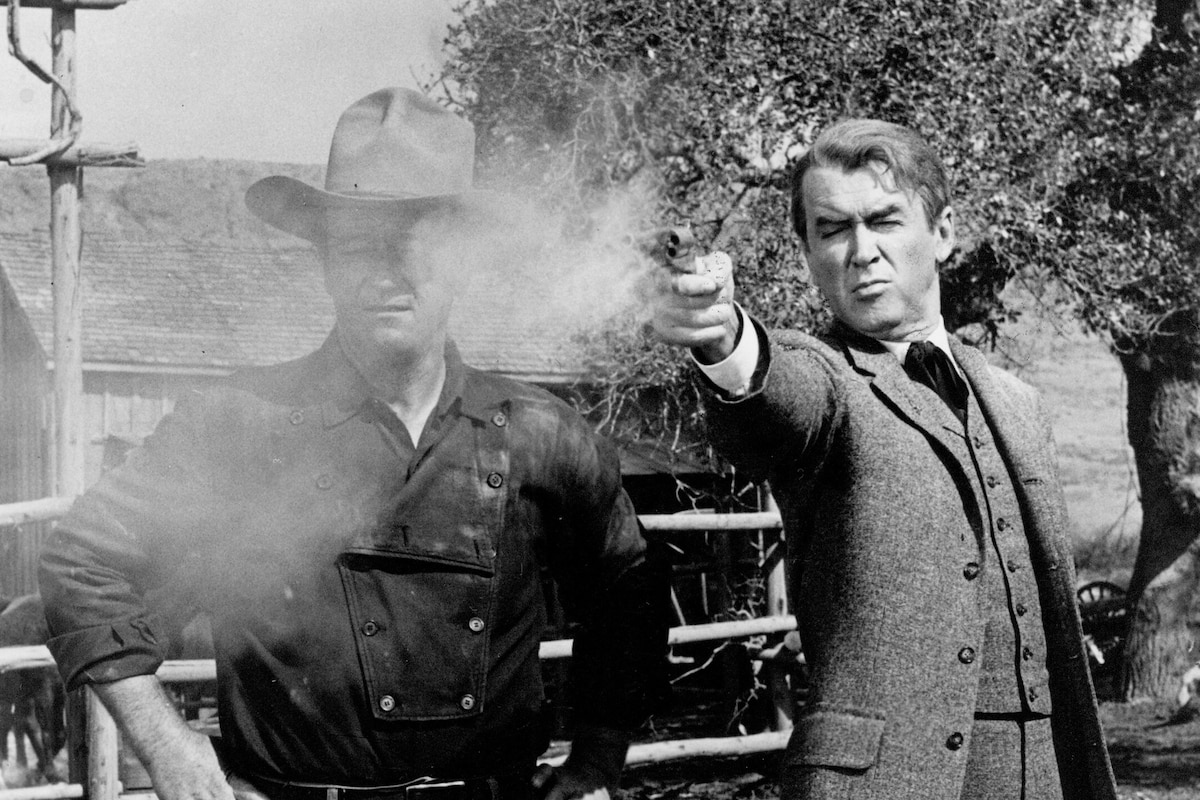
Sen. Ransom Stoddard and his wife Hallie, visitors from Washington, D.C.,
arrive in the Western town of Shinbone, where they met and married years before,
to attend the funeral of their old friend Tom Doniphon. The couple finds the
town changed from the lawless frontier they once knew. Except for a few old-
timers, no one in Shinbone even remembers Tom, once the toughest and fastest
gunman in the territory. Yet, everybody has heard about Stoddard, the man who
shot Liberty Valance, a murderous outlaw who terrorized the town until his death
brought law and order to the district. While Doniphon's simple coffin is readied
for a pauper's burial, reporters gather around Stoddard with questions about his
life and past deeds. But the senator insists on setting the record straight
about the incident that made him famous.
"When the legend becomes fact, print the legend." The most memorable line from
The Man Who Shot Liberty Valance might also be the motto for John Ford's
career. Although he directed in a wide range of genres, Ford is best known for
his Westerns, and along with writer Zane Grey, artist Frederick Remington and
perhaps a few others, no one did more to forge the myths of the Old West
its heroes and villains, its codes and philosophies, the look and sound and feel
of it. Ford's perspective is often a romantic, even sentimental vision of our
historical past, but it's a viewpoint that confirms the indomitable nature of
America's Western pioneers.
The Man Who Shot Liberty Valance predates by just a few years
"revisionist" Westerns like Sam Peckinpah's The Wild Bunch (1969) and
even Ford's own Cheyenne Autumn (1964), in which the brutality and
ambiguous morality of America's relentless drive across the continent were
thrown into a harsher light. This film is not exactly a reversal of Ford's
vision of the frontier, but it is shot through with the darkness, regret and a
touch of cynicism of an older and wiser man. Once again, as in two of his
greatest works, My Darling Clementine (1946) and The Searchers
(1956), we get the struggle between individual and society, between wilderness
and civilization, between wild nature and tamed garden (represented here by the
desert rose cactus bloom Tom brings to Hallie and by Sen. Stoddard's massive
irrigation project). What's missing are the elegant vistas of Monument Valley, a
place Ford immortalized on screen, and the strong sense of destiny and history.
The film is dark and confined, shot on a sound stage instead of the outdoors.
Destiny here is more a matter of accident and misunderstanding, and history
depends entirely on who's telling it and why.
Ford's decision to shoot the entire film in black and white at the studio was
taken by some reviewers of the time as a sign that the venerable filmmaker was
becoming lazy and careless in his twilight years. New Yorker film critic
Pauline Kael, who had criticized Ford's Western films of the forties for
overemphasizing the pictorial beauty of the frontier, disliked this film for
never venturing outdoors. But many have reevaluated the look of The Man Who
Shot Liberty Valance, seeing in its murky darkness and confined spaces a
reflection of the story's thematic gloom and pessimism. Foregoing the historical
sweep of his cavalry films and other classics, Ford concentrates here on the
characters and their often-suppressed emotions, motives, and truths.
Even in this, however, the film came under fire for employing actors (notably
Stewart) who were far too old to play themselves in flashbacks to their earlier
days. A look back, however, reveals not a cavalier casting decision but the
effect of playing with the notions of truth, legend and history inherent in the
story. We don't see the characters realistically as they were years earlier but
as projections of their memories which have been distorted by legend and the
fateful acts from which there is no escape.
Director: John Ford
Producer: John Ford, Willis Goldbeck
Screenplay: James Warner Bellah, Willis Goldbeck, based on a story by Dorothy M.
Johnson
Cinematographer: William H. Clothier
Editor: Otho Lovering
Art Director: Eddie Imazu, Hal Pereira
Original Music: Cyril J. Mockridge
Cast: John Wayne (Tom Doniphon), James Stewart (Ransom Stoddard), Vera
Miles (Hallie Stoddard), Lee Marvin (Liberty Valance), Edmond O'Brien (Dutton
Peabody), Andy Devine (Marshall Link Appleyard)
BW-124m. Letterboxed. Closed
captioning.
by Rob Nixon
