A revisionist Western that makes complex statements about the nature of
race, identity, and loyalty, Run of the Arrow (1957) is a key film in the
oeuvre of renegade director Samuel Fuller. Though Fuller was often
criticized for lacking a social conscience - his taste for lurid pulp
fiction usually excluded it - this picture paints as open-minded an image of
the American Indian as you're likely to find in 1950s cinema. The main
character, played by Rod Steiger, actually sides with the Indians for the
better part of the film, a stance that runs decidedly counter to what John
Wayne and his ilk had been doing for the previous 20 years.
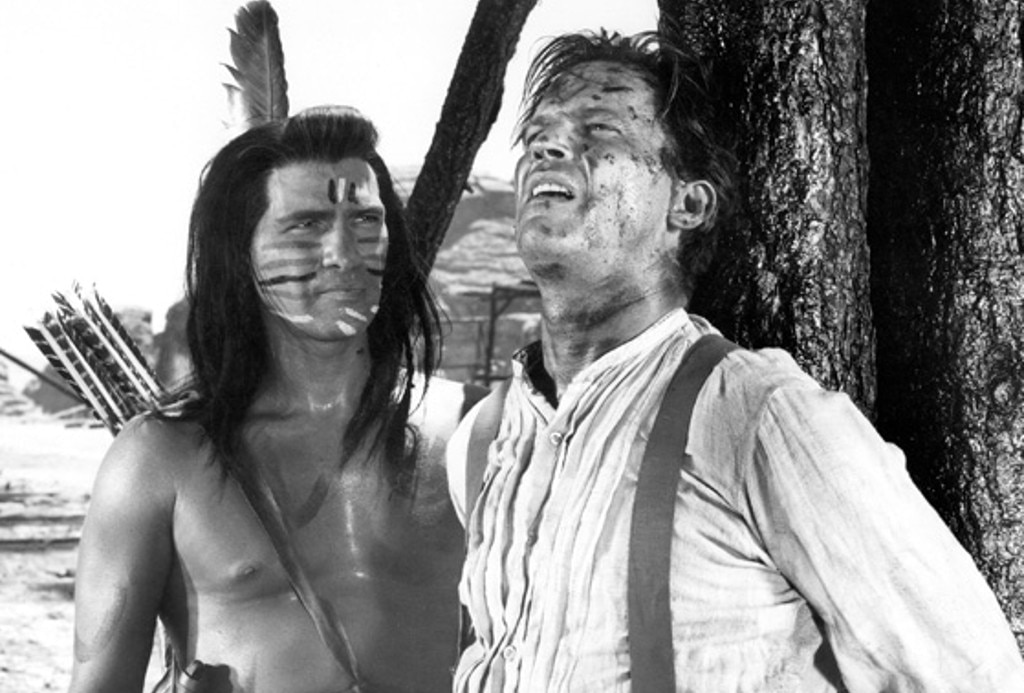
Steiger plays Pvt. O'Meara, a Confederate soldier who fires what turns out
to be the final shot of the Civil War. A Union lieutenant named Driscoll
(Ralph Meeker) is on the receiving end of the bullet, but he recovers from
his wound. Unwilling to accept the "death" of his beloved South once the
peace treaty is signed at Appomattox, O'Meara heads West. There, after
establishing his worthiness through an endurance test known as "the run of
the arrow," he joins a Sioux Indian tribe. Eventually, he falls in love
with a beautiful maiden named Yellow Moccasin, played by Sarita Montiel, whose voice was dubbed by RKO contract player Angie Dickinson!
Tension mounts when the U.S. Army, lead by Lt. Driscoll, builds Fort Abraham
Lincoln just beyond the edge of a hallowed Sioux hunting ground. When a
popular captain (Brian Keith) is killed by an enraged Sioux warrior (H.M.
Wynant), Driscoll uses that as an excuse to attack the Indians. This leads
to a failed peace-keeping attempt by O'Meara, and an exceptionally bloody
battle in and around the fort. The ambiguous finale suggests that O'Meara
is finally done with his personal Civil War, but remains torn between the
Sioux and the world he left behind.
Steiger never met a piece of scenery he couldn't chew, but he's actually
well-suited to Fuller's bulldozing method. Though he seldom enjoyed the
luxury of a big budget, Fuller pushed the boundaries of what could be
accomplished by commercial filmmakers, with a blunt primitivism that was
championed by the French New Wave critics of the 1960s, and ultimately
influenced such directors as Martin Scorsese and Quentin Tarantino. The
often hysterical melodrama of Fuller's scripts can overshadow just how
brilliantly he employs his camera. Run of the Arrow is as fluidly
and economically shot as any of his films.
In Sam Fuller: Film is a Battleground by Lee Server, the director recalled the sequence toward the beginning of Run of the Arrow where Steiger says goodbye to his mother: "The Confederate in that scene who sang the song against the Constitution was played by a Southerner, whose hobby was collecting folklore and ballads. He loved it, being a Southerner and against the damn Yankees. My art director on the picture was a very virulent Yankee. I'm only telling you this because there's an evil streak in me that I like. I thought it would be wonderful to get them together in my office. I'll never forget it; it was the most wonderful moment of my life to introduce these two men who despised each other. They immediately got into a tremendous argument. I heard the whole Civil War fought all over again in my office." Fuller also commented on the famous "run of the arrow" sequence: "I shot that scene without my star. Steiger sprained his ankle right before we shot it, and he was taken off to the hospital. I used a young Indian in his place. Nobody noticed it. They thought I was being highly creative, highly artistic: "Imagine! Almost a boy wonder, a genius! Sensational! The way he shot it by just showing the feet!" Well, I would have shot about eighty per cent of the scene with just feet anyway, because that's the whole idea of the Run. But occasionally I would have liked to whip up with the camera and show Steiger's face."
Movie buffs will note the similarities between Run of the Arrow and
Kevin Costner's Oscar-winning epic, Dances with Wolves (1990). Both
films feature disheartened lead characters who journey West at the end of
the Civil War, only to find new strength in the culture and teachings of the
Sioux Indians. In due course, both men are forced to test their new-found
beliefs when other war veterans arrive on Sioux land, guns at the ready.
Fuller, however, is somewhat more inclined to let bullets and tomahawks do
the talking than Costner is. After all, he was making B-pictures, not
sensitivity training films.
Though supporting actor Tim McCoy was an Indian agent who started his film
career as a technical advisor on silent Westerns, it seems unlikely that he
did much advising on Run of the Arrow. The Sioux, for instance,
would never kiss on the lips as shown in the movie. And, though Fuller
suggests they're ready to skin a person alive at one point, they were never
proponents of torture.
There's certainly overstatement in the finished product, but Fuller refused
to pull punches at a time when his much more honored peers were busy minding
their manners. His white-hot passions permeate Run of the Arrow,
making it one of the more fascinating entries in a truly American body of
work.
Producer/Director: Samuel Fuller
Screenplay: Samuel Fuller
Art Direction: Albert S. D'Agostino, Jack Okey
Cinematography: Joseph Biroc
Film Editing: Gene Fowler, Jr.
Original Music: Victor Young
Cast: Rod Steiger (O'Meara), Sarita Montiel (Yellow Moccasin), Brian Keith (Capt. Clark), Ralph Meeker (Lt. Driscoll), Jay C. Flippen (Walking Coyote), Charles Bronson (Blue Buffalo), Olive Carey (Mrs. O'Meara), H. M. Wynant (Crazy Wolf), Frank DeKova (Red Cloud).
C-86m. Letterboxed.
By Paul Tatara
Run of the Arrow
by Paul Tatara | October 30, 2002
SIGN UP FOR OUR NEWSLETTERS

CONNECT WITH TCM