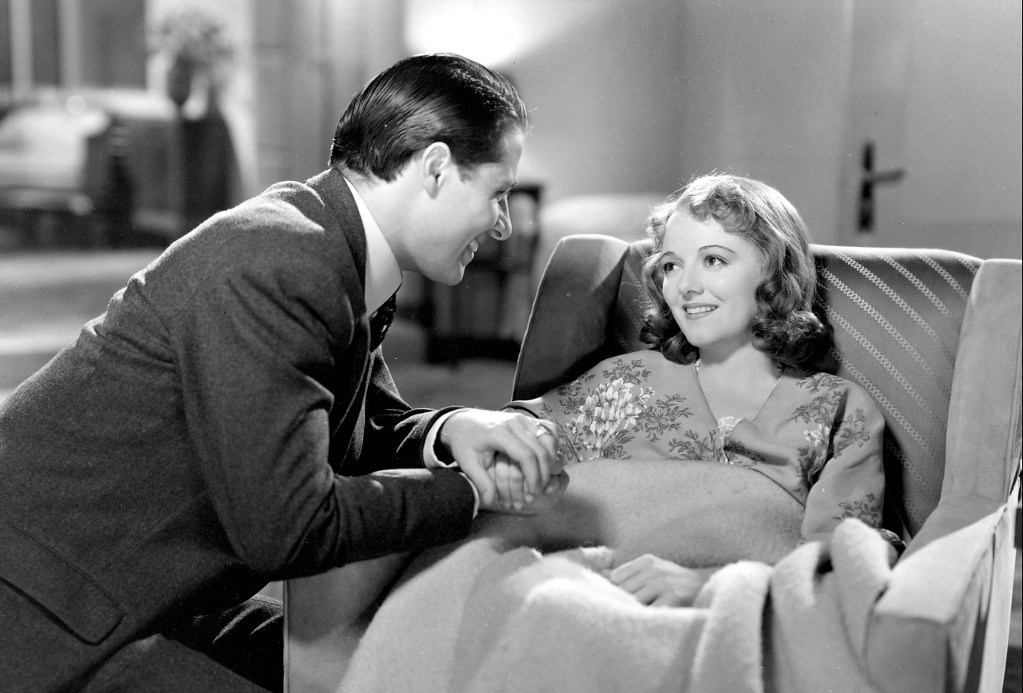
Twentieth Century-Fox's Ladies in Love (1936) was all about the ladies. Despite the men in the cast, it was Janet Gaynor, Loretta Young, and Constance Bennett who were billed above the title, with Simone Simon just underneath, followed by the men: Don Ameche, Paul Lukas, Tyrone Power (billed here as Tyrone Power, Jr.) and Alan Mowbray. Also in the cast were Wilfrid Lawson, best known for playing Eliza Doolittle's father in Pygmalion (1938), Virginia Field, and Lynn Bari continuing her bit parts at Fox before the studio advanced her to leads in the 1940s.
Directed by Edward H. Griffith, from a screenplay by Melville Baker, Ladies in Love was based on the play by Ladislaus Bus-Fekete, later published as the novel Three Girls in 1937. The film was intended for Gaynor, as Motion Picture Daily revealed when they featured an ad in the spring of 1936 announcing that the film would go into production starring "Janet Gaynor and Two Other Stars in Ladies in Love . Two feminine stars of comparable rank will be signed for this important picture." Gaynor had been a star of the first rank for The Fox Film Corporation since the 1920s, when she had won an Academy Award for three films she made for William Fox in 1929, Sunrise, Street Angel, and Seventh Heaven . In 1935, she signed a new contract with the studio that gave her more creative control and the obligation for only two pictures a year at $115,000 each. Only a few months later, The Fox Film Corporation merged with Twentieth Century Pictures, and suddenly Gaynor wasn't the most important leading lady at the studio. In addition, her contract, which called for her to be the main star of her films, was ignored in favor of a new policy enacted after a poll of Fox exhibitors showed that audiences wanted films with more than one star. That policy would lead to Gaynor being costarred with Bennett and Young in Ladies in Love .
Set in Budapest, Ladies in Love is a convoluted tale of three girls, Susie Schmidt, a chatterbox chorus girl (Young) who wants to be independent, Yoli Haydn (Bennett), a model who is after a rich man, and Martha Kerenye, baroness reduced to poverty after World War I, who just wants a good home and a family (Gaynor). Unlike the other two, Martha works odd jobs, including selling ties and feeding rabbits owned by Dr. Rudi Imre (Ameche), but when he can't pay her, she goes to work as housekeeper/valet for a magician, Paul Sandor (Mowbray). Yoli falls for John Barta (Lukas), who is in Budapest temporarily before returning to South America, and whose "cousin by marriage" - the apparently teenaged Marie Armand (Simon, new to America and to English) shows up at his apartment unannounced. The oddest tale is of Susie, who has a two week romance with Karl Lanyi (the barely seen Tyrone Power), and decides to commit suicide when she discovers he's about to be married to the Countess Helena (Virginia Field).
The storyline is frankly confusing; leading the viewer to think it had been put together quickly and edited haphazardly. For example, Susie goes from meeting Karl to revealing that she has already told him she loved him. We don't see this scene and we don't know how much time has passed since they met. This time warp continues throughout the film, which we learn in the end has occurred in the space of only four weeks. There are twists and turns, and two of the three women don't end up with the men the audience expects, which goes against the norm of Hollywood narratives.
Frank S. Nugent, in his review for The New York Times wrote that the story was sectioned into plots starring each actress, which might have been titled, "I Loved and Lost a Count," by Miss Young; "So I Married the Doctor," by Miss Gaynor; "I Learned Too Late That You Can't Play at Love," by Miss Bennett, and "Never Take No For an Answer," by Miss Simon. [...] Paul Lukas, Tyrone Power Jr. and Don Ameche play the passive lovers with complete resignation, gratefully accepting the few dramatic crumbs the ladies brushed from their make-up tables [...] The only non-subordinate male in the cast is Alan Mowbray as Sandor the magician, who employs Miss Gaynor as his valet and makes love to her in a purely self-reassuring way. "You do love me? Good! I was afraid I was slipping," Sandor remarks complacently. Mr. Mowbray has been a great help in rescuing the picture from its romantics."
The exhibitors weren't pleased with the film, saying that the actresses were fine, but the story tried to cover too much and was confusing. From complaints in the Motion Picture Herald , it seems the box office receipts weren't what they expected. Robert K. Yancey, the owner of the Paradise Theater in Cotter, Arkansas, wrote, "If anyone cared for this I have never found them."
For Janet Gaynor, Ladies in Love was the last straw. She put out a press release stating that her "contract with Twentieth Century-Fox ended with the release of Ladies in Love . I was asked to make a new term contract with the company, but several days ago, [...] I notified Mr. [Darryl] Zanuck I would not make a new contract." Gaynor would star in two more films after Ladies in Love for David O. Selznick, A Star is Born (1937), which earned her an Academy Award nomination, and The Young in Heart (1938). Shortly after, she married MGM costume designer Adrian, had a son named Robin, and retired from the screen until 1957, when she returned to 20th Century-Fox to play Pat Boone's mother in Bernardine .
By Lorraine LoBianco
SOURCES:
Carman, Emily Independent Stardom: Freelance Women in the Hollywood Studio System
Yancey, Robert K. "Letter to the Editor" Motion Picture Daily April 1936
Motion Picture Herald Jul-Aug 1937
Nugent, Frank S. "A Bid for the Feminine Trade Is 'Ladies in Love,' at the Rivoli" The New York Times 29 Oct 36
Ladies in Love
by Lorraine LoBianco | July 11, 2016
SIGN UP FOR OUR NEWSLETTERS

CONNECT WITH TCM