From as early as 1941, when he was creating a stage show for the Department of Agriculture in New York, director Elia Kazan had toyed with an idea for a project that eventually would emerge as the film Wild River (1960). Kazan was interested generally in the way government agencies relate to "flesh-and-blood" people. More specifically, he was concerned about those affected by the Tennessee Valley Authority, the federal agency formed in 1933 to provide flood control, economic development and other resources to the Tennessee Valley, a region grimly affected by the Great Depression. Kazan envisioned the project as his homage to President Roosevelt and the "New Deal."
Over the years, Kazan worked at creating his own screenplay for the anticipated film, but was not pleased by the results and asked for help from his friend, playwright/screenwriter Paul Osborn (author of the screenplay for Kazan's 1955 East of Eden). Osborn declined to work on the project but apparently continued to think about it. Kazan enlisted two other screenwriters, Ben Maddow and Calder Willingham, to try their hand at the material. Several drafts later, they too had failed to come up with a script that Kazan liked.
During this process, 20th Century-Fox acquired the rights to two novels covering much of the same ground: Borden Deal's Dunbar's Cove, about a battle of wills between TVA authorities and generations-old land owners; and William Bradford Huie's Mud on the Stars, which tells of a rural matriarchal family and their reaction to the destruction of their land. Finally, Osborn returned to work with Kazan, blending the original idea with those in the two books. He succeeded in at last pleasing the director and was given sole credit for the screenplay for Wild River, with appropriate nods to Deal and Huie. The film marked a breakthrough in films for Huie, whose novels had previously been considered too controversial for the screen. Subsequent movies made from his books would include The Outsider (1961) and The Americanization of Emily (1964).
Kazan's original idea for a central figure in Wild River was an older, idealistic Department of Agriculture functionary, much like one he had worked for years before. His thought was to cast Burl Ives in the role. But as he and Osborn developed the script, they realized that a younger and sexier character at the center of the story would give their movie more energy and commercial appeal. As eventually written, the screenplay follows Chuck Glover, a youngish New Dealer of the 1930s who is sent from Washington to buy land that would be inundated when the TVA changes the course of the Tennessee River, and to resettle its occupants. Among these is the Garth family, which farms an island in the river and are led by the fierce matriarch Ella Garth, who is in her 80s and refuses to budge from her land. Adding further tension to the situation, Chuck falls in love with Ella's widowed granddaughter, Carol.
Kazan originally wanted Marlon Brando for the leading role, but eventually settled on Montgomery Clift despite reservations about his dependability. Clift had become dependent upon drugs and alcohol after a horrific automobile accident that had marred his handsome face and wrecked his body. It was common knowledge that he had had a difficult time getting through his previous movie, Suddenly, Last Summer (1959). Kazan recognized Clift's talent, having directed him onstage in his 1942 production The Skin of Our Teeth. He had offered the actor choice leading roles in his films On the Waterfront (1954) and East of Eden (1955), although Clift turned down both. Now Kazan said bluntly, "I can't work with a drunk," and made Clift promise that he "would not take a drink from the first day of work to the last." Clift, who had tremendous respect for his director, did his best to comply and from all reports was largely successful, delivering a performance that is focused and intense.
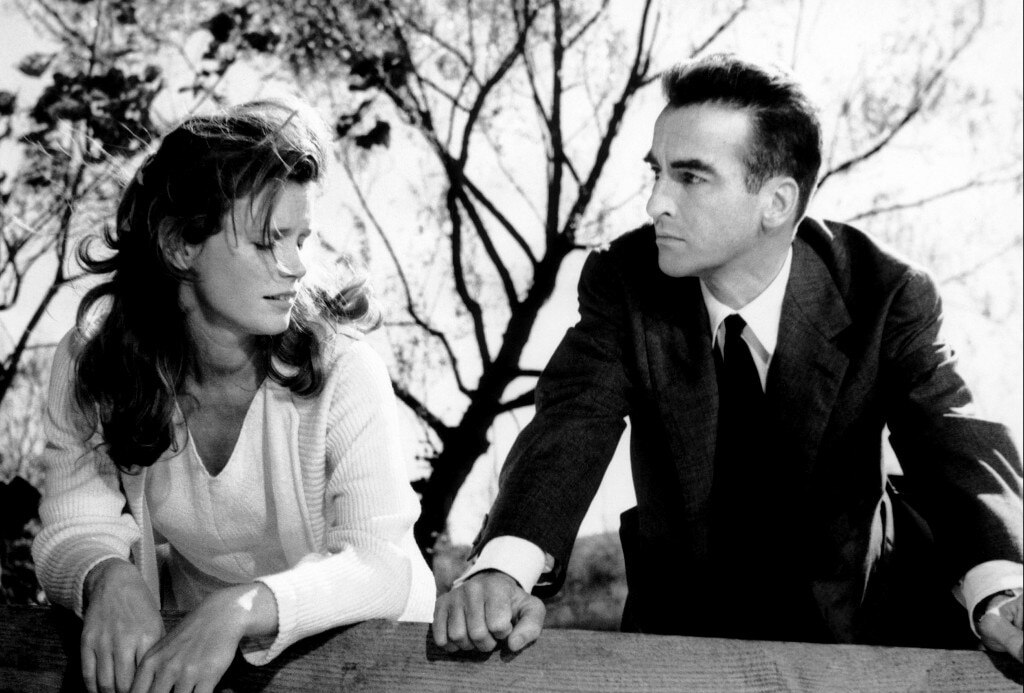
Kazan wrote in his memoirs that, as he worked on Wild River, "I discovered an astonishing thing. I'd switched sides... My hero was to be a resolute New Dealer engaged in the difficult task of convincing 'reactionary' country people, for the public good, for them to move off the land... Now I found my sympathies were with the obdurate old lady who refused to be patriotic." He also found the dynamics of the film changing because of the casting of Clift: "He'd be no match for the country people whom he'd have to convince of the 'greater good,' and certainly no physical match for any of them if it came to violence. Pictorially, the story would pit the weak against the strong-- in reverse."
Kazan readily accepted these changes, "and reinforced the pattern with every bit of my casting." Forty-four-year-old Jo Van Fleet, who specialized in characters much older than herself and had won an Oscar playing an aged woman in Kazan's East of Eden, was cast as Ella Garth. Kazan wrote that he knew she "would eat Clift alive" in their scenes together, and proceeded to let her do just that. As the gentle but strong-willed Carol, Kazan cast Lee Remick, whom he had directed in A Face in the Crowd (1957) and considered to be "one of the finest younger actresses" of the period as well as "an exceptional person." First he had to fend off an "absurd" casting idea by producer Buddy Adler that Carol should be played by Marilyn Monroe. In the film, Kazan takes full advantage of the fact that Remick would be dominant while Clift was "sexually uncertain." This uneven match of personalities lends an unusual and delicious tension to their love scenes.
Wild River was the first major motion picture to be shot in its entirety in Tennessee. Filming took place in Bradley County--in the towns of Cleveland and Charleston, at Lake Chickamauga and along the banks of the Hiwassee River--over a period of two and a half months beginning in November 1959. It was estimated that locals with no previous acting experience filled 80 percent of the film's approximately 50 speaking parts. A large set representing the Garth farmhouse, which took two months to build at a cost of $40,000, was burnt to the ground for a climactic scene.
A long list of working titles had been created for the movie including Mud on the Stars, Time and Tide, The Swift Season, As the River Rises, God's Valley, The Coming of Spring and New Face in the Valley. Kazan spent six months cutting his film, which was released in July 1960. A black-and-white prologue shows actual footage from the infamous Tennessee River flood which caused great destruction and took many lives, followed by an interview with a real-life survivor. An offscreen narrator provides historical background about the formation of the TVA.
Kazan felt that Fox never gave the movie a fair chance in its distribution, booking it "thinly" in the U.S. and not bothering with exhibition in Europe until Kazan "staged a stormy scene" in the office of studio head Spyros Skouras. "Money makes the rules of the market," Kazan wrote in his memoir, "and by this rule, the film was a disaster." It remained, however, a personal favorite of the director's. Critical reaction at the time was mixed, although Wild River was voted eighth runner-up for Best Picture of 1960 by the National Board of Review. The film has found champions among modern-day critics, with Dave Kehr of the Chicago Reader calling it "probably Elia Kazan's finest and deepest film, a meditation on how the past both inhibits and enriches the present."
Sources: A Life by Elia Kazan, 1988
Elia Kazan: A Biography by Richard Schickel, 2005
Monty: A Biography of Montgomery Clift by Robert LaGuardia, 1977
Montgomery Clift: A Biography by Patricia Bosworth, 1978
By Roger Fristoe
Wild River
by Roger Fristoe | July 06, 2016
SIGN UP FOR OUR NEWSLETTERS

CONNECT WITH TCM