Spencer Williams will likely always be best known for playing Andrew H. Brown, aka Andy, on the TV incarnation of the long running comedy Amos 'n' Andy. It gave him the biggest audience he ever had but his career was much richer than that single role. He was an actor, screenwriter, recording artist, and pioneering African American filmmaker. Beginning his film career as sound recording technician for Hollywood producer Al Christie on a series of black-cast short films, he ended up working on all aspects of production behind the camera as well as performing in front of it. He went on to play bit parts in Hollywood productions and major parts in the "race" features produced for African American audiences, including a series of westerns starring Herb Jeffries (some of which he also wrote). He was a movie veteran by the time he directed his first film, the landmark The Blood of Jesus (1941), made in a tiny budget for Texas-based producer Alfred R. Sack, who was the dominant distributor of black-cast films of the era. It was a hit and a partnership was born. Williams directed ten films for Sack over the decade.
Dirty Gertie from Harlem U.S.A. (1946), one of their last productions, is an unauthorized adaptation of W. Somerset Maugham's short story "Miss Thompson." It had already been turned into a play (Rain) and brought to the screen twice (as Sadie Thompson, 1928, and Rain, 1932). Williams' version, from a screenplay credited to True T. Thompson, relocates the setting from the South Pacific to a fictional Caribbean island called Rinidad and transforms its title character, renamed Gertie La Rue, from a prostitute to a celebrity headliner in a nightclub act (her exact talents are vague but one fan remembers seeing her striptease act two years before). She earned the name "Dirty Gertie" for her philandering ways and had to flee Harlem after cheating on her man. Before the curtain rises on her first show, she is courted by a sailor, a Marine officer, and the owner of the local show palace.
Francine Everett (her last name is misspelled as Everette in the credits) stars as the glamorous Gertie. Everett was a singer, dancer, and actress who went to Hollywood in the 1930s with her husband, Rex Ingram, but turned down the stereotypical roles offered black actors and instead turned to low-budget race films. She was a striking beauty and Dirty Gertie gave her the chance to play a glamorous, sexy black woman never seen in Hollywood pictures. In addition to her film roles, she was a featured vocalist in over 50 "soundies" (short musical films) and a popular fashion model. She was one of the last of the leading ladies of all-black films and made her final screen appearance in an unbilled part in No Way Out (1950), which marked the film debut of Sidney Poitier.
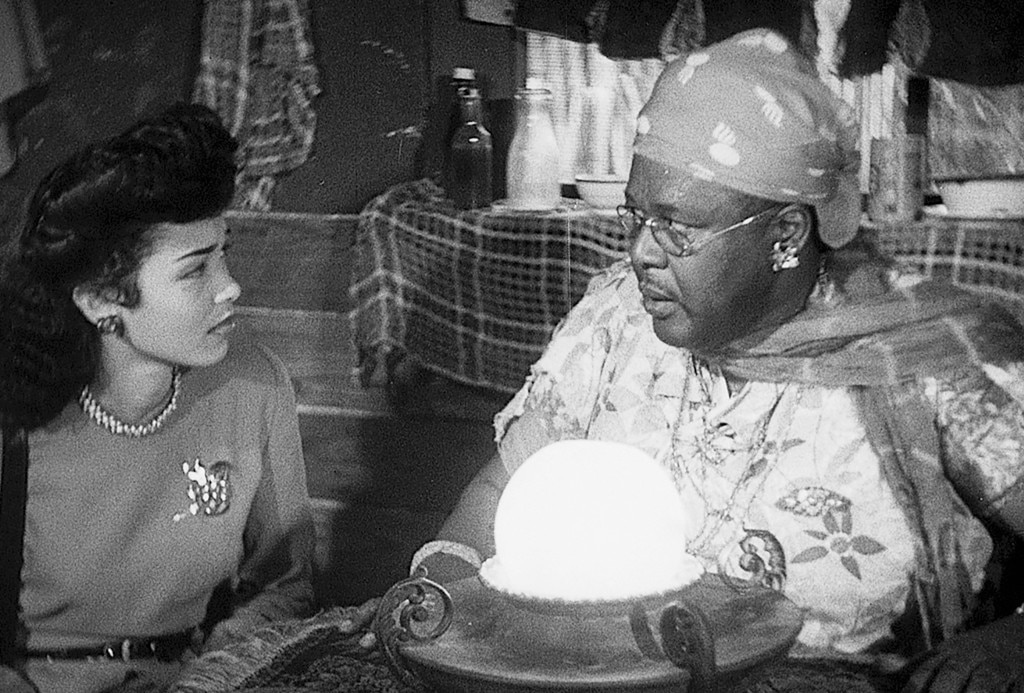
Williams himself takes on a small but memorable role: the "voodoo woman" Old Hager, who sees no good in Gertie's future. In some ways he anticipates Tyler Perry, playing the voice of fate in drag, but with his visible mustache and a husky voice, Williams barely bothers with the pretense of playing a wizened old woman beyond wearing a shapeless muumuu and gypsy jewelry. The weirdness of the scene, however, adds to the tension as a black cat and a broken mirror bring out Gertie's superstitions.
Dirty Gertie from Harlem U.S.A. was shot in Dallas, Texas, where the tropical island setting is recreated on a budget smaller than a typical Hollywood B-movie. It was a success on the race circuit but virtually unseen by white audiences and it was one of the last films he directed. The all-black film circuit disappeared in the 1950s, as Hollywood began to integrate its films and feature black actors and actresses in major, non-stereotyped roles. Their low budgets and primitive technical resources could not compete with Hollywood polish and the race circuit went the way of vaudeville. For years the film, which had fallen into the public domain and was virtually abandoned but for dedicated archives (such as Southwest Film-Video Archives in Dallas), was available to the public only on horribly degraded, poor-quality VHS tapes and DVDs. This new restoration was mastered from 35mm film elements preserved by the G. William Jones Film and Video Collection of Southern Methodist University.
Sources:
Bright Boulevards, Bold Dreams, Donald Bogle. Ballantine Books, 2005.
Oscar Micheaux and his Circle, ed. Pearl Bowser, Jane Gaines and Charles Musser. Indiana University Press, 2001.
Spencer Williams, Alvin Childress, Tim Moore and Spencer Williams. AfricanAmericans.com.
"Black Filmmaking," G. William Jones. Handbook of Texas Online, 2010.
"Francine Everett, Striking Star of All-Black Movies, Is Dead," Mel Watkins. The New York Times, June 20, 1999.
AFI Catalog of Feature Films
IMDb
By Sean Axmaker
Dirty Gertie from Harlem U.S.A.
by Sean Axmaker | June 23, 2016
SIGN UP FOR OUR NEWSLETTERS

CONNECT WITH TCM