Veiled Aristocrats was the third feature-length talkie written and directed by Oscar Micheaux, the indefatigable black novelist and filmmaker. He had been writing books since 1913 and making movies with African-American subjects and performers since 1919, working in complete independence from the American motion-picture industry. Released early in 1932, Veiled Aristocrats was a remake of his own 1927 silent The House Behind the Cedars, based on the 1900 novel of that title by Charles W. Chestnutt, who was a prolific author as well as a civil-rights activist and, like a major character in Veiled Aristocrats, a successful lawyer.
Micheaux and Chestnutt were both interested in the ways different skin tones affected African-American communities, especially in matters of social status, miscegenation, and racial "passing." They approached these issues from somewhat different personal perspectives, since Micheaux had dark skin while Chestnutt was a "bright mulatto" with mixed black and white ancestry. But both were strongly committed to the African-American culture of their time.
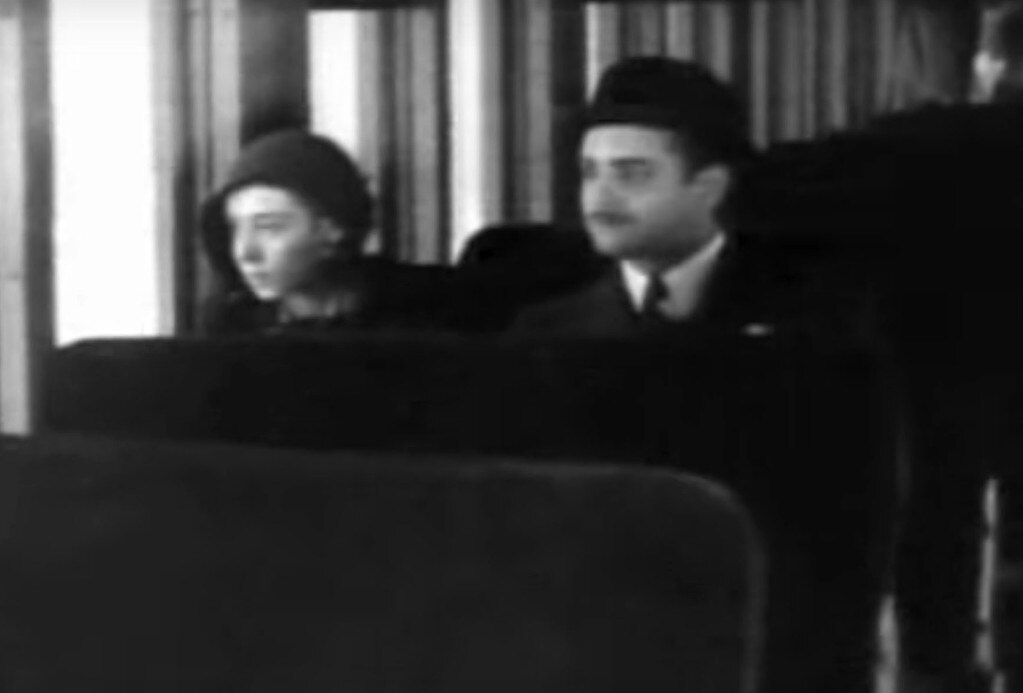
The main character of Veiled Aristocrats is Rena Walden (Lucille Lewis), a light-skinned North Carolina woman. In the opening scene, her brother John (Lorenzo Tucker), also light-skinned, returns home for the first time in twenty years. He is now a prosperous lawyer, and his mother Molly (Laura Bowman) coos with joy at what a "great man" he has become. Rena is equally pleased with her handsome and impeccably dressed brother, whom see hasn't seen since she was a little girl.
John may be a great man, but he has questionable ideas as to Rena's future. Instead of spending her life in the black neighborhoods of Fayetteville, he wants her to move elsewhere with him and establish a new identity as a white woman. Rena is reluctant, since she's in love with dark-skinned Frank Fowler (Carl Mahon), a rising entrepreneur who wants to marry her. John's arguments are persuasive, though, and Rena agrees to give it a try.
Frank agrees to the plan, since he has no doubt she'll eventually see the light and return to him. Rena's new home is splendid, complete with a household staff of black servants, and she passes so successfully that a wealthy white man proposes to her. But she can't get over her feeling that she's acting like a "liar and a cheat," so she goes back to Frank and resumes the black identity she temporarily laid aside. "I only know that I am not a white girl but a negress," she tells her disappointed brother, "and happy and sorry as only I know they can be." She wants to share "their joys, their sorrows, their poverty, their everything," and marrying Frank will be the first step in her new life as a proud African-American woman.
Veiled Aristocrats is a musical as well as a melodrama, spiced with songs and dances by the multitalented supporting cast. These are the film's most engaging moments, since the serious aspects of the story are often undermined by the wooden dialogue, clunky camerawork, and stiff, inexpressive acting frequently found in Micheaux's movies. But what the picture lacks in professional polish it makes up in heartfelt sincerity and historical interest, presenting a rough-hewn yet vivid sketch of African-American identity politics almost a century ago.
Director: Oscar Micheaux
Producer: Oscar Micheaux
Screenplay: Oscar Micheaux; based on Charles W. Chestnutt's novel The House Behind the Cedars
With: Lucille Lewis (Rena Walden), Lorenzo Tucker (John Warwick), Laura Bowman (Molly Walden), Barrington Guy (George Tryon), Willor Lee Guilford (Miss Waring), Mabel Garrett (The Maid), Aurora Edwards (The Cook), Bernardine Mason (A Singer), Arnold Wiley (The Driver)
BW-48m.
by David Sterritt
Veiled Aristocrats
by David Sterritt | June 23, 2016
SIGN UP FOR OUR NEWSLETTERS

CONNECT WITH TCM