Critical reaction to Winchester '73 was mostly positive, though often
condescending; many saw the plot to be essentially a grab-bag of Western
cliches. The only critic who seems to have missed the point, and the entire
tone of the film, is Bosley Crowther:
There you have it: simple, direct and action-crammed – and, as Universal
presents it, good-humored and tongue-in-cheek, too. For neither the script of
Robert L. Richards and Borden Chase nor the direction of Anthony Mann have
taken the formula too seriously or the cliches as anything but larks. The
dialogue is humorous, the characters are broadly picturesque and, as a matter
of fact, the whole picture has the nature of a marginal burlesque. As the
cowboy hero, Mr. Stewart drawls and fumbles comically, recalling his previous
appearance as a diffident cowpoke in "Destry Rides Again"...Dan Duryea
completely clowns the villainies of the reckless highwayman and Stephen
McNally is as dark as thunder in the role of the original thief....It is far
from the mature outdoor drama that might be brilliantly filmed around a gun.
It's just a frisky, fast-moving, funny Western in which a rifle is the apple
of a cowboy's eye. – Bosley Crowther, the New York Times, June 8,
1950.
Stewart brings real flavor and appeal to the role of Lin, in a lean,
concentrated portrayal that is completely convincing. He's supported by a
cast that, even in the bit roles, makes each character a standout. McNally is
hard and unbending as the runaway, patricidal brother. Mitchell lends warmth
as Stewart's loyal henchman and friend. Shelley Winters is just sufficiently
hard-bitten and cynical as the dancehall girl mauled about by sheriffs and
bandits. Dan Duryea comes into the film in its latter part only as a
trigger-happy cutthroat, but makes each appearance felt...Direction and pace
are on a par with performances. – Brog, Variety, June 7, 1950.
Winchester '73 is a crisp western in which a handsome repeating rifle
("the gun that won the West") inspires such yearning, fondling and fighting as
not even horses, let alone heroines, ordinarily provoke....Before the hunt
ends, the rifle is lost & found by half a dozen other characters, giving
director Anthony Mann plenty of story line to tie together some classic
horse-opera situations. Among the episodes: the scalping of a crooked trader
by redskins; a deafening battle between Indians and the U.S. cavalry; the
ambush of desperados in a burning house; a bank holdup and, finally, an
exciting rifle duel on the side of a craggy cliff. Strikingly photographed in
black & white, the film is directed with an eye to realistic detail, an ear
for the script's frequently natural dialogue and a knack for building
suspense. It also has some good performances by Dan Duryea, John McIntire and
Millard Mitchell, as well as actors Stewart and McNally. Heroine Shelley
Winters, who seems lost in all the uproar, might as well have been lost in the
script. - Time, June 19, 1950.
The seductive heroine of this appendix to the well-thumbed history of the old
West is Shelley Winters. But neither the good guy in the cast (James
Stewart), nor the two major bad guys (Stephen McNally and Dan Duryea) show
nearly as much interest in her as they do in a brand-new Winchester repeater
rifle (model 1873). The new-fangled weapon is capable of killing a lot of
Indians and/or cavalrymen. And once it gets stolen from its original owner
(Stewart), it changes hands often enough to take its toll of both. But for
all its eleven-shot capacity, the '73 lacks the personality to justify the
blood shed on its behalf. At best, this well-directed but poorly motivated
saga of the "gun that won the West" serves as a doubtlessly merited tribute to
the Winchester Repeating Arms Co. - Newsweek, July 3. 1950.
Mann's first film with James Stewart, with whom he was to make a series of
classic Westerns, this offers the clearest example of Mann's use of the
revenge plot. Hero (Stewart) and villain (McNally) are brothers who have been
taught to shoot by their father. After McNally murders the father, Stewart
sets out to seek revenge and so prove himself worthy of his father's name,
symbolized by the perfect Winchester Stewart wins in a shooting contest and
McNally steals from him. So begins the long chase to one of the most neurotic
shootouts in the history of the Western. – Phil Hardy, Time Out Film
Guide.
Mann's Westerns are psychological, and his best heroes are beset by
self-doubt. But it's too big a stretch to call those films neurotic when they
revel in the beauty of daylight, space, and distance. Rather, I would suggest
that Mann discovered his own Western sensibility, which was to see human
stories as small, and even aberrant, in the vastness of terrain. Thus,
Winchester '73 is a round, a circle, that needs huge horizons..." -
David Thomson, The New Biographical Dictionary of Film.
"Mann's first western with Stewart is often a throwback. Though purposefully
stripped of Fordian sentimentality and transcendence, Winchester '73
has many counterparts in plot, characters, and settings, to the 1930s and
1940s films of John Ford, especially Stagecoach and My Darling
Clementine...The most radical thing about Winchester '73 is that
its protagonist is not the locus of western myth. What's held in awe, what's
fetishized throughout the movie, both by characters who clutch it and fondle
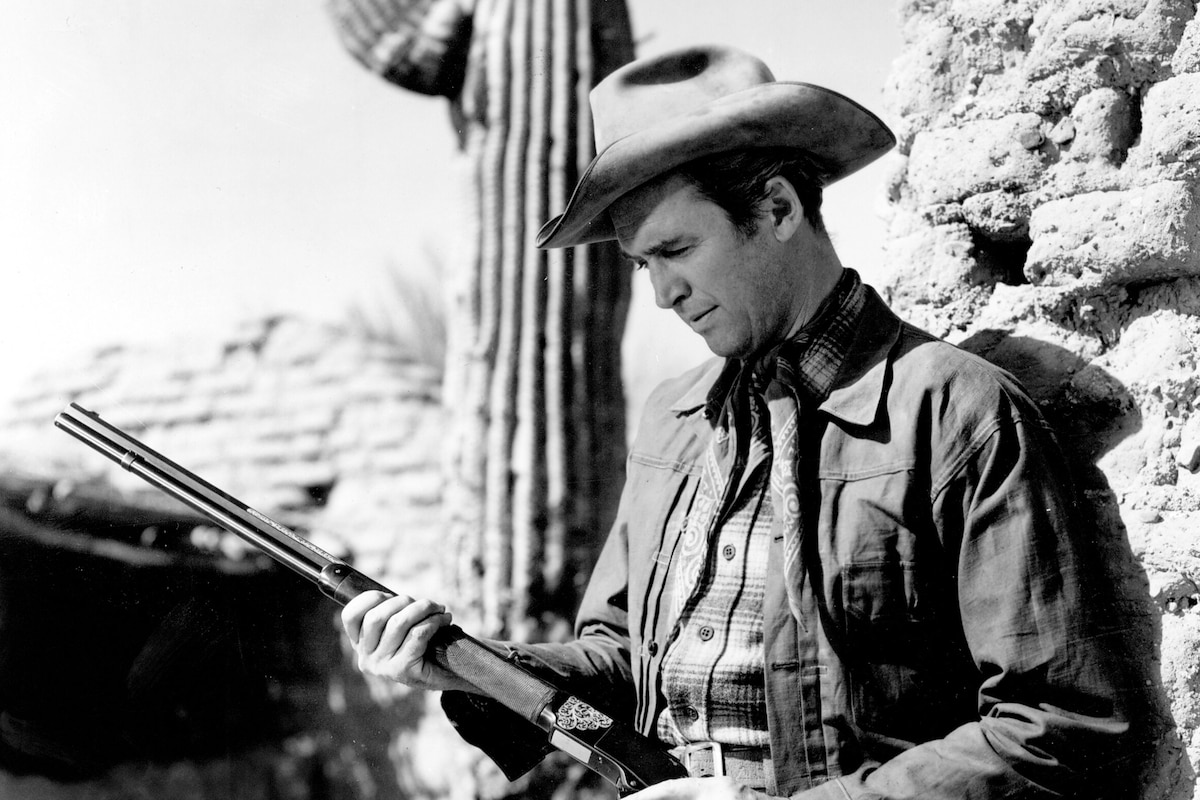
it and by Anthony Mann's camera, is that titular rifle. Practically every
scene starts and ends by Mann focusing on it in close-up, and it appears in
many scenes from which Lin is absent." - Gerald Peary, The A List: 100
Essential Films (Da Capo Press).
"Classic adult western...What makes it special are the unusual
characterizations and interesting relationships. The characters have all made
choices about how they want to spend their lives. There's fine, unpretentious
dialogue." - Danny Peary, Guide for the Film Fanatic (Fireside).
"Stewart, in career doldrums, made a comeback in two Westerns that were filmed
back-to-back: this one and Broken Arrow [1950]. Although
Broken Arrow was the bigger of the two (filmed in color, this one is
black-and-white) and received more attention because of its theme,
Winchester '73 is the superior film." - Brian Garfield, Western
Films: A Complete Guide (Rawson Associates).
"First rate in every way, this landmark film was largely responsible for
renewed popularity of Westerns in the 1950s." - Leonard Maltin's Classic
Movie Guide (Plume).
"Entertaining, popular, hard-riding, hard-shooting Western of the old school."
- Halliwell's Film & Video Guide (HarperPerennial).
Compiled by John Miller & Jeff Stafford
The Critics Corner - WINCHESTER '73
by John Miller & Jeff Stafford | March 21, 2006
SIGN UP FOR OUR NEWSLETTERS

CONNECT WITH TCM