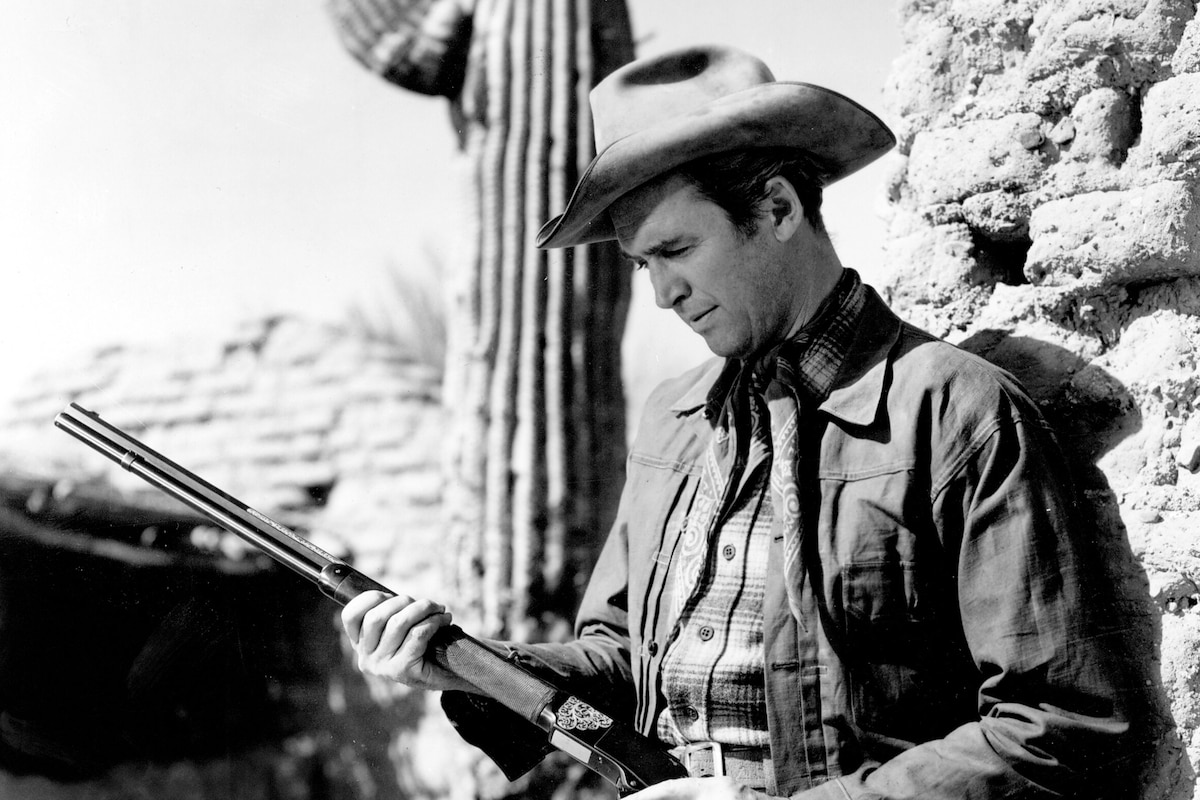
Authenticity was important to both James Stewart and Anthony Mann, so the actor began preparations well in advance of filming on Winchester '73. Stewart had been known to research roles and practice for hours to look convincing in a character's physical task, such as baseball for The Stratton Story (1949). As Mann later described, "[Stewart] was magnificent walking down a street with a Winchester rifle cradled in his arm. And he was great too actually firing the gun. He studied hard at it. His knuckles were raw with practicing… It was those sorts of things that helped make the film look so authentic, gave it its sense of reality." An expert from the Winchester company, Herb Parsons, actually did the trick shooting required for the film, and assisted Stewart in his training.
Shelley Winters was worried upon finding out that both she and Stewart thought that their best-photographed side was their left side, but she found that Stewart would yield in their close-ups. As she later said, "A couple of Left Profiles don't make for a convincing love scene when the two of them are staring off in the same direction. Since he was the star… I knew who'd be told to turn right. I couldn't have been more wrong. One morning Tony Mann came to me and said that Jimmy wanted me to be shot from the left because he knew that the whole thing was making me anxious. Naturally, Jimmy never said a word to me directly."
Shelley Winters would not have her dramatic breakthrough until her role in George Stevens' A Place in the Sun (1951) the following year; although she gave an excellent performance in Winchester '73, it is clear from her later comments that she didn't think much of the role: "Here you've got all these men… running around to get their hands on this goddam rifle instead of going after a beautiful blonde like me. What does that tell you about the values of that picture? If I hadn't been in it, would anybody have noticed?"
Stewart, Mann and screenwriter Borden Chase seemed very conscious of the fact that Stewart's McAdam was a clear break from the sort of hero the actor was previously associated with. Chase, in fact, narrowed down the transition to the moment that McAdam confronts Dan Duryea's character in a saloon, smashing his face down onto the bar. As Chase was quoted in Donald Dewey's James Stewart, "When the picture was given a sneak preview, there had even been some titters in the audience at seeing Stewart's name in the opening titles of a western. …But once he smashed Duryea in that bar, there would be no more snickering." In his book Horizons West, Jim Kitses later echoed this observation when he wrote, "Lin's destruction of Waco is consequently a key moment since it both satisfies our moral expectations and disturbs them, our identification with the hero jarred by the naked violence with which he sets about the villain."
Stewart was almost universally praised for his performance, and in particular for a new "maturity" in his acting style. Stewart later commented, saying "You might call it a desperation move. [After the war] I found that I was relying on the sort of romantic comedy style I had developed before the war. I'd sort of fallen back on it. But it wasn't accepted. The public seemed to want either the wild, slapstick type of comedy or pretty serious stuff…" In a 1990 interview with the New York Times, Stewart was asked specifically about the "toughening up" of his character in Winchester '73, and his reply was typically casual: "The very idea of changing my whole thing from the sort of shy, fumbling fellow to the western was just my work. It's all hard work and dedication, to be able to make a go of it. And those were the things offered to me."
by John Miller
Behind the Camera
by John Miller | March 21, 2006
SIGN UP FOR OUR NEWSLETTERS

CONNECT WITH TCM