Winchester '73 had been floating around Universal as a project for several years in the late 1940s. Director Fritz Lang was initially attached to the project; Lang was already known for such westerns as The Return of Frank James (1940) and Western Union (1941), both made for 20th Century Fox. Press notices in 1946 announced Winchester '73, and that Lang would do location shooting in Utah, at Zion City National Park. Lang was to work from a screenplay by Robert L. Richards, based on a story by Stuart N. Lake. Lake stories had already been the basis for two other classics, William Wyler's The Westerner (1940) and John Ford's My Darling Clementine (1946). Lake was an expert on Wyatt Earp, so it is not surprising that, as with My Darling Clementine, the colorful historical figure turned up in another story. Lang was still attached to the Winchester '73 project in June of 1947, when another press release announced that he would film exteriors for his picture in Nevada.
Actor James Stewart, meanwhile, had been busy with his career since returning from his heroic service in World War II. Jumping between different studios, he had already made It's a Wonderful Life (1946) for Frank Capra's Liberty Films; Rope (1948), his first movie for Alfred Hitchcock; and starred in the biopic The Stratton Story (1949) at his old home studio, Metro-Goldwyn-Mayer. Beginning on July 14, 1947, Stewart took over the Broadway role of Elwood P. Dowd in the Mary Chase play Harvey. Stewart was determined to secure the role in the Universal film of the play, and the resulting contract proved to be a groundbreaking one for a Hollywood actor. In his biography, James Stewart, Donald Dewey relates the story of the Universal deal. "...the actor's MCA agent Lew Wasserman encountered Universal chief William Goetz at a party during the summer of 1949 and mentioned Stewart's enthusiasm for starring in the film version of Harvey, the play he had already done twice on Broadway. Goetz, in turn, was more interested in talking about a western that had been gathering dust at the studio for quite a number of years. The last point on which the principals agreed in later accounts was that Wasserman mentioned that Stewart's asking price was $200,000 and Goetz replied that Universal couldn't manage such a steep salary. Depending on the source, it was then either the studio head or the agent who proposed the idea of Stewart doing both Harvey and the western Winchester '73, for a percentage of the profits."
The deal itself was not unusual; Abbott and Costello already had a profit participation contract with the studio. What was unusual was the sizable chunk of the revenues that Stewart would see from the films. As Stewart later said, "The truth is that I'm a very poor mathematician. I kept flunking algebra although I could do something called descriptive geometry. I've never been very close to the financial part of the picture business but when it [profit participation] was suggested to me, it seemed a logical and sensible way of looking at it. You were much more part of the picture because you had more at stake in the outcome." Harvey, though fondly regarded today, was actually a box-office disappointment in 1950. Winchester '73, though, was a financial hit for the studio. Over a period of several years, it is estimated that Stewart made a half-million dollars from his participation in the film – an astronomical sum for an actor to make from one movie in the early 1950s. Goetz was the son-in-law of MGM chief Louis B. Mayer, Stewart's one-time boss. Mayer saw the percentage deal as another example of the whittling-away of the powers of the studio system, and, no doubt with an eye toward his own stars still under contract at MGM, he famously accused Goetz of allowing "the lunatics to take over the asylum."
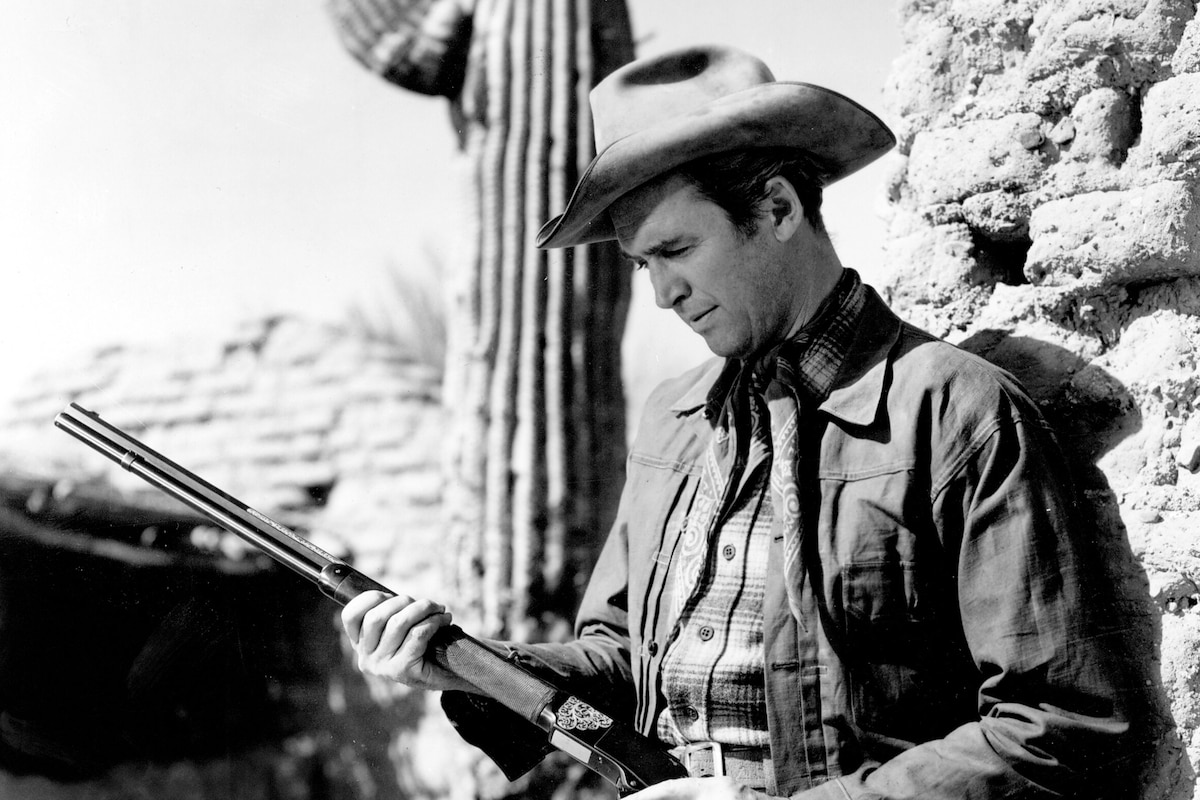
By the time Stewart had been attached to the project, Fritz Lang had dropped out as director of Winchester '73. Stewart himself suggested a replacement. He admired the work done on the Metro-Goldwyn-Mayer western Devil's Doorway (1950), and though he had never worked with the director before, Stewart recommended Anthony Mann be hired to direct Winchester '73. Mann brought in Borden Chase to re-write the Richards script. Chase had just had a great success co-writing the screenplay to Howard Hawks' classic western Red River (1948), an adaptation of Chase's story "The Chisholm Trail." Mann himself later said the film "...was one of my biggest successes. And it's also my favorite western. The gun which passed from hand to hand allowed me to embrace a whole epoch, a whole atmosphere. I really believe that it contains all the ingredients of the western, and that it summarizes them."
by John Miller
The Big Idea
by John Miller | March 21, 2006
SIGN UP FOR OUR NEWSLETTERS

CONNECT WITH TCM